Skip to Content
MilliporeSigma

258164

2,4-Dibromophenol

95%

Sign In to View Organizational & Contract Pricing

Select a Size

5 G

$35.02

100 G

$136.85

$35.02

List Price$41.20Save 15%

Available to ship TODAYDetails


Ships Every 4 weeks

About This Item

Linear Formula:
Br2C6H3OH
CAS Number:
Molecular Weight:
251.90
Beilstein/REAXYS Number:
1861291
EC Number:
MDL number:
UNSPSC Code:
12352100
PubChem Substance ID:
NACRES:
NA.22

Skip To

Technical Service
Need help? Our team of experienced scientists is here for you.
Let Us Assist

Quality Level

assay

95%

form

solid

bp

154 °C/11 mmHg (lit.)

mp

35-38 °C (lit.)

functional group

bromo

SMILES string

Oc1ccc(Br)cc1Br

InChI

1S/C6H4Br2O/c7-4-1-2-6(9)5(8)3-4/h1-3,9H

InChI key

FAXWFCTVSHEODL-UHFFFAOYSA-N

Gene Information

Looking for similar products? Visit Product Comparison Guide

Compare Similar Items

View Full Comparison

Show Differences

1 of 4

This Item
249440137715252018
assay

95%

assay

98%

assay

99%

assay

99%

Quality Level

100

Quality Level

100

Quality Level

100

Quality Level

100

mp

35-38 °C (lit.)

mp

−7-−5 °C (lit.)

mp

90-94 °C (lit.)

mp

53-56 °C (lit.)

bp

154 °C/11 mmHg (lit.)

bp

107 °C/11 mmHg (lit.)

bp

282-290 °C/746 mmHg (lit.)

bp

255-256 °C/740 mmHg (lit.)

form

solid

form

liquid

form

-

form

solid

functional group

bromo

functional group

acyl chloride, phenyl

functional group

bromo

functional group

bromo

General description

The electrochemical hydrodehalogenation of 2,4-dibromophenol has been studied by electrochemical reduction in H-cells and solid polymer electrolyte cells using catalyzed cathodes[1]. 2,4-Dibromophenol inhibits the microbial activity in marine sediments[2].

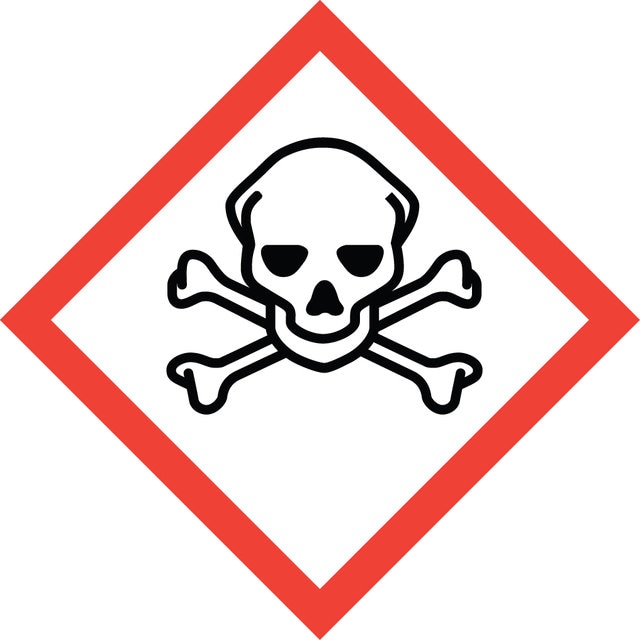
pictograms

Skull and crossbones

signalword

Danger

Hazard Classifications

Acute Tox. 2 Oral - Eye Irrit. 2 - Skin Irrit. 2 - STOT SE 3

target_organs

Respiratory system

Storage Class

6.1A - Combustible acute toxic Cat. 1 and 2 / very toxic hazardous materials

wgk_germany

WGK 3

flash_point_f

235.4 °F - closed cup

flash_point_c

113 °C - closed cup

ppe

Eyeshields, Faceshields, Gloves, type P2 (EN 143) respirator cartridges


Choose from one of the most recent versions:

Certificates of Analysis (COA)

Lot/Batch Number

Don't see the Right Version?

If you require a particular version, you can look up a specific certificate by the Lot or Batch number.

Already Own This Product?

Find documentation for the products that you have recently purchased in the Document Library.

Visit the Document Library

Inhibition of microbial activity in marine sediments by a bromophenol from a hemichordate.
King GM.
Nature, 323(6085), 257-259 (1986)
Aliaksandr I Balabanovich et al.
Environmental science & technology, 39(14), 5469-5474 (2005-08-09)
Halogen-containing aromatics, mainly bromine-containing phenols, are harmful compounds contaminating pyrolysis oil from electronic boards containing halogenated flame retardants. In addition,theirformation increases the potential for evolution of polybrominated dibenzo-p-dioxins (PBDDs) and dibenzofurans (PBDFs) at relatively low temperature (up to 500 degrees
Hui Liu et al.
Chemosphere, 84(4), 512-518 (2011-04-05)
Hydroxylated polybrominated diphenyl ethers (HO-PBDEs) have received significant attention due to their toxicities and universal presence in the environmental matrices. However, their origins are not fully understood. We explored the feasibility of the generation of HO-PBDEs through photochemical processes from
Keun Young Kim et al.
Journal of food science, 75(5), H145-H150 (2010-07-16)
A bromophenol, bis(2,3-dibromo-4,5-dihydroxybenzyl) ether, was purified from the red alga Polyopes lancifolia. Its IC(50) values were 0.098 and 0.120 microM against Saccharomyces cerevisiae and Bacillus stearothermophilus alpha-glucosidases, respectively, and 1.00 and 1.20 mM against rat-intestinal sucrase and maltase. This bromophenol
G M King
Applied and environmental microbiology, 54(12), 3079-3085 (1988-12-01)
Halophenols such as 2,4-dibromophenol (DBP) occur naturally in some marine sediments, as a consequence of various animal and algal activities. In an earlier study, DBP was observed in the burrow microenvironment of the hemichordate Saccoglossus kowalewskii. At the concentrations found

Questions

Reviews

No rating value

Active Filters

Our team of scientists has experience in all areas of research including Life Science, Material Science, Chemical Synthesis, Chromatography, Analytical and many others.

Contact Technical Service