

If this product has an expiration or retest date, it will be shown on the Certificate of Analysis (COA, CofA). If there is no retest or expiration date listed on the product's COA, we do not have suitable stability data to determine a shelf life. For these products, the only date on the COA will be the release date; a retest, expiration, or use-by-date will not be displayed.
For all products, we recommend handling per defined conditions as printed in our product literature and website product descriptions. We recommend that products should be routinely inspected by customers to ensure they perform as expected.
For products without retest or expiration dates, our standard warranty of 1 year from the date of shipment is applicable.
For more information, please refer to the Product Dating Information document: https://www.sigmaaldrich.com/deepweb/assets/sigmaaldrich/marketing/global/documents/418/501/product-dating-information-06-25-mk.pdf
220551

Chloramphenicol
Chloramphenicol, CAS 56-75-7, is a synthetic bacteriostatic antibiotic that inhibits the translation of RNA by blocking the peptidyltransferase reaction on ribosomes.
Synonym(s):
Chloramphenicol
Select a Size
| Size/SKU | Availability | Price |
|---|
About This Item
Quality Segment
assay
≥97% (by Assay)
form
crystalline powder
manufacturer/tradename
Calbiochem®
storage condition
OK to freeze
color
gray to off-white
solubility
water: 2.5 mg/mL, methanol: 35 mg/mL, ethanol: soluble
shipped in
ambient
storage temp.
10-30°C
InChI
1S/C11H12Cl2N2O5/c12-10(13)11(18)14-8(5-16)9(17)6-1-3-7(4-2-6)15(19)20/h1-4,8-10,16-17H,5H2,(H,14,18)
InChI key
WIIZWVCIJKGZOK-UHFFFAOYSA-N
General description
Biochem/physiol Actions
trasnslation of RNA
Other Notes
Lu, J., and Jiang, C. 1993. Biochem. Biophys. Res. Commun.196, 12.
Saltarelli, M.J., et al. 1993. Virol.197, 35.
Holt, J.T. 1992. Ann. N.Y. Acad. Sci.660, 88.
Maniatis, T., et al. 1989. In Molecular Cloning, A Laboratory Manual, Second Edition. Cold Spring Harbor, NY, p. 1.6, A.6.
Legal Information
Still not finding the right product?
Explore all of our products under Chloramphenicol
Signal Word
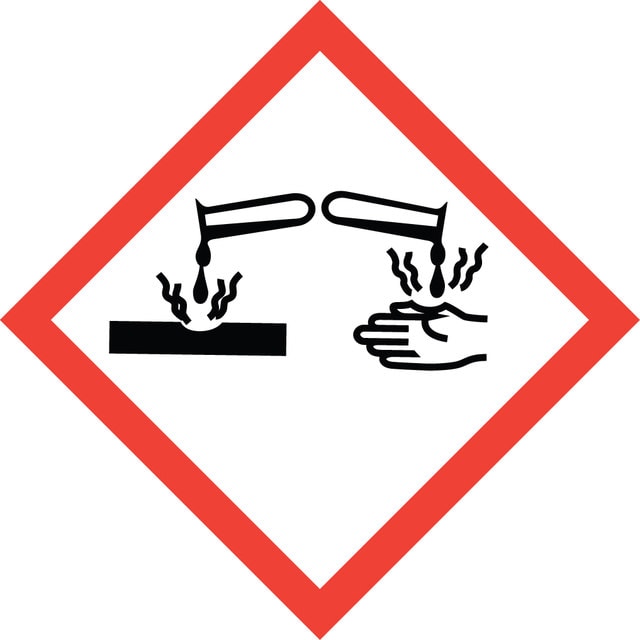
Danger
Hazard Codes
Precautionary Statements
Hazard Classifications
Carc. 2 - Eye Dam. 1 - Repr. 2
Storage Class
11 - Combustible Solids
WGK
WGK 3
Choose from one of the most recent versions:
Already Own This Product?
Find documentation for the products that you have recently purchased in the Document Library.
-
How can I determine the shelf life / expiration / retest date of this product?
1 answer-
Helpful?
-
-
How is shipping temperature determined? And how is it related to the product storage temperature?
1 answer-
Products may be shipped at a different temperature than the recommended long-term storage temperature. If the product quality is sensitive to short-term exposure to conditions other than the recommended long-term storage, it will be shipped on wet or dry-ice. If the product quality is NOT affected by short-term exposure to conditions other than the recommended long-term storage, it will be shipped at ambient temperature. As shipping routes are configured for minimum transit times, shipping at ambient temperature helps control shipping costs for our customers. For more information, please refer to the Storage and Transport Conditions document: https://www.sigmaaldrich.com/deepweb/assets/sigmaaldrich/marketing/global/documents/316/622/storage-transport-conditions-mk.pdf
Helpful?
-