
If this product has an expiration or retest date, it will be shown on the Certificate of Analysis (COA, CofA). If there is no retest or expiration date listed on the product's COA, we do not have suitable stability data to determine a shelf life. For these products, the only date on the COA will be the release date; a retest, expiration, or use-by-date will not be displayed.
For all products, we recommend handling per defined conditions as printed in our product literature and website product descriptions. We recommend that products should be routinely inspected by customers to ensure they perform as expected.
For products without retest or expiration dates, our standard warranty of 1 year from the date of shipment is applicable.
For more information, please refer to the Product Dating Information document: https://www.sigmaaldrich.com/deepweb/assets/sigmaaldrich/marketing/global/documents/418/501/product-dating-information-06-25-mk.pdf
S7903

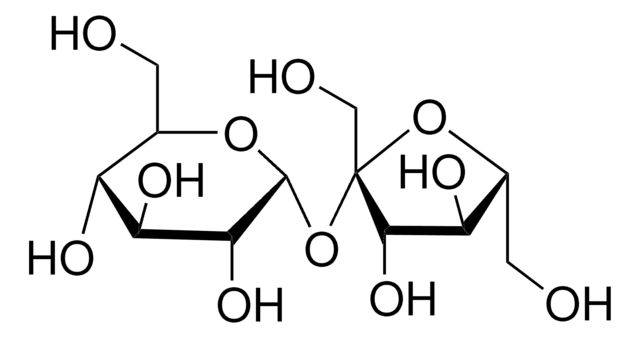
Sacarosa
≥99.5% (GC), BioXtra
Sinónimos:
α-D-Glc-(1→2)-β-D-Fru, α-D-Glucopiranosil β-D-fructofuranósido, ββ-D-Fructofuranosil-α-D-glucopiranósido, D(+)-Sacarosa, Azúcar
Seleccione un Tamaño
| A ustedes/SKU | Disponibilidad | Precio |
|---|---|---|
250 g | Fecha estimada de envío06 de julio de 2026desdeMILWAUKEE | $55.80 |
1 kg | Fecha estimada de envío06 de julio de 2026desdeMILWAUKEE | $121.00 |
5 kg | Fecha estimada de envío06 de julio de 2026desdeMILWAUKEE | $349.00 |
Acerca de este artículo
biological source
sugar cane
Quality Segment
product line
BioXtra
assay
≥99.5% (GC)
form
crystals
optical activity
[α]20/D +66.5±1°, c = 10 in H2O(lit.)
technique(s)
gas chromatography (GC): suitable
impurities
Insoluble matter, passes filter test
ign. residue
≤0.01% (as SO4)
loss
≤0.2% loss on drying, HV, 18 - 26°C
color
white
pH
5.5-7.5 (20 °C, 1 M in H2O)
mp
185-187 °C (lit.)
solubility
H2O: 1 M, clear, colorless
anion traces
chloride (Cl-): ≤0.005%, sulfate (SO42-): ≤0.005%
cation traces
Al: ≤0.0005%, As: ≤0.0001%, Ba: ≤0.0005%, Bi: ≤0.0005%, Ca: ≤0.001%, Cd: ≤0.0005%, Co: ≤0.0005%, Cr: ≤0.0005%, Cu: ≤0.0005%, Fe: ≤0.0005%, K: ≤0.005%, Li: ≤0.0005%, Mg: ≤0.0005%, Mn: ≤0.0005%, Mo: ≤0.0005%, Na: ≤0.005%, Ni: ≤0.0005%, Pb: ≤0.0005%, Sr: ≤0.0005%, Zn: ≤0.0005%
absorption
≤0.07 at 280 in H2O at 1 M, ≤0.09 at 260 in H2O at 1 M
SMILES string
OC[C@H]1O[C@H](O[C@]2(CO)O[C@H](CO)[C@@H](O)[C@@H]2O)[C@H](O)[C@@H](O)[C@@H]1O
InChI
1S/C12H22O11/c13-1-4-6(16)8(18)9(19)11(21-4)23-12(3-15)10(20)7(17)5(2-14)22-12/h4-11,13-20H,1-3H2/t4-,5-,6-,7-,8+,9-,10+,11-,12+/m1/s1
InChI key
CZMRCDWAGMRECN-UGDNZRGBSA-N
Application
Preparation Note
Other Notes
1 of 1
Este artículo | |||
|---|---|---|---|
| biological source sugar cane | biological source sugar cane | biological source sugar cane | biological source - |
| technique(s) gas chromatography (GC): suitable | technique(s) gas chromatography (GC): suitable | technique(s) HPLC: suitable, cryopreservation: suitable, electron microscopy: suitable, enzyme immunoassay: suitable, gas chromatography (GC): suitable, immunohistochemistry: suitable | technique(s) - |
| assay ≥99.5% (GC) | assay ≥99.5% (GC) | assay ≥99.5% (GC) | assay ≥99.5% (HPLC) |
| solubility H2O: 1 M, clear, colorless | solubility H2O: 0.5 g/mL, clear, colorless to faintly yellow | solubility H2O: soluble 50 g + 50 mL | solubility H2O: 1 M at 20 °C, clear, colorless |
| form crystals | form powder | form crystals | form crystals |
| impurities Insoluble matter, passes filter test | impurities - | impurities ≤0.1% free glucose | impurities DNases, none detected, RNases, none detected, insoluble matter, passes filter test, phosphatases, none detected, proteases, none detected |
Still not finding the right product?
Explore all of our products under Sacarosa
Clase de almacenamiento
11 - Combustible Solids
flash_point_f
Not applicable
flash_point_c
Not applicable
ppe
Eyeshields, Gloves, type N95 (US)
Elija entre una de las versiones más recientes:
¿Ya tiene este producto?
Encuentre la documentación para los productos que ha comprado recientemente en la Biblioteca de documentos.
-
How can I determine the shelf life / expiration / retest date of this product?
1 answer-
Helpful?
-
-
Is this reagent suitable for density gradient ultracentrifugation?
1 answer-
This reagent has not been tested for suitability in density gradient ultracentrifugation.
Helpful?
-
-
What does BIOXTRA mean?
1 answer-
BIOXTRA grade products undergo stringent testing protocols, which may include trace metal analysis and specialized suitability testing, such as hybridoma or mouse embryo testing. These products also include application-specific formulations, such as tablets and prepared solutions.
Helpful?
-
-
How is shipping temperature determined? And how is it related to the product storage temperature?
1 answer-
Products may be shipped at a different temperature than the recommended long-term storage temperature. If the product quality is sensitive to short-term exposure to conditions other than the recommended long-term storage, it will be shipped on wet or dry-ice. If the product quality is NOT affected by short-term exposure to conditions other than the recommended long-term storage, it will be shipped at ambient temperature. As shipping routes are configured for minimum transit times, shipping at ambient temperature helps control shipping costs for our customers. For more information, please refer to the Storage and Transport Conditions document: https://www.sigmaaldrich.com/deepweb/assets/sigmaaldrich/marketing/global/documents/316/622/storage-transport-conditions-mk.pdf
Helpful?
-