Skip to Content
MilliporeSigma

Skip To

E1895

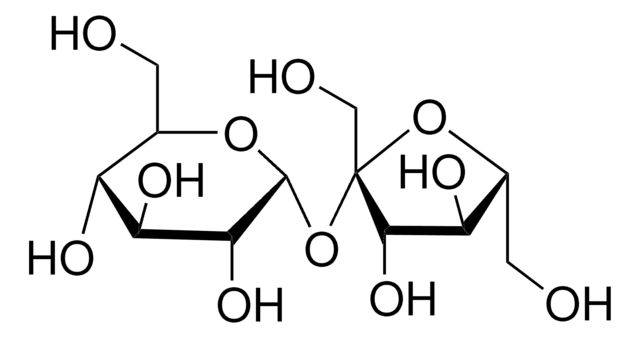
Erlose

≥94% (HPLC)

Synonym(s):

α-D-Glc-(1→4)-α-D-Glc-(1→2)-β-D-Fru, α-Maltosyl β-fructofuranoside

Sign In to View Organizational & Contract Pricing.

Select a Size

Change View
Pack SizeSKUAvailabilityPrice
50 mg
Please contact Customer Service for Availability
$632.00

About This Item

Empirical Formula (Hill Notation):
C18H32O16
CAS Number:
Molecular Weight:
504.44
NACRES:
NA.25
PubChem Substance ID:
UNSPSC Code:
12352201
MDL number:

$632.00


Please contact Customer Service for Availability

Request a Bulk Order
Technical Service
Need help? Our team of experienced scientists is here for you.
Let Us Assist


biological source

plant

Quality Level

assay

≥94% (HPLC)

form

powder

optical activity

[α]20/D 108 to 115°, c = 0.84% (w/v) in water

storage condition

desiccated

impurities

≤12.5% water (Karl Fischer)

color

white to off-white

solubility

H2O: 50 mg/mL, clear to slightly hazy, colorless to faintly yellow

storage temp.

−20°C

SMILES string

OC[C@H]1O[C@H](O[C@H]2[C@H](O)[C@@H](O)[C@H](O[C@@H]2CO)O[C@]3(CO)O[C@H](CO)[C@@H](O)[C@@H]3O)[C@H](O)[C@@H](O)[C@@H]1O

InChI

1S/C18H32O16/c19-1-5-8(23)10(25)12(27)16(30-5)32-14-7(3-21)31-17(13(28)11(14)26)34-18(4-22)15(29)9(24)6(2-20)33-18/h5-17,19-29H,1-4H2/t5-,6-,7-,8-,9-,10+,11-,12-,13-,14-,15+,16-,17-,18+/m1/s1

InChI key

FVVCFHXLWDDRHG-KKNDGLDKSA-N

Application

Erlose, a triose sugar (trisaccharide), is used in studies on dietary preference and utilization of triose sugars from aphid honeydew by various insects, such as honey bees and ants. Erlose may be used as a reference compound in assays that analyze the sugars of foods such as royal jelly and honey.[1][2]

Other Notes

To gain a comprehensive understanding of our extensive range of Oligosaccharides for your research, we encourage you to visit our Carbohydrates Category page.

Disclaimer

moisture sensitive

Compare Similar Items

View Full Comparison

Show Differences

1 of 1

This Item
S4001S8501S5391
assay

≥94% (HPLC)

assay

≥98% (HPLC)

assay

≥99.5% (GC)

assay

≥99.5% (GC)

biological source

plant

biological source

plant (Stachys tuberifera)

biological source

sugar cane

biological source

sugar cane

solubility

H2O: 50 mg/mL, clear to slightly hazy, colorless to faintly yellow

solubility

water: 50 mg/mL, clear to very slightly hazy, colorless

solubility

H2O: 0.5 g/mL, clear, colorless to faintly yellow

solubility

H2O: 0.5 g/mL, clear, colorless to faintly yellow

Quality Level

200

Quality Level

200

Quality Level

300

Quality Level

300

form

powder

form

powder

form

powder

form

powder

storage temp.

−20°C

storage temp.

-

storage temp.

room temp

storage temp.

room temp


Storage Class

11 - Combustible Solids

wgk

WGK 3

flash_point_f

Not applicable

flash_point_c

Not applicable

ppe

Eyeshields, Gloves, type N95 (US)


Choose from one of the most recent versions:

Certificates of Analysis (COA)

Lot/Batch Number

Don't see the Right Version?

If you require a particular version, you can look up a specific certificate by the Lot or Batch number.

Already Own This Product?

Find documentation for the products that you have recently purchased in the Document Library.

Visit the Document Library


Julian Görl et al.
Chembiochem : a European journal of chemical biology, 13(1), 149-156 (2011-11-30)
An isomelezitose synthase was redesigned out of the sucrose isomerase from Protaminobacter rubrum for the synthesis of isomelezitose (6-O(F)-glucosylsucrose), a potential nutraceutical. The variants F297A, F297P, R333K, F321A_F319A and E428D catalyze the formation of isomelezitose in up to 70 %
Kris A G Wyckhuys et al.
Journal of insect physiology, 54(2), 481-491 (2008-01-15)
Parasitoids commonly forage in agricultural settings where the predominant sugar source is homopteran honeydew. The aphidiine braconid, Binodoxys communis, is an Asian parasitoid currently being released against the soybean aphid, Aphis glycines, in North American soybean fields. We conducted a
Roger Konrad et al.
Journal of insect physiology, 55(12), 1158-1166 (2009-08-25)
Like honey bees (Apis mellifera), non-Apis bees could exploit honeydew as a carbohydrate source. In addition to providing carbohydrates, this may expose them to potentially harmful plant products secreted in honeydew. However, knowledge on honeydew feeding by solitary bees is


Global Trade Item Number

SKUGTIN
E1895-50MG04061833602294

Questions

Reviews

No rating value

Active Filters