Accéder au contenu
MilliporeSigma

204722

Tin(II) chloride

≥99.99% trace metals basis

Synonyme(s) :

Stannous chloride

Se connecter pour consulter les tarifs organisationnels et contractuels.

Sélectionner une taille de conditionnement


A propos de cet article

Formule linéaire :
SnCl2
Numéro CAS:
Poids moléculaire :
189.62
PubChem Substance ID:
eCl@ss:
38140204
UNSPSC Code:
12352302
NACRES:
NA.21
EC Number:
231-868-0
MDL number:
Assay:
≥99.99% trace metals basis
Form:
crystalline powder
flakes
Service technique
Besoin d'aide ? Notre équipe de scientifiques expérimentés est là pour vous.
Laissez-nous vous aider
Service technique
Besoin d'aide ? Notre équipe de scientifiques expérimentés est là pour vous.
Laissez-nous vous aider

Nom du produit

Tin(II) chloride, ≥99.99% trace metals basis

InChI key

AXZWODMDQAVCJE-UHFFFAOYSA-L

InChI

1S/2ClH.Sn/h2*1H;/q;;+2/p-2

SMILES string

Cl[SnH2]Cl

vapor pressure

33 hPa (~429 °C)

assay

≥99.99% trace metals basis

form

crystalline powder
flakes

reaction suitability

reagent type: catalyst
core: tin

pH

2.18 (20 °C)

bp

652 °C (lit.)

mp

246 °C (lit.)

Quality Level

Vous recherchez des produits similaires ? Visite Guide de comparaison des produits

Application

Tin(II) chloride has been used for the reduction of hydroperxoxides to the corresponding alcohols in a study.
Tin(II) chloride may be used:
  • To catalyze the addition of diazo sulfones, diazo phosphine oxides and diazo phosphonates to aldehydes to form β-keto sulfones, β-keto phosphine oxides and β-keto phosphonates, respectively.
  • Along with trityl chloride, to catalyze the aldol reaction of silyl enol ethers with acetals or aldehydes and the Michael reaction of silyl enol ethers with α,β-unsaturated ketones.
  • As a promoter in the allylic amination of allylic alcohols with amines in the presence of palladium catalyst.

General description

Tin(II) chloride (Stannous chloride, SnCl2) is widely employed as reducing reagent. It plays significant role in diverse fields of science. Since it exhibits superior catalytic action in molten state, it is employed for the hydroliquefaction of coals. It is a promising raw material for the chemical vapour deposition (CVD) of semiconducting layers. It can be prepared by reacting its dihydrate form with acetic anhydride. It exhibits reducing properties in acidic media. It participates in the reduction of the following compounds:
  • aromatic nitro compounds
  • nitriles
  • cyanosilyl ethers
  • organic azides
On mixing sodium cyanoborohydride with SnCl2 in a 2:1 ratio, a reducing reagent mixture is obtained. This reagent is useful for the reduction of tertiary, allyl and benzyl halides.

signalword

Danger

Hazard Classifications

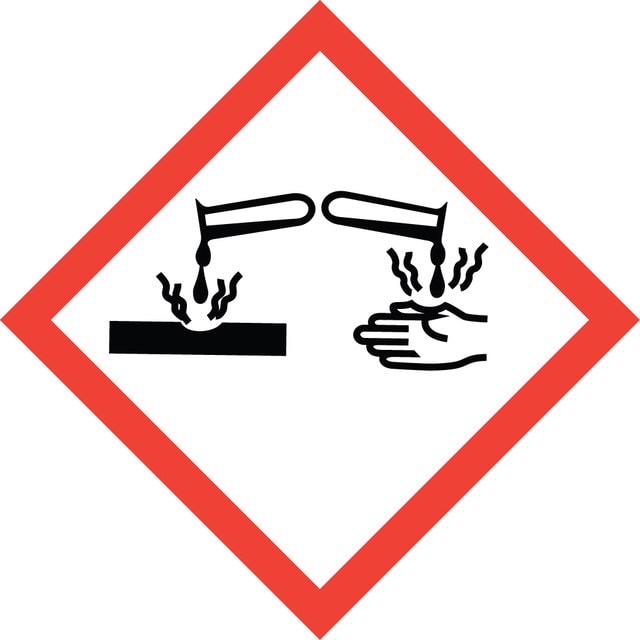
Acute Tox. 4 Inhalation - Acute Tox. 4 Oral - Aquatic Chronic 3 - Eye Dam. 1 - Met. Corr. 1 - Skin Corr. 1B - Skin Sens. 1 - STOT RE 2 Oral - STOT SE 3

target_organs

Cardio-vascular system, Respiratory system

Classe de stockage

8B - Non-combustible corrosive hazardous materials

wgk

WGK 3

flash_point_f

Not applicable

flash_point_c

Not applicable

ppe

Eyeshields, Faceshields, Gloves, type P3 (EN 143) respirator cartridges


Faites votre choix parmi les versions les plus récentes :

Certificats d'analyse (COA)

Lot/Batch Number

Vous ne trouvez pas la bonne version ?

Si vous avez besoin d'une version particulière, vous pouvez rechercher un certificat spécifique par le numéro de lot.

Déjà en possession de ce produit ?

Retrouvez la documentation relative aux produits que vous avez récemment achetés dans la Bibliothèque de documents.

Consulter la Bibliothèque de documents

Tin (II) Chloride.
Faul MM and Thiel OR.
e-EROS Encyclopedia of Reagents for Organic Synthesis. (1995)
Quantitative assays for esterified oxylipins generated by immune cells.
Morgan AH, et al.
Nature Protocols, 5(12), 1919-1931 (2010)
Transformation of molten SnCl2 to SnO2 nano-single crystals.
Kamali AR, et al.
Ceramics International, 40(6), 8533-8538 (2014)
Palladium-catalyzed allylic amination of allylic alcohols with tin (II) chloride and triethylamine.
Masuyama Y, et al.
Chemistry Letters (Jpn), 24(12), 1121-1122 (1995)
Tin (II) chloride catalyzed addition of diazo sulfones, diazo phosphine oxides, and diazo phosphonates to aldehydes.
Holmquist CR and Roskamp EJ.
Tetrahedron Letters, 33(9), 1131-1134 (1992)

Notre équipe de scientifiques dispose d'une expérience dans tous les secteurs de la recherche, notamment en sciences de la vie, science des matériaux, synthèse chimique, chromatographie, analyse et dans de nombreux autres domaines..

Contacter notre Service technique