Skip to Content
Merck

N10950

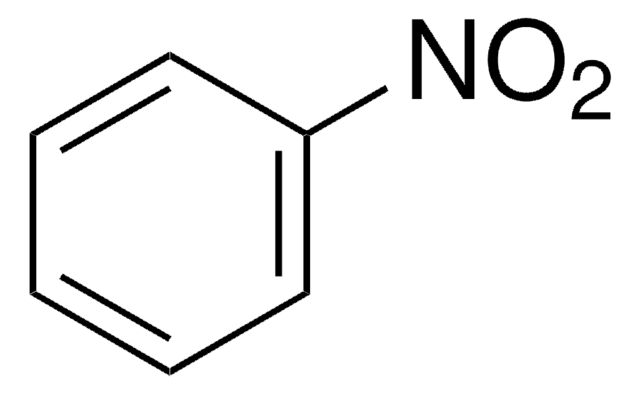
Nitrobenzene

ReagentPlus®, 99%

Sign In to View Organizational & Contract Pricing.

Select a Size

Pricing and availability is not currently available.

About This Item

Empirical Formula (Hill Notation):
C6H5NO2
CAS Number:
Molecular Weight:
123.11
UNSPSC Code:
12191501
NACRES:
NA.21
PubChem Substance ID:
EC Number:
202-716-0
Beilstein/REAXYS Number:
507540
MDL number:
Assay:
99%
Bp:
210-211 °C (lit.)
Vapor pressure:
0.15 mmHg ( 20 °C)
50 mmHg ( 120 °C)

Skip To

Technical Service
Need help? Our team of experienced scientists is here for you.
Let Us Assist

Product Name

Nitrobenzene, ReagentPlus®, 99%

InChI key

LQNUZADURLCDLV-UHFFFAOYSA-N

InChI

1S/C6H5NO2/c8-7(9)6-4-2-1-3-5-6/h1-5H

SMILES string

[O-][N+](=O)c1ccccc1

vapor density

4.2 (vs air)

vapor pressure

0.15 mmHg ( 20 °C)
50 mmHg ( 120 °C)

product line

ReagentPlus®

assay

99%

form

liquid

autoignition temp.

899 °F

expl. lim.

40 %

dilution

(for general lab use)

refractive index

n20/D 1.551 (lit.)

pH

8-8.5 (20 °C, 1 g/L)

bp

210-211 °C (lit.)

mp

5-6 °C (lit.)

density

1.196 g/mL at 25 °C (lit.)

Quality Level

Looking for similar products? Visit Product Comparison Guide

Compare Similar Items

View Full Comparison

Show Differences

1 of 4

This Item
25237906084PHR3498
assay

99%

assay

≥99.0%

assay

≥99.0% (GC)

assay

-

Quality Level

100

Quality Level

200

Quality Level

100

Quality Level

300

form

liquid

form

liquid

form

-

form

liquid

vapor pressure

0.15 mmHg ( 20 °C), 50 mmHg ( 120 °C)

vapor pressure

0.15 mmHg ( 20 °C), 50 mmHg ( 120 °C)

vapor pressure

0.15 mmHg ( 20 °C), 50 mmHg ( 120 °C)

vapor pressure

-

autoignition temp.

899 °F

autoignition temp.

899 °F

autoignition temp.

899 °F

autoignition temp.

-

bp

210-211 °C (lit.)

bp

210-211 °C (lit.)

bp

210-211 °C (lit.)

bp

-

Application

Nitrobenzene may be used as an oxidizing agent in the oxidative carbonylation of methanol in the presence of palladium diphosphane complexes.[1]

General description

Nitrobenzene is an aromatic compound that can be prepared by the nitration of benzene with nitric acid and sulfuric acid mixture.[2] Reduced graphene oxide catalyzed reduction of nitrobenzene has been reported to form N-phenylhydroxylamine as an intermediate.[3] The ability of nitrobenzene to cause DNA damage has been assessed in tobacco by single-cell gel electrophoresis (SCGE). The mechanism of photolysis of nitrobenzene has been reported.[4]

Legal Information

ReagentPlus is a registered trademark of Merck KGaA, Darmstadt, Germany

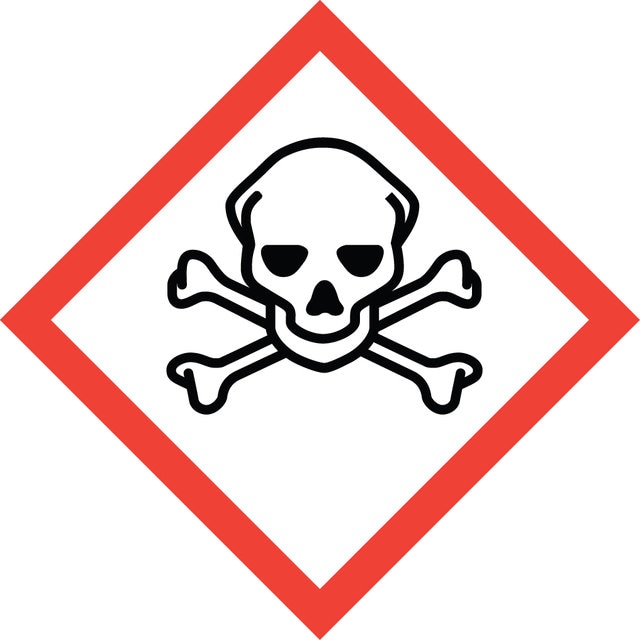
pictograms

Skull and crossbonesHealth hazard

signalword

Danger

Hazard Classifications

Acute Tox. 3 Dermal - Acute Tox. 3 Inhalation - Acute Tox. 3 Oral - Aquatic Chronic 3 - Carc. 2 - Repr. 1B - STOT RE 1 Inhalation

target_organs

Blood

Storage Class

6.1A - Combustible acute toxic Cat. 1 and 2 / very toxic hazardous materials

wgk

WGK 3

flash_point_f

190.4 °F - closed cup

flash_point_c

88 °C - closed cup


Choose from one of the most recent versions:

Certificates of Analysis (COA)

Lot/Batch Number

Don't see the Right Version?

If you require a particular version, you can look up a specific certificate by the Lot or Batch number.

Already Own This Product?

Find documentation for the products that you have recently purchased in the Document Library.

Visit the Document Library

Reduced graphene oxide as a catalyst for hydrogenation of nitrobenzene at room temperature.
Gao Y, et al.
Chemical Communications (Cambridge, England), 47(8), 2432-2434 (2011)
Photodissociation dynamics of nitrobenzene and o-nitrotoluene.
Lin MF, et al.
J. Chem. Phys. , 126(6), 064310-064310 (2007)
Mechanistic Study of the Oxidative Carbonylation of Methanol Catalyzed by Palladium Diphosphane Complexes with Nitrobenzene as Oxidant.
Mooibroek TJ, et al.
European Journal of Inorganic Chemistry, 2012(9), 1403-1412 (2012)
Nitrobenzene and Nitrotoluenes.
Dugal, M.
Kirk-Othmer Encyclopedia of Chemical Technology (2005)
Jiping Jiang et al.
Journal of hazardous materials, 227-228, 280-291 (2012-06-06)
This paper presents a generic framework and decision tools of real-time risk assessment on Emergency Environmental Decision Support System for response to chemical spills in river basin. The generic "4-step-3-model" framework is able to delineate the warning area and the

Questions

Reviews

No rating value

Active Filters

Our team of scientists has experience in all areas of research including Life Science, Material Science, Chemical Synthesis, Chromatography, Analytical and many others.

Contact Technical Service