
There is no available information or data on the stability duration of reconstituted sucrose water for mice consumption. This specific data has not been tested.
S5391

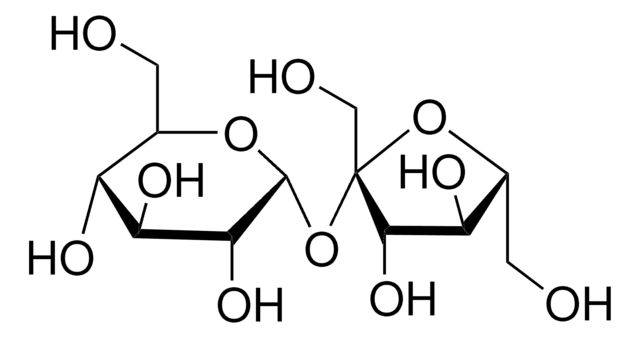
Sucrose
≥99.5% (GC), Grade II, suitable for plant cell culture
Synonym(s):
α-D-Glc-(1→2)-β-D-Fru, α-D-Glucopyranosyl β-D-fructofuranoside, β-D-Fructofuranosyl-α-D-glucopyranoside, D(+)-Saccharose, Sugar
Sign In to View Organizational & Contract Pricing
Select a Size
1 KG
CHF 97.00
5 KG
CHF 374.00
25 KG
CHF 1’300.00
About This Item
Empirical Formula (Hill Notation):
C12H22O11
CAS Number:
Molecular Weight:
342.30
Beilstein:
90825
EC Number:
MDL number:
UNSPSC Code:
12352201
PubChem Substance ID:
NACRES:
NA.28
Skip To
biological source
sugar cane
type
Grade II
Assay
≥99.5% (GC)
form
powder
availability
not available in Japan
technique(s)
cell culture | plant: suitable
color
white
useful pH range
5.5-7 (25 °C, 342 g/L)
mp
185-187 °C (lit.)
solubility
H2O: 0.5 g/mL, clear, colorless to faintly yellow
application(s)
agriculture
storage temp.
room temp
SMILES string
OC[C@H]1O[C@H](O[C@]2(CO)O[C@H](CO)[C@@H](O)[C@@H]2O)[C@H](O)[C@@H](O)[C@@H]1O
InChI
1S/C12H22O11/c13-1-4-6(16)8(18)9(19)11(21-4)23-12(3-15)10(20)7(17)5(2-14)22-12/h4-11,13-20H,1-3H2/t4-,5-,6-,7-,8+,9-,10+,11-,12+/m1/s1
InChI key
CZMRCDWAGMRECN-UGDNZRGBSA-N
Looking for similar products? Visit Product Comparison Guide
1 of 4
This Item | S9378 | 1.07651 | S1174 |
|---|---|---|---|
| biological source sugar cane | biological source sugar cane | biological source - | biological source sugar cane |
| technique(s) cell culture | plant: suitable | technique(s) gas chromatography (GC): suitable | technique(s) - | technique(s) HPLC: suitable, gas chromatography (GC): suitable |
| assay ≥99.5% (GC) | assay ≥99.5% (GC) | assay - | assay ≥99.5% (GC) |
| Quality Level 300 | Quality Level 200 | Quality Level 200 | Quality Level 100 |
| solubility H2O: 0.5 g/mL, clear, colorless to faintly yellow | solubility H2O: 0.5 g/mL, clear, colorless | solubility - | solubility - |
| form powder | form crystals | form solid | form - |
Application
Use in plant cell culture applications as a cryopreservative.
Other Notes
Slightly less pure than Grade I
To gain a comprehensive understanding of our extensive range of Disaccharides for your research, we encourage you to visit our Carbohydrates Category page.
Storage Class Code
11 - Combustible Solids
WGK
WGK 1
Flash Point(F)
Not applicable
Flash Point(C)
Not applicable
Personal Protective Equipment
dust mask type N95 (US), Eyeshields, Gloves
Choose from one of the most recent versions:
Already Own This Product?
Find documentation for the products that you have recently purchased in the Document Library.
Jean Grisouard et al.
Blood, 125(13), 2131-2140 (2015-01-18)
The acquired somatic JAK2-V617F mutation is present in >80% of patients with myeloproliferative neoplasms (MPNs). Stat3 plays a role in hematopoietic homeostasis and might influence the JAK2-V617F-driven MPN phenotype. We crossed our transgenic SclCre;V617F mice with a conditional Stat3 knockout
Zsuzsanna Tucsek et al.
The journals of gerontology. Series A, Biological sciences and medical sciences, 69(10), 1212-1226 (2013-11-26)
There is growing evidence that obesity has deleterious effects on the brain and cognitive function in the elderly population. However, the specific mechanisms through which aging and obesity interact to promote cognitive decline remain unclear. To test the hypothesis that
Marcus Karlstetter et al.
Progress in retinal and eye research, 45, 30-57 (2014-12-06)
Resident microglial cells can be regarded as the immunological watchdogs of the brain and the retina. They are active sensors of their neuronal microenvironment and rapidly respond to various insults with a morphological and functional transformation into reactive phagocytes. There
Akie Shimotohno et al.
Plant & cell physiology, 56(4), 620-630 (2015-02-12)
Boron, an essential micronutrient, is transported in roots of Arabidopsis thaliana mainly by two different types of transporters, BORs and NIPs (nodulin26-like intrinsic proteins). Both are plasma membrane localized, but have distinct transport properties and patterns of cell type-specific accumulation
Julia B Cordero et al.
The EMBO journal, 33(13), 1474-1491 (2014-05-03)
The non-receptor tyrosine kinase c-Src, hereafter referred to as Src, is overexpressed or activated in multiple human malignancies. There has been much speculation about the functional role of Src in colorectal cancer (CRC), with Src amplification and potential activating mutations
Related Content
Product Information Sheet
-
How long does sucrose water stay stable before it goes bad or becomes moldy?
1 answer-
Helpful?
-
Active Filters
Our team of scientists has experience in all areas of research including Life Science, Material Science, Chemical Synthesis, Chromatography, Analytical and many others.
Contact Technical Service