
Sign In to View Organizational & Contract Pricing.
Select a Size
Change View
| Size/SKU | Availability | Price |
|---|
About This Item
UNSPSC Code:
41121811
Pricing and availability is not currently available.
manufacturer/tradename
BPS Bioscience
technique(s)
activity assay: suitable (Fluorescence Polarization)
UniProt accession no.
shipped in
dry ice
storage temp.
-65 to -96°C
General description
The PARPtrap Combo Assay Kit for PARP1 and PARP2 is a kit designed to measure DNA complex formations of PARP1 and PARP2 enzymes in a high throughput screening assay using fluorescence polarization (FP). The key to the PARPtrap Combo Assay Kit are the fluorescent-labeled DNA probes recognized by PARP1 and PARP2. In the absence of ribosylation, PARP1/2 binds to the DNA fluorescent probe, forming a large complex and resulting in the emission of highly polarized light. However, after autoribosylation, PARP1/2 dissociates from the oligonucleotide duplex, which then rotates freely, emitting less polarized light (Fig. 1). Addition of a PARP inhibitor results in trapping of PARP1/2 to the fluorescent-labeled DNA, and increases the FP signal in a dose dependent manner. The combo kit is particularly useful to directly and specifically compare, in a single assay, the effect and potency of a compound on PARP1 and PARP2. The PARPtrap Combo Assay Kit for PARP1 and PARP2 is a homogeneous fluorescence polarization assay. The FP signal is measured using a fluorescent microplate reader capable of measuring fluorescence polarization.
Application
Screen small molecules that enhance PARP1/2 trapping onto DNA for drug discovery and high throughput screening (HTS) applications, and IC50 determination.
PARP1, also known as poly-(ADP-ribose) polymerase 1 or NAD+ ADP-ribosyltransferase 1, is part of the PARP family, and it is the most abundant member. ADP ribosylation, which is the addition of an ADP-ribose to a protein, is a reversible post-translational modification of proteins mostly involved in the DNA Damage Response (DDR) pathway. Poly-ADP-ribosylation (termed PARylation) is the addition of linear or branched chains of ADP-ribose. PARP1 participates in DNA repair by non-homologous end joining (NHEJ), homologous recombination (HR), microhomology-mediated end-joining (MMEJ) and nucleotide excision repair. Dysfunction of DDR pathways can lead to oncogenesis. Overexpression of PARP1 has been found in breast and colon cancer, neuroblastoma, and others. This overexpression can lead to increasing MMEJ, an error-prone DNA repair mechanism, and genome instability leading to cancer. In addition to being involved in DDR, PARP1 is also linked to inflammation and type I diabetes. PARP2 participates in DNA repair (only 10% of the PARP activity is due to PARP2), but also in oxidative stress and mitochondrial fragmentation. Dysfunction of the DDR and oxidative stress pathways can lead to oncogenesis. Genetic ablation of PARP2 has indicated roles of PARP2 in adipogenesis, spermatogenesis and thymocyte survival. It is also a co-factor of nuclear receptors like ER (estrogen receptor) and PPAR (peroxisome proliferator-activated receptors). PARP2 is overexpressed in prostate cancer (PCa) and may contribute to the disease through the FOXA1 (forkhead box protein A1)/AR pathway. PARP1 and PARP2 are known to bind damaged DNA through its DNA-binding domains. Binding to DNA activates PARP1/2 and in the presence of NAD+ PARP1/2 ribosylates itself (auto-ribosylation) and dissociates from the DNA due to the accumulated negative charge of the ribosyl polymer. In the presence of some inhibitors, however, PARP remains bound to DNA, a phenomenon termed trapping. Trapped PARP-DNA complexes have been shown to be highly cytotoxic to cancer cells, making such inhibitors desirable in cancer therapy. Further understanding of the molecular pathways involving PARP1/2, and their contribution to disease, will continue to pave the way for new therapies for PARP1/2-linked diseases.
Datasheet and Protocols may be found here.
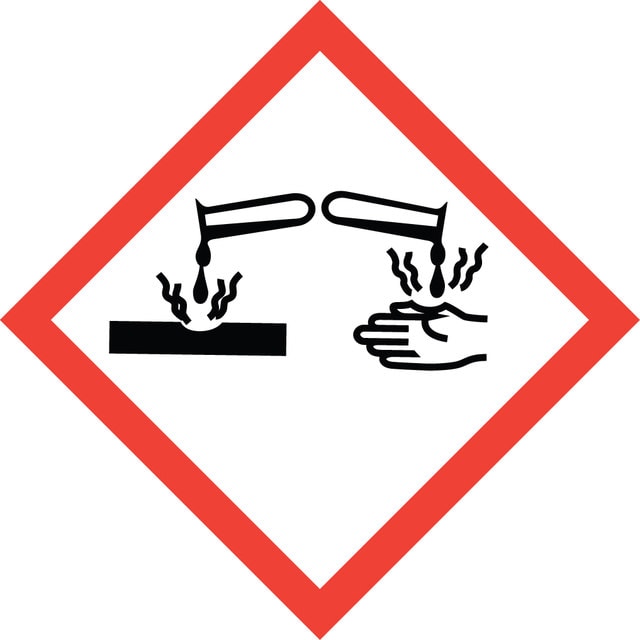
Signal Word
Danger
Hazard Codes
Precautionary Statements
Hazard Classifications
Eye Dam. 1 - Skin Corr. 1B
Storage Class
8A - Combustible corrosive hazardous materials
WGK
WGK 2
Choose from one of the most recent versions:
Already Own This Product?
Find documentation for the products that you have recently purchased in the Document Library.