


This product contains EDTA as the major active component, which acts as a chelating agent for divalent cations to loosen cell–cell contacts but does not break down the extracellular matrix as trypsin does. Empirical testing is needed to determine if this approach is more effective. It is highly recommended to review the literature to determine if an EDTA-only dissociation method has been successfully used with the particular primary microglia preparation protocol.
C5789

Cell Dissociation Solution Non-enzymatic 1x
Prepared in Hanks′ Balanced Salt Solution without calcium and magnesium, sterile-filtered, BioReagent, suitable for cell culture
Sinónimos:
Cell Dissociation Reagent
Iniciar sesión para ver los precios por organización y contrato.
Seleccione un Tamaño
Cambiar Vistas
| Talla/SKU | Disponibilidad | Precio |
|---|---|---|
100 mL | Póngase en contacto con nuestro Servicio de Atención al Cliente para disponibilidad | 50,60 € |
Acerca de este artículo
Concentration:
1 ×
50,60 €
Póngase en contacto con nuestro Servicio de Atención al Cliente para disponibilidad
Servicio técnico
¿Necesita ayuda? Nuestro equipo de científicos experimentados está aquí para ayudarle.
Permítanos ayudarleQuality Segment
sterility
sterile-filtered
product line
BioReagent
form
solution
concentration
1 ×
technique(s)
cell culture | mammalian: suitable
pH
6.5-7.5
shipped in
wet ice
storage temp.
room temp
General description
Cell Dissociation Solution Non-enzymatic buffer systems are alternative to the canonical trypsin based buffers for dissociation of adherent mesenchymal stem cell (MSC) monolayers.
Application
Special non-enzymatic formulation for gently dislodging adherent cell types from plastic or glass surfaces.
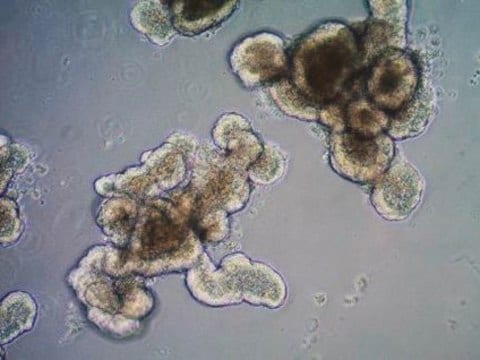
Cell Dissociation Solution Non-enzymatic 1x has been used in the dissociation of murine macrophage (RAW2647) cells, A549 pulmonary cells, islets cells and 2D cell and 3D mammospheres.
1 of 1
Este artículo | |||
|---|---|---|---|
| description Prepared in Hanks′ Balanced Salt Solution without calcium and magnesium, sterile-filtered, BioReagent, suitable for cell culture | description The Enzyme-Free Cell Dissociation Solution is a PBS based formulation of chelating agents & agents to stabilize their activity on cells. This solution is available in a 500ml format. | description The Enzyme-Free Cell Dissociation Solution is a Hank′s based formulation of chelating agents & agents to stabilize their activity on cells. This solution is available in a 500ml format. | description Chemically defined enzyme-free organoid dissociation solution. |
| technique(s) cell culture | mammalian: suitable | technique(s) - | technique(s) single cell analysis: suitable, cell culture | mammalian: suitable | technique(s) cell culture | stem cell: suitable |
| form solution | form liquid | form liquid | form liquid |
| concentration 1 × | concentration - | concentration - | concentration - |
| pH 6.5-7.5 | pH - | pH - | pH - |
| sterility sterile-filtered | sterility - | sterility - | sterility - |
| shipped in wet ice | shipped in - | shipped in - | shipped in - |
Still not finding the right product?
Explore all of our products under Cell Dissociation Solution Non-enzymatic 1x
Clase de almacenamiento
12 - Non Combustible Liquids
WGK
WGK 1
Punto de inflamación (°F)
Not applicable
Punto de inflamación (°C)
Not applicable
Elija entre una de las versiones más recientes:
¿Ya tiene este producto?
Encuentre la documentación para los productos que ha comprado recientemente en la Biblioteca de documentos.
-
Hi, I am working with primary microglia and it very tricky to dissociate. I usually dissociate them with 0.5% Trypsin for 7 min at 37˚C and still hard to collect them. May I know whether this reagent would be a better alternative? Thank you!
1 respuesta-
¿Le ha resultado útil?
-
-
What is the concentration of EDTA in Cat#C5789? Thanks
1 respuesta-
The concentration of EDTA in this formulation is proprietary. Additional components include Sodium Citrate, Nitrilotriacetic Acid, and Glycerol in Hank's Balanced Salt solution. Should the concentration of EDTA be required, product E8008, EDTA 0.2% in DPBS, may be of interest. Both items are tested for cell dissociation. Please see the link below to review this product option:
https://www.sigmaaldrich.com/US/en/product/sigma/e8008¿Le ha resultado útil?
-