


No, the BSA B6917 is not sequenced.
B6917

Bovine Serum Albumin
lyophilized powder, suitable for (for molecular biology), Non-acetylated, Molecular Biology
Synonym(s):
Albumin bovine serum, BSA, Bovine albumin
Sign In to View Organizational & Contract Pricing.
Select a Size
25 MG
€182.00
100 MG
€227.00
5 X 100 MG
€883.00
About This Item
Skip To
Product Name
Bovine Serum Albumin, lyophilized powder, suitable for (for molecular biology), Non-acetylated, Molecular Biology
biological source
bovine
grade
Molecular Biology
assay
≥98% (agarose gel electrophoresis)
form
lyophilized powder
quality
deacetylated
mol wt
~66 kDa
purified by
heat shock fractionation
packaging
glass bottle of
origin
USA origin
technique(s)
electrophoresis: suitable-98% using Agarose
impurities
enzymatic impurity, none detected
pH
7
solubility
water: soluble (50 mg/ml)
suitability
suitable for (for molecular biology)
UniProt accession no.
foreign activity
Alkaline Phosphatase free
Alkaline phosphatase and peroxidase, none detected
DNase free
DNase, RNase, and protease, none detected
Peroxidase free
Protease free
RNase free
storage temp.
2-8°C
Quality Level
Gene Information
bovine ... ALB(280717)
Looking for similar products? Visit Product Comparison Guide
1 of 4
This Item | A9418 | A3156 | A2153 |
|---|---|---|---|
| origin USA origin | origin USA origin | origin USA origin | origin USA origin |
| technique(s) electrophoresis: suitable-98% using Agarose | technique(s) cell culture | mammalian: suitable | technique(s) cell culture | mammalian: suitable | technique(s) ELISA: suitable, blood typing: suitable, microbiological culture: suitable |
| grade for molecular biology | grade - | grade - | grade - |
| assay ≥98% (agarose gel electrophoresis) | assay ≥96% (agarose gel electrophoresis) | assay ≥99% (agarose gel electrophoresis) | assay ≥96% (agarose gel electrophoresis) |
| biological source bovine | biological source bovine | biological source bovine | biological source bovine |
| Quality Level 300 | Quality Level 200 | Quality Level 200 | Quality Level 200 |
Application
Bovine Serum Albumin (BSA) has been used
- as a component of phosphate buffer saline (PBS) solution for dissolving tumor necrosis factor α (TNFα), which was added as a supplement for culture media[1]
- as a blocking agent to reduce non-specific binding during the albumin sensor assay
- as a blocking agent in the immunofluorescence (IF) assay[2]
- as a protein standard in the Bradford assay
Biochem/physiol Actions
Bovine Serum Albumin (BSA) is a versatile protein commonly utilized in cell and tissue culture media as a supplement. It helps in lipid solubilization and stabilizing other proteins. BSA is also a carrier for small molecules such as steroids, fatty acids, and thyroid hormones. It serves as a standard protein for immunochemical tests to determine protein concentration in a solution and calibration studies.
Certain conformational and primary-sequence epitopes of BSA are suspected allergens in human beef and milk allergies.
Features and Benefits
This BSA product for molecular biology is tested for the following properties:
* Alkaline Phosphatase-free
* DNase-free / Exonuclease-free
* Nickase-free / Endonuclease-free
* Peroxidase-free
* Protease-free
* RNase-free
* Alkaline Phosphatase-free
* DNase-free / Exonuclease-free
* Nickase-free / Endonuclease-free
* Peroxidase-free
* Protease-free
* RNase-free
General description
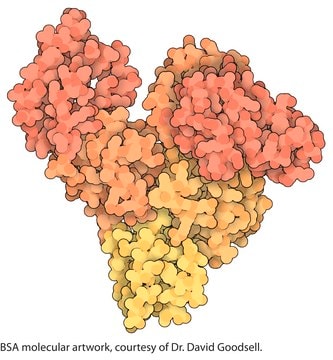
Bovine Serum Albumin (BSA) is a plasma protein produced in the bovine liver that has a globular, non-glycosylated α-helical structure. It consists of a single polypeptide chain with 583 amino acid residues and 17 cysteine residues that form the cross-linked disulfide bridges, stabilizing its structure. The BSA protein comprises three structurally distinct domains (I, II, and III), each of which contains two sub-domains (A and B) arranged in a heart-shaped architecture.[3]
Preparation Note
Serum albumin may be referred to as Fraction V. This naming convention is taken from the original Cohn method of fractionating serum proteins using cold ethanol precipitation. Serum albumin was found in the fifth ethanol fraction using Cohn′s method. Since then, the term "Fraction V" has been used by some to describe serum albumin regardless of the method of preparation. Others have used this term to describe serum albumin purified by ethanol fractionation methods that have been highly modified since the original Cohn method was described. Sigma-Aldrich manufactures and distributes serum albumins purified from a variety of primary methods including the true Cohn fractionation method, modified ethanol fractionation methods, heat shock and chromatography. Additional purification steps may include crystallization or charcoal filtration.
Storage Class
11 - Combustible Solids
wgk
WGK 1
flash_point_f
Not applicable
flash_point_c
Not applicable
ppe
Eyeshields, Gloves, type N95 (US)
Choose from one of the most recent versions:
Already Own This Product?
Find documentation for the products that you have recently purchased in the Document Library.
Fadi Jacob et al.
Cell, 180(1), 188-204 (2019-12-31)
Glioblastomas exhibit vast inter- and intra-tumoral heterogeneity, complicating the development of effective therapeutic strategies. Current in vitro models are limited in preserving the cellular and mutational diversity of parental tumors and require a prolonged generation time. Here, we report methods for
Tamara Topală et al.
Clujul medical (1957), 87(4), 215-219 (2014-01-01)
The continuous search for new molecules with therapeutic abilities has led to the synthesis and characterization of a large number of metal complexes, proven to exhibit potential as pharmacological agents through their antibacterial, antiviral, antifungal and antineoplastic properties. As serum
Marcos V A S Navarro et al.
PLoS biology, 9(2), e1000588-e1000588 (2011-02-10)
The bacterial second messenger bis-(3'-5') cyclic dimeric guanosine monophosphate (c-di-GMP) has emerged as a central regulator for biofilm formation. Increased cellular c-di-GMP levels lead to stable cell attachment, which in Pseudomonas fluorescens requires the transmembrane receptor LapD. LapD exhibits a
Manoj K Pandey et al.
Molecular pharmacology, 75(3), 525-533 (2008-12-24)
The aim of the current study is to determine whether butein (3,4,2',4'-tetrahydroxychalcone) exhibits antiproliferative effects against tumor cells through suppression of the signal transducer and activator of transcription 3 (STAT3) activation pathway. We investigated the effects of butein on constitutive
Tânia Veiga et al.
Eukaryotic cell, 11(2), 238-249 (2011-12-14)
The industrial production of penicillin G by Penicillium chrysogenum requires the supplementation of the growth medium with the side chain precursor phenylacetate. The growth of P. chrysogenum with phenylalanine as the sole nitrogen source resulted in the extracellular production of
Related Content
-
I would like to know the fast reference sequence of BSA B6917, could you provide me with this information? I thank you for your attention
1 answer-
Helpful?
-
-
What's the molecular formula?.
1 answer-
B6917 BSA is a single polypeptide chain consisting of about 583 amino acid residues and no carbohydrates. This information can be found on the product information sheet: https://www.sigmaaldrich.com/deepweb/assets/sigmaaldrich/product/documents/937/825/b6917pis.pdf
Additional information can also be reviewed at the UniProt listing. See the link below:
https://www.uniprot.org/uniprotkb/P02769/entryHelpful?
-
Active Filters
Our team of scientists has experience in all areas of research including Life Science, Material Science, Chemical Synthesis, Chromatography, Analytical and many others.
Contact Technical Service