
70794

BugBuster® GST-Bind Purification Kit
Affinity purification of GST fusion proteins
Select a Size
£675.00
£675.00
About This Item
Skip To
manufacturer/tradename
Novagen®
storage condition
OK to freeze
1 of 4
This Item | 70922 | 70584-M | 70751 |
|---|---|---|---|
| manufacturer/tradename Novagen® | manufacturer/tradename Novagen® | manufacturer/tradename Novagen® | manufacturer/tradename Novagen® |
| storage condition OK to freeze | storage condition OK to freeze, avoid repeated freeze/thaw cycles | storage condition OK to freeze, avoid repeated freeze/thaw cycles | storage condition OK to freeze |


General description
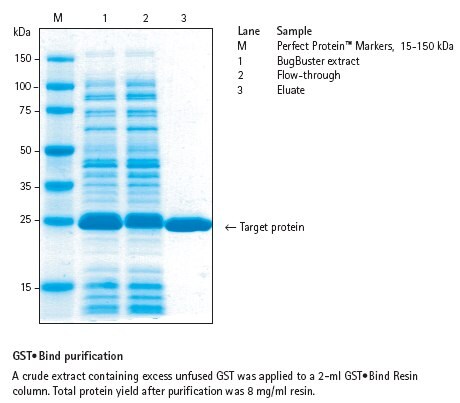
Other Notes
•10,000 UBenzonase Nuclease, purity >90%
•10 mlGST•Bind Resin
•pkg/4Chromatography Columns
•2 x 100 ml10X GST Bind/Wash Buffer
•40 ml10X Glutathione Reconstitution Buffer
•1 gGlutathione, Reduced
Legal Information
Disclaimer

Signal Word
Warning
Hazard Statements
Precautionary Statements
Hazard Classifications
Flam. Liq. 3
Storage Class Code
3 - Flammable liquids
Flash Point(F)
96.8 °F
Flash Point(C)
36 °C
Certificates of Analysis (COA)
Search for Certificates of Analysis (COA) by entering the products Lot/Batch Number. Lot and Batch Numbers can be found on a product’s label following the words ‘Lot’ or ‘Batch’.
Already Own This Product?
Find documentation for the products that you have recently purchased in the Document Library.
Related Content
Traditionally, protein purification from E. coli consists of four distinct phases: harvest, bacterial cell lysis, lysate clarification and protein purification. Bacterial lysis typically requires several time-consuming, hands-on steps, such as freeze/thaw cycles and sonication. These harsh lysis techniques may negatively impact protein quality and contribute to sample-to-sample variability. To maintain protein activity and integrity, detergent-based lysis buffers are routinely used to avoid mechanical protein extraction methods. Regardless of the lysis method used, centrifugation is traditionally required to pellet unwanted cell debris and permit recovery of the clarified lysate. The final step, purification, is frequently performed using affinity media specific for expressed epitope tags. Agarose-based media have typically been used, either as a slurry in microcentrifuge tubes or packed into gravity-driven or spin columns. While easier to manipulate, columns are greatly affected by lysate consistency and carryover of cell debris, which can lead to clogging of the column frits.
Active Filters
Our team of scientists has experience in all areas of research including Life Science, Material Science, Chemical Synthesis, Chromatography, Analytical and many others.
Contact Technical Service