
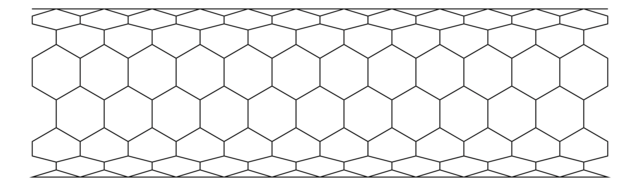

The graphene arrangement for this product has not been determined, and there are no photos available. Typically, multi-walled carbon nanotubes (MWCNTs) are predominantly concentric. However, it is theoretically possible for some variations or defects to lead to a herringbone-like arrangement, though this is not typical and would be considered an exception rather than the norm for MWCNTs. The standard structure remains concentric, which contributes to their well-known properties.
901019

Carbon nanotube, multi-walled
50-90 nm diameter, >95% carbon basis
Synonym(s):
MWCNT, MWNT, Multiwall carbon nanotube
Skip To
description
D/G ratio: 0.1 (by Raman spectroscopy)
Real density: 2.1 g/cm^3 (by Pycnometer)
Quality Level
Assay
>95% carbon basis
aspect ratio
>100 , by FE-SEM
surface area
28 m2/g , by N<SUB>2</SUB> adsorption
diameter
50-90 nm
65 nm (by FE-SEM)
mp
3652-3697 °C (lit.)
density
~2.1 g/mL at 25 °C (lit.)
bulk density
0.007 g/cm3 (by HCC method)
SMILES string
[C]
InChI
1S/C
InChI key
OKTJSMMVPCPJKN-UHFFFAOYSA-N
Looking for similar products? Visit Product Comparison Guide
1 of 4
This Item | 698849 | 901002 | 637351 |
|---|---|---|---|
| assay >95% carbon basis | assay >98% carbon basis | assay >95% carbon basis | assay 50-80% carbon basis |
| Quality Level 100 | Quality Level 100 | Quality Level 100 | Quality Level - |
| description D/G ratio: 0.1 (by Raman spectroscopy) | description - | description - | description - |
| aspect ratio >100 , by FE-SEM | aspect ratio - | aspect ratio - | aspect ratio - |
| surface area 28 m2/g , by N<SUB>2</SUB> adsorption | surface area ~220 m2/g , SSA | surface area - | surface area >600 m2/g |
| diameter 50-90 nm | diameter - | diameter - | diameter - |
General description
Carbon nanotubes are hollow cylinders of carbon atoms. They are rolled-upgraphene sheets with carbon atoms covalently bonded to each other through sp2hybridization. Owing to their excellent mechanical and electrical properties,they are widely used in the field of flexible and wearable electronicdevices.
Application
Multi-walled carbon nanotubes (MWCNTs) functionalized with a polymer blend can be used as a hybrid catalyst for the degradation of crystal violet under visible light.
Due to their high magnetic sensitivity, MWCNT/manganese–zinc ferrite nanocomposites can be used in integrated nanoscale electronic systems.
They can also be used tofabricate sensors for strain-sensing applications because of their highmechanical flexibility and stability.
Due to their high magnetic sensitivity, MWCNT/manganese–zinc ferrite nanocomposites can be used in integrated nanoscale electronic systems.
They can also be used tofabricate sensors for strain-sensing applications because of their highmechanical flexibility and stability.
Features and Benefits
- Excellent conductivity
- Light weight
- Chemical stability
- Large surface area
- High mechanical strength
Preparation Note
Chemical Vapor Deposition (CVD) Method
Storage Class Code
13 - Non Combustible Solids
WGK
WGK 3
Flash Point(F)
Not applicable
Flash Point(C)
Not applicable
Choose from one of the most recent versions:
Already Own This Product?
Find documentation for the products that you have recently purchased in the Document Library.
Articles
The European Green Deal and Circular Economy Action Plan address resource challenges with eco-products and circulatory work, while the revised EU Ecodesign Directive promotes e-waste reduction and natural resource value reform. This review examines renewable substrates and conductive materials for flexible electronics.
-
J'ai acheté ce produit, je voudrais savoir quelle est la disposition des graphenes par rapport á l'axe des tubes: de type concentrique ou de type "herringbone"? Avez-vous des photos type? Merci de votre réponse
1 answer-
Helpful?
-
-
How can I determine the shelf life / expiration / retest date of this product?
1 answer-
If this product has an expiration or retest date, it will be shown on the Certificate of Analysis (COA, CofA). If there is no retest or expiration date listed on the product's COA, we do not have suitable stability data to determine a shelf life. For these products, the only date on the COA will be the release date; a retest, expiration, or use-by-date will not be displayed.
For all products, we recommend handling per defined conditions as printed in our product literature and website product descriptions. We recommend that products should be routinely inspected by customers to ensure they perform as expected.
For products without retest or expiration dates, our standard warranty of 1 year from the date of shipment is applicable.
For more information, please refer to the Product Dating Information document: https://www.sigmaaldrich.com/deepweb/assets/sigmaaldrich/marketing/global/documents/418/501/product-dating-information-06-25-mk.pdfHelpful?
-
-
What is the HCC method used for determining bulk density mentioned in the product properties?
1 answer-
The HCC method is a pycnometry method specific for 'hollow cone-like carbon'. Details of the method cannot be shared, as this product is only MQ100.
Helpful?
-
-
How is shipping temperature determined? And how is it related to the product storage temperature?
1 answer-
Products may be shipped at a different temperature than the recommended long-term storage temperature. If the product quality is sensitive to short-term exposure to conditions other than the recommended long-term storage, it will be shipped on wet or dry-ice. If the product quality is NOT affected by short-term exposure to conditions other than the recommended long-term storage, it will be shipped at ambient temperature. As shipping routes are configured for minimum transit times, shipping at ambient temperature helps control shipping costs for our customers. For more information, please refer to the Storage and Transport Conditions document: https://www.sigmaaldrich.com/deepweb/assets/sigmaaldrich/marketing/global/documents/316/622/storage-transport-conditions-mk.pdf
Helpful?
-
-
what is the mean number of walls in MWCNT?
1 answer-
There are 88 - 100 walls in these multi-walled carbon nanotubes.
Helpful?
-
-
What's the length of these tubes?
1 answer-
The length of this product is typically > 6.5 micron.
Helpful?
-
Active Filters
Our team of scientists has experience in all areas of research including Life Science, Material Science, Chemical Synthesis, Chromatography, Analytical and many others.
Contact Technical Service