
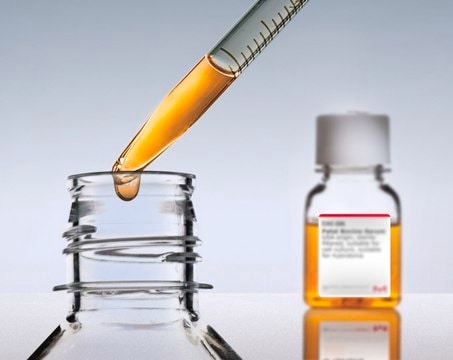
Heat inactivation is required based on the specific application or protocol. It is typically necessary for hybridoma cultures or immunological studies that require the inactivation of complement proteins. However, heat inactivation is not required for all applications.
F2442

Fetal Bovine Serum
USA origin, sterile-filtered, suitable for cell culture, suitable for hybridoma
Synonym(s):
Fetal Bovine Sera, Fetal Calf Serum, FBS, FCS, sera, serum
Sign In to View Organizational & Contract Pricing
Select a Size
100 ML
₩255,273
500 ML
₩1,182,983
About This Item
Biological source:
bovine fetus
Origin:
USA origin
Sterility:
sterile-filtered
Shipped in:
dry ice
Skip To
biological source
bovine fetus
sterility
sterile-filtered
product line
FBS Classic
composition
Bovine IgG, ≤1 mg/mL
Hemoglobin, ≤20 mg/dL
origin
USA origin
technique(s)
cell culture | hybridoma: suitable
cell culture | mammalian: suitable
impurities
≤10 EU/mL endotoxin
shipped in
dry ice
storage temp.
−20°C
Looking for similar products? Visit Product Comparison Guide
1 of 3
This Item | F4135 | F8192 |
|---|---|---|
| origin USA origin | origin USA origin | origin Australia origin |
| sterility sterile-filtered | sterility sterile-filtered | sterility sterile-filtered |
| biological source bovine fetus | biological source bovine fetus | biological source bovine fetus |
| technique(s) cell culture | hybridoma: suitable, cell culture | mammalian: suitable | technique(s) cell culture | hybridoma: suitable, cell culture | insect: suitable, cell culture | mammalian: suitable | technique(s) cell culture | hybridoma: suitable, cell culture | mammalian: suitable |
| shipped in dry ice | shipped in dry ice | shipped in dry ice |
| impurities ≤10 EU/mL endotoxin | impurities ≤10 EU/mL endotoxin | impurities ≤10 EU/mL endotoxin |
General description
Fetal Bovine Serum (FBS) is a complex mixture with low and high molecular weight biomolecules exhibiting optimal growth-enhancing and growth-suppressing functions. FBS contains molecules, such as growth factors, proteins, vitamins, trace elements, hormones etc. These molecules are important for the growth and maintenance of cells. It is a common supplement for cell culture media.[1][2] FBS is derived from the calf blood. It is devoid of fibrin and clotting factors. Heat inactivation of FBS blocks the complement system.[3] FBS derived from clotted blood is the most widely used undefined supplement in eukaryotic, especially mammalian, cell culture.[4][5] It is typically used with the classical media that were developed in the 1950s and 1960s. These include many popular media such as Minimum Essential Medium (MEM),[6] Dulbecco′s Modified Eagles Media (DME, DMEM); Iscove′s Modified Eagles Medium (IMDM),[7] M199[8] and Roswell Park Memorial Institute medium, RPMI-1640.[6]
Application
Biochem/physiol Actions
FBS remains a popular media supplement because it provides a wide array of functions in cell culture. FBS delivers nutrients, growth and attachment factors and protects cells from oxidative damage and apoptosis by mechanisms that are difficult to reproduce in serum-free media (SFM) systems.
Analysis Note
- Endotoxin and hemoglobin tested
- Tested for the presence of bacteria, virus, and mycoplasma
- Triple filtered with 0.1 micron membrane under aseptic conditions
Other Notes
Tested for the presence of bacteria, virus, mycoplasma, endotoxin and for hemoglobin content. Triple filtered with 0.1 micron membrane under aseptic conditions.
related product
Product No.
Description
Pricing
Storage Class Code
10 - Combustible liquids
WGK
WGK 3
Flash Point(F)
Not applicable
Flash Point(C)
Not applicable
Personal Protective Equipment
dust mask type N95 (US), Eyeshields, Gloves
Choose from one of the most recent versions:
Already Own This Product?
Find documentation for the products that you have recently purchased in the Document Library.
Axenic Procyclic Culture of L. tropica and L. donovani in Culture of FBS-free Medium
Mosa FM, et al.
Ife Journal of Science, 4B, 3088-3093 (2015)
Inhibiting tyrosine phosphorylation of protein kinase Cd (PKCd) protects the salivary gland from radiation damage.
Wie SM et al.
The Journal of Biological Chemistry, 289, 10900-10900 (2014)
MENT, a heterochromatin protein that mediates higher order chromatin folding, is a new serpin family member.
Grigoryev SA et al.
The Journal of Biological Chemistry, 274, 5626-5626 (1999)
Cunzhi Yu et al.
Frontiers in pharmacology, 8, 832-832 (2017-12-07)
Low solubility, tissue accumulation, and toxicity are chief obstacles to developing triptolide derivatives, so a better understanding of the pharmacokinetics and toxicity of triptolide derivatives will help with these limitations. To address this, we studied pharmacokinetics and toxicity of (5R)-5-hydroxytriptolide
Diana Lizeth Cervantes-Madrid et al.
Oncology letters, 13(3), 1411-1416 (2017-04-30)
The expression levels of cyclooxygenase (COX)-2 and the prostaglandin E2 (PGE2) content have been associated with poor prognosis in patients with colorectal cancer (CRC). There is a strong correlation between COX-2 expression and PGE2 production in tissues from CRC patients
Articles
High titer lentiviral particles for LC3 variants used for live cell analysis of cellular autophagy.
Millicell® hanging cell culture inserts for staining and microscopic analysis directly from the insert. Learn to utilize hanging cell culture inserts in barrier measurements.
High titer lentiviral particles including beta-actin, alpha-tubulin and vimentin used for live cell analysis of cytoskeleton structure proteins.
Calcium is an ionically stable divalent cation with important beneficial and toxic properties in cell culture. It is a component of a wide range of cell culture media.
Protocols
Detailed procedure for how to perform a lentiviral transduction of MISSION shRNA lentiviral particles to achieve a stable long term silencing and phenotypic change.
Related Content
Our broad range of the most trusted tools for cell culture includes stringently sourced and tested FBS, established media formulations, and sterile labware. Cutting-edge techniques using stem cells and 3D matrices are enabled by organoids, hydrogels, culture scaffolds, and bioinks for 3D bioprinting.
Learn how to effectively filter fetal bovine serum (FBS) using Stericup® Quick Release vacuum filtration devices, including flow test data and analysis.
Step-by-step protocol for generating apical-out human gut organoids for microbiome, ADME/Tox, viral and gastrointestinal related disease research. See the complete organoid culture protocol.
-
is heat inactivation necessary?
1 answer-
Helpful?
-
-
How to heat inactivate this serum Fetal Bovine Serum USA origin,(Cat Log - F2442)
1 answer-
Heat inactivation occurs when serum is heated to 56°C for a period of 30 minutes.
Here's a protocol for heat inactivation:
1. Allow serum containers to come to room temperature. Swirl bottles of serum immediately before adding to the water bath.
2. A water-filled control bottles (T1) should be placed in a 56 °C water bath. Place the containers in the water bath up to the serum line. Do not completely submerge the containers. When the temperature of T1 reaches 56 °C, start the timer set for 30 minutes. Do not allow temperatures to exceed 56 °C. Higher temperatures will denature the proteins, gel the serum or alter the performance of the serum.
3. Gently swirl the bottles every 5 to 10 minutes while in the water bath and check the temperature in the control bottle. It is not uncommon for plastic containers to bow slightly after heat treatment. This is not harmful to the serum.
4. At the end of 30 minutes remove the serum bottles from the water bath. Aliquot the serum into smaller volumes and freeze. Sigma-Aldrich does not recommend repeated thaw-freeze cycles.Helpful?
-
-
is this Heat Inactivate FBS?
1 answer-
This product has not been heat inactivated.
Helpful?
-
-
can F2442 FBS be used for culturing peritoneal macrophages? what is the suitable one?
1 answer-
This product is tested for suitability in mammalian cell culture. While it is not specifically tested on macrophages, it is subject to stringent specifications, including low endotoxin, and should perform well. Please see the link below to review a sample Certificate of Analysis:
https://www.sigmaaldrich.com/coa/SIGMA/F2442/23A317Helpful?
-
-
Can this f2442 fbs be used for culture expansion of mesenchymal stem cells? Please confirm Thanks
1 answer-
Fetal Bovine Serum (Cat. no.: F2442) is suitable for use in mammalian cell culture. However, it is not tested specifically in mesenchymal stem cell culture. There is some evidence in the literature that this product would be suitable. See the link below for a relevant reference:
https://www.ncbi.nlm.nih.gov/pmc/articles/PMC4545441/Helpful?
-
-
Is Fetal Bovine Serum, Product F2442, available as a charcoal stripped, de-lipidated serum?
1 answer-
We offer Product No. F6765 (Fetal Bovine Serum, charcoal stripped). The charcoal stripping decreases the levels of hormones; it may also decrease the levels of lipids. If further reduction of lipid levels is required, you may need to treat the serum with fumed silica (e.g. Product No. S5130). Use 20 grams of S5130 per Liter of serum (not plasma). It is mixed for 3-4 hours, then centrifuged in 1 L containers for about 15 minutes at 2000 xg. The supernatant can then be decanted, and filtered if desired. NOTE: Silica is extremely fluffy, and care must be taken not to inhale its dust. Allow for about 15% loss of the serum due to adsorption.
Helpful?
-
-
What is the difference between Fetal Bovine Serum F2442 and 12103C?
1 answer-
Product No. 12103C meets most of the specifications of F2442. Both products are from the same raw material suppliers and undergo the same stringent testing prior to release. However, the F2442 has been use-tested in hybridoma culture, whereas 12103C has not.
Helpful?
-
-
There is a precipitate in my serum. Is my serum contaminated?
1 answer-
Precipitates in serum can often appear as large round bodies, even as doublets per microscopic exam. This can be mistaken as a yeast contamination. Brownian motion may be mistaken for motility. These are lipid aggregates that will be readily dissolved when exposed to lipase. Also, these particles will not gram stain or show any growth in culture on aerobic, anaerobic, or fungal media and culture conditions. The performance of the material is not effected. Centrifugation or filtration of small volumes will remove these particles.
Helpful?
-
-
What is the cloning assay performed on Fetal Bovine Serum, Product F2442?
1 answer-
The cloning efficiency assay is performed on each lot of FBS to verify that each lot will support clonal growth of myeloma cells and/or fusion products. The assay is performed using 5% and 10% concentrations of the FBS.
Helpful?
-
-
Once a bottle of Fetal Bovine Serum (FBS) is thawed, for how long can the bottle be used?
1 answer-
Once Fetal Bovine Serum has been thawed, the bottle can be used in cell culture for up to 7 days for most cell types when stored refrigerated at 2-8°C. If the cells are not fastidous (e.g. HeLa or fibroblasts), the thawed and refrigerated serum can be used for up to 30 days. For some extremely fastidious cell lines, it may be necessary to screen individual lots for acceptable performance. For uses such as blocking for various immuno procedures, usage will generally be for 30 days and perhaps somewhat longer when stored at 2-8°C. For other procedures, usage beyond 30 days storage at 2-8°C will need to be determined.
Helpful?
-
Active Filters
Our team of scientists has experience in all areas of research including Life Science, Material Science, Chemical Synthesis, Chromatography, Analytical and many others.
Contact Technical Service