Skip to Content
Merck

C109401

Cyclooctane

≥99%

Sign In to View Organizational & Contract Pricing.

Select a Size

Pricing and availability is not currently available.

About This Item

Empirical Formula (Hill Notation):
C8H16
CAS Number:
Molecular Weight:
112.21
UNSPSC Code:
12352100
NACRES:
NA.22
PubChem Substance ID:
EC Number:
206-031-8
Beilstein/REAXYS Number:
1900349
MDL number:

Skip To

Technical Service
Need help? Our team of experienced scientists is here for you.
Let Us Assist

Product Name

Cyclooctane, ≥99%

InChI

1S/C8H16/c1-2-4-6-8-7-5-3-1/h1-8H2

InChI key

WJTCGQSWYFHTAC-UHFFFAOYSA-N

SMILES string

C1CCCCCCC1

vapor pressure

16 mmHg ( 37.7 °C)

assay

≥99%

form

liquid

refractive index

n20/D 1.458 (lit.)

bp

151 °C/740 mmHg (lit.)

mp

10-13 °C (lit.)

density

0.834 g/mL at 25 °C (lit.)

Quality Level

Looking for similar products? Visit Product Comparison Guide

Compare Similar Items

View Full Comparison

Show Differences

1 of 4

This Item
C109800C95803C110507
assay

≥99%

assay

98%

assay

99%

assay

99%

Quality Level

200

Quality Level

200

Quality Level

200

Quality Level

100

refractive index

n20/D 1.458 (lit.)

refractive index

-

refractive index

-

refractive index

-

density

0.834 g/mL at 25 °C (lit.)

density

0.958 g/mL at 25 °C (lit.)

density

-

density

-

mp

10-13 °C (lit.)

mp

32-41 °C (lit.)

mp

158 °C (lit.)

mp

53-56 °C (lit.)

bp

151 °C/740 mmHg (lit.)

bp

195-197 °C (lit.)

bp

-

bp

55 °C/5 mmHg (lit.)

Application

Cyclooctane can undergo oxidation with hydrogen peroxide in the presence of triethylpropylammonium-functionalized silica and transition metal mono-substituted polyoxotungstates.[1]
Cyclooctane may undergo oxidation with hydrogen peroxide in the presence of triethylpropylammonium-functionalized silica and transition metal mono-substituted polyoxotungstates.[1]

pictograms

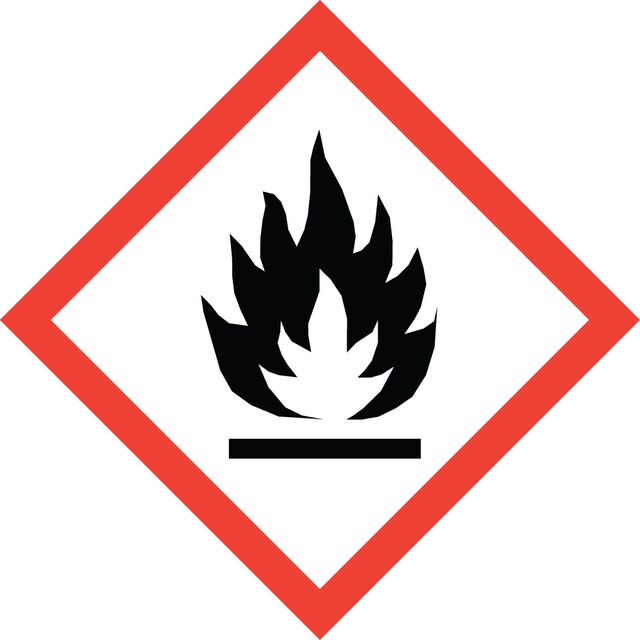
FlameHealth hazard

signalword

Danger

hcodes

Hazard Classifications

Asp. Tox. 1 - Flam. Liq. 3

Storage Class

3 - Flammable liquids

wgk

WGK 2

flash_point_f

82.4 °F - closed cup

flash_point_c

28 °C - closed cup

ppe

Eyeshields, Faceshields, Gloves, type ABEK (EN14387) respirator filter


Choose from one of the most recent versions:

Certificates of Analysis (COA)

Lot/Batch Number

Don't see the Right Version?

If you require a particular version, you can look up a specific certificate by the Lot or Batch number.

Already Own This Product?

Find documentation for the products that you have recently purchased in the Document Library.

Visit the Document Library

Silica supported transition metal substituted polyoxotungstates: Novel heterogeneous catalysts in oxidative transformations with hydrogen peroxide.
Estrada AC, et al.
Applied Catalysis A: General, 392(1-2), 28-35 (2011)
Pieter van Delft et al.
Organic letters, 12(23), 5486-5489 (2010-11-06)
The conjugation of a ribonucleic acid 16-mer with the cationic amphiphilic peptide penetratin and an anionic hyaluronan tetrasaccharide by means of Cu-free "click" chemistry is reported. The alkyne-functionalized 16-mer was prepared by automated solid-phase synthesis, using a newly developed strained
Zhong-Ke Yao et al.
Organic letters, 13(1), 134-137 (2010-11-26)
Discovering new carbon building blocks is very significant to advance transition-metal-catalyzed cycloadditions for the synthesis of various-sized ring compounds. A new seven-carbon building block from buta-1,3-dienylcyclopropanes (BDCPs) has been developed, showing that, under the catalysis of [Rh(CO)(2)Cl](2), BDCPs react with
Heidi E Bostic et al.
Chemical communications (Cambridge, England), 48(10), 1431-1433 (2011-10-04)
Copper-free click chemistry was employed to derivatize membrane bilayers. This approach uses an azido-lipid conjugate presented on liposomes, which can be labeled in bioorthogonal fashion via cyclooctyne-tagged reagents. An immobilization-based approach using streptavidin-coated microplates was exploited to evaluate membrane derivatization.
Shawn Martin et al.
The Journal of chemical physics, 132(23), 234115-234115 (2010-06-25)
Understanding energy landscapes is a major challenge in chemistry and biology. Although a wide variety of methods have been invented and applied to this problem, very little is understood about the actual mathematical structures underlying such landscapes. Perhaps the most

Questions

Reviews

No rating value

Active Filters

Our team of scientists has experience in all areas of research including Life Science, Material Science, Chemical Synthesis, Chromatography, Analytical and many others.

Contact Technical Service