
Skip to Content
Merck

17104

Dodecyltrimethylammonium chloride

purum, ≥98.0% anhydrous basis (AT)

Synonym(s):

DTAC

Sign In to View Organizational & Contract Pricing

Select a Size

Pricing and availability is not currently available.

About This Item

Linear Formula:
CH3(CH2)11N(CH3)3Cl
CAS Number:
Molecular Weight:
263.89
Beilstein:
3915951
EC Number:
MDL number:
UNSPSC Code:
12352116
PubChem Substance ID:
NACRES:
NA.22

Skip To

Technical Service
Need help? Our team of experienced scientists is here for you.
Let Us Assist

description

cationic

Quality Level

grade

purum

Assay

≥98.0% anhydrous basis (AT)

form

solid

mol wt

263.89 g/mol

mp

37 °C

SMILES string

[Cl-].CCCCCCCCCCCC[N+](C)(C)C

InChI

1S/C15H34N.ClH/c1-5-6-7-8-9-10-11-12-13-14-15-16(2,3)4;/h5-15H2,1-4H3;1H/q+1;/p-1

InChI key

DDXLVDQZPFLQMZ-UHFFFAOYSA-M

Looking for similar products? Visit Product Comparison Guide

Compare Similar Items

View Full Comparison

Show Differences

1 of 4

This Item
442428.16142D8638
grade

purum

grade

-

grade

-

grade

-

form

solid

form

solid

form

solid

form

powder

assay

≥98.0% anhydrous basis (AT)

assay

≥99.0% (AT)

assay

-

assay

≥98%

description

cationic

description

cationic

description

-

description

cationic

mp

37 °C

mp

37 °C

mp

246 °C (decomposition)

mp

246 °C (dec.) (lit.)

Quality Level

200

Quality Level

200

Quality Level

200

Quality Level

200

General description

Dodecyltrimethylammonium chloride is a quaternary ammonium compound (QAC) commonly used as a cationic surfactant.[1] It is used in antimicrobial sanitizers due to its surface activity and germicidal efficiency.[2]

Application

  • Polyethylene terephthalate depolymerization: Dodecyltrimethylammonium chloride was applied in the enzymatic depolymerization of polyethylene terephthalate, illustrating its utility in enhancing the efficiency of plastic degradation processes (Kawai et al., 2022).

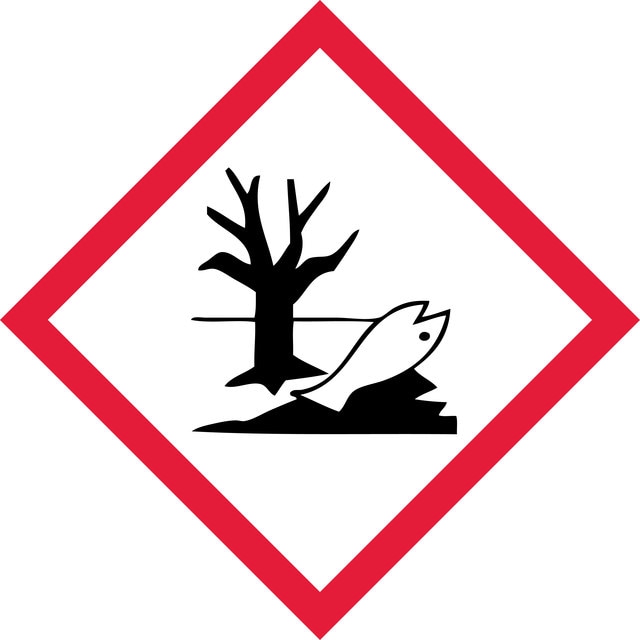
Pictograms

Exclamation markEnvironment

Signal Word

Warning

Hazard Statements

Hazard Classifications

Acute Tox. 4 Oral - Aquatic Acute 1 - Eye Irrit. 2 - Skin Irrit. 2

Storage Class Code

13 - Non Combustible Solids

WGK

WGK 3

Flash Point(F)

Not applicable

Flash Point(C)

Not applicable

Personal Protective Equipment

dust mask type N95 (US), Eyeshields, Gloves

Choose from one of the most recent versions:

Certificates of Analysis (COA)

Lot/Batch Number

Don't see the Right Version?

If you require a particular version, you can look up a specific certificate by the Lot or Batch number.

Already Own This Product?

Find documentation for the products that you have recently purchased in the Document Library.

Visit the Document Library

Pathogenicity of dodecyltrimethylammonium chloride-resistant Salmonella enterica.
Kautz MJ
Applied and Environmental Microbiology, 79(7), 2371-2376 (2013)
Sorption of dodecyltrimethylammonium chloride (DTAC) to agricultural soils.
Xiang L Sun
The Science of the Total Environment, 560, 197-203 (2016)
Sriram Sokalingam et al.
PloS one, 7(7), e40410-e40410 (2012-07-14)
Two positively charged basic amino acids, arginine and lysine, are mostly exposed to protein surface, and play important roles in protein stability by forming electrostatic interactions. In particular, the guanidinium group of arginine allows interactions in three possible directions, which
A A Mikhailovskaya et al.
The journal of physical chemistry. B, 115(33), 9971-9979 (2011-07-26)
The dynamic dilatational surface elasticity of mixed solutions of globular proteins (β-lactoglobulin (BLG) and bovine serum albumin (BSA)) with cationic (dodecyltrimethylammonium bromide (DTAB)) and anionic (sodium dodecyl sulfate (SDS)) surfactants was measured as a function of the surfactant concentration and
I Echavarri Franco et al.
Langmuir : the ACS journal of surfaces and colloids, 28(10), 4815-4828 (2012-02-16)
The binding of cationic surfactants with varying alkyl chain length to a regiorandom conjugated polyanion, poly(3-thiophene acetic acid) (PTAA), is studied in an aqueous buffer by using absorption and emission spectroscopies, photon correlation spectroscopy, isothermal titration calorimetry, and cryogenic transmission

Questions

Reviews

No rating value

Active Filters

Our team of scientists has experience in all areas of research including Life Science, Material Science, Chemical Synthesis, Chromatography, Analytical and many others.

Contact Technical Service