Skip to Content
Merck

PHR1107

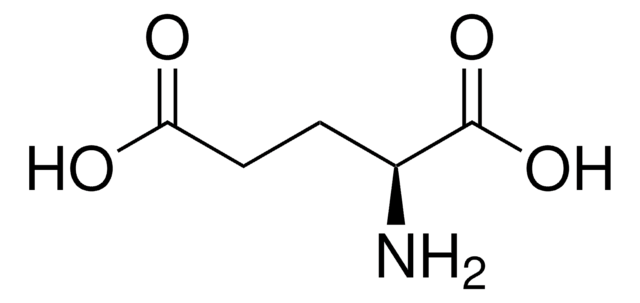
L-Glutamic acid

Pharmaceutical Secondary Standard; Certified Reference Material

Synonym(s):

(S)-2-Aminopentanedioic acid, Glu

Sign In to View Organizational & Contract Pricing.

Select a Size

Pricing and availability is not currently available.

About This Item

Linear Formula:
HO2CCH2CH2CH(NH2)CO2H
CAS Number:
Molecular Weight:
147.13
UNSPSC Code:
41116107
NACRES:
NA.24
PubChem Substance ID:
EC Number:
200-293-7
Beilstein/REAXYS Number:
1723801
MDL number:

Skip To

Technical Service
Need help? Our team of experienced scientists is here for you.
Let Us Assist

Product Name

L-Glutamic acid, Pharmaceutical Secondary Standard; Certified Reference Material

InChI

1S/C5H9NO4/c6-3(5(9)10)1-2-4(7)8/h3H,1-2,6H2,(H,7,8)(H,9,10)/t3-/m0/s1

InChI key

WHUUTDBJXJRKMK-VKHMYHEASA-N

SMILES string

N[C@@H](CCC(O)=O)C(O)=O

grade

certified reference material
pharmaceutical secondary standard

agency

traceable to Ph. Eur. G0355000
traceable to USP 1294976

API family

glutamic acid

CofA

current certificate can be downloaded

technique(s)

HPLC: suitable
gas chromatography (GC): suitable

mp

205 °C (dec.) (lit.)

application(s)

cleaning products
cosmetics
food and beverages
personal care
pharmaceutical (small molecule)

format

neat

storage temp.

2-30°C

Quality Level

Looking for similar products? Visit Product Comparison Guide

Compare Similar Items

View Full Comparison

Show Differences

1 of 4

This Item
95436G8415G1251
application(s)

cleaning products
cosmetics
food and beverages
personal care
pharmaceutical (small molecule)

application(s)

cleaning products
cosmetics
flavors and fragrances
food and beverages
personal care

application(s)

pharmaceutical (small molecule)

application(s)

-

technique(s)

HPLC: suitable, gas chromatography (GC): suitable

technique(s)

HPLC: suitable, gas chromatography (GC): suitable

technique(s)

cell culture | mammalian: suitable

technique(s)

microbiological culture: suitable

format

neat

format

neat

format

-

format

-

Quality Level

300

Quality Level

300

Quality Level

300

Quality Level

200

grade

certified reference material, pharmaceutical secondary standard

grade

certified reference material, TraceCERT®

grade

-

grade

-

storage temp.

2-30°C

storage temp.

-

storage temp.

-

storage temp.

-

Analysis Note

These secondary standards offer multi-traceability to the USP and EP (PhEur) primary standards, where they are available.

Application

L-Glutamic acid may be used as a pharmaceutical reference standard for the determination of the analyte in pharmaceutical formulations by ion chromatography technique.[1]
These Secondary Standards are qualified as Certified Reference Materials. These are suitable for use in several analytical applications including but not limited to pharma release testing, pharma method development for qualitative and quantitative analyses, food and beverage quality control testing, and other calibration requirements.

Biochem/physiol Actions

An excitatory amino acid neurotransmitter that is an agonist at all subtypes of glutamate receptors (metabotropic, kainate, NMDA, and AMPA).

General description

Pharmaceutical secondary standards for application in quality control, provide pharma laboratories and manufacturers with a convenient and cost-effective alternative to the preparation of in-house working standards.

Other Notes

Find a digital Reference Material for this product available on our online platform ChemisTwin® for NMR. You can use this digital equivalent on ChemisTwin® for your sample identity confirmation and compound quantification (with digital external standard). An NMR spectrum of this substance can be viewed and an online comparison against your sample can be performed with a few mouseclicks. Learn more here and start your free trial.
This Certified Reference Material (CRM) is produced and certified in accordance with ISO 17034 and ISO/IEC 17025. All information regarding the use of this CRM can be found on the certificate of analysis.
To see an example of a Certificate of Analysis for this material enter LRAA7158 in the slot below. This is an example certificate only and may not be the lot that you receive.

Storage Class

11 - Combustible Solids

wgk

WGK 1

flash_point_f

Not applicable

flash_point_c

Not applicable


Certificates of Analysis (COA)

Search for Certificates of Analysis (COA) by entering the products Lot/Batch Number. Lot and Batch Numbers can be found on a product’s label following the words ‘Lot’ or ‘Batch’.

Already Own This Product?

Find documentation for the products that you have recently purchased in the Document Library.

Visit the Document Library

Ion-chromatographic determination of carbocisteine in pharmaceuticals based on non-suppressed conductimetric detection
Megoulas NC and Koupparis MA
Journal of Chromatography A, 1026(1-2), 167-174 (2004)
Luigi F Agnati et al.
Pharmacological reviews, 55(3), 509-550 (2003-07-19)
The molecular basis for the known intramembrane receptor/receptor interactions among G protein-coupled receptors was postulated to be heteromerization based on receptor subtype-specific interactions between different types of receptor homomers. The discovery of GABAB heterodimers started this field rapidly followed by
G Alfredsson et al.
Biological psychiatry, 23(7), 689-697 (1988-04-01)
The concentrations of homovanillic acid (HVA), 5-hydroxyindoleacetic acid (5-HIAA), 4-hydroxy-3-methoxyphenylglycol (HMPG), and glutamate were determined in cerebrospinal fluid (CSF) and serum in 10 healthy volunteers. The monoamine metabolites were measured by mass fragmentography and the glutamate by high-performance liquid chromatography.
Katarzyna Rogoz et al.
Molecular pharmacology, 85(2), 322-334 (2013-11-28)
The transient receptor potential cation channel subfamily V member 1 (TRPV1) is known as a thermosensor and integrator of inflammation-induced hyperalgesia. TRPV1 is expressed in a subpopulation of primary afferent neurons that express several different neurotransmitters. The role of the
Nils Muhlert et al.
Journal of neurology, neurosurgery, and psychiatry, 85(8), 833-839 (2014-01-17)
Glutamate is the principal excitatory neurotransmitter and is involved in normal brain function. Cognitive impairment is common in multiple sclerosis (MS), and understanding its mechanisms is crucial for developing effective treatments. We used structural and metabolic brain imaging to test

Questions

Reviews

No rating value

Active Filters

Our team of scientists has experience in all areas of research including Life Science, Material Science, Chemical Synthesis, Chromatography, Analytical and many others.

Contact Technical Service