Skip to Content
Merck

439169

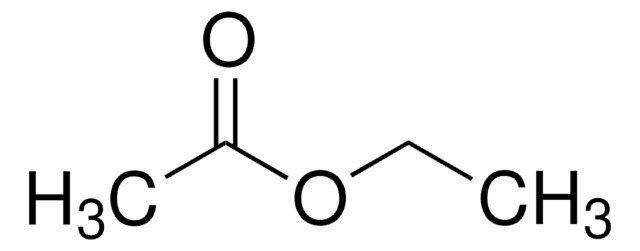
Ethyl acetate

suitable for HPLC, ≥99.8%

Synonym(s):

EtOAc

Sign In to View Organizational & Contract Pricing.

Select a Size

Pricing and availability is not currently available.

About This Item

Linear Formula:
CH3COOC2H5
CAS Number:
Molecular Weight:
88.11
UNSPSC Code:
12190000
NACRES:
NA.21
PubChem Substance ID:
EC Number:
205-500-4
Beilstein/REAXYS Number:
506104
MDL number:
Grade:
HPLC grade
Assay:
≥99.8%
Technique(s):
GC/MS: suitable
HPLC: suitable
Application(s):
food and beverages
Bp:
76.5-77.5 °C (lit.)
Vapor pressure:
73 mmHg ( 20 °C)

Skip To

Technical Service
Need help? Our team of experienced scientists is here for you.
Let Us Assist

Product Name

Ethyl acetate, suitable for HPLC, ≥99.8%

InChI key

XEKOWRVHYACXOJ-UHFFFAOYSA-N

InChI

1S/C4H8O2/c1-3-6-4(2)5/h3H2,1-2H3

SMILES string

CCOC(C)=O

grade

HPLC grade

vapor density

3 (20 °C, vs air)

vapor pressure

73 mmHg ( 20 °C)

assay

≥99.8%

form

liquid

autoignition temp.

801 °F

expl. lim.

2.2-11.5 %, 38 °F

technique(s)

GC/MS: suitable
HPLC: suitable

impurities

<0.050% water

evapn. residue

<0.0003%

refractive index

n20/D 1.3720 (lit.)

bp

76.5-77.5 °C (lit.)

mp

−84 °C (lit.)

solubility

alcohol: soluble(lit.)
chloroform: soluble(lit.)

density

0.902 g/mL at 25 °C (lit.)

λ

H2O reference

UV absorption

λ: 254 nm Amax: 1.00
λ: 263 nm Amax: 0.05
λ: 275-400 nm Amax: 0.01

application(s)

food and beverages

format

neat

Quality Level

Looking for similar products? Visit Product Comparison Guide

Compare Similar Items

View Full Comparison

Show Differences

1 of 4

This Item
650528537446W241407
technique(s)

GC/MS: suitable, HPLC: suitable

technique(s)

HPLC: suitable, gas chromatography (GC): suitable

technique(s)

-

technique(s)

-

assay

≥99.8%

assay

99.9%

assay

≥99.8%

assay

≥99%

Quality Level

100

Quality Level

100

Quality Level

100

Quality Level

400

application(s)

food and beverages

application(s)

-

application(s)

-

application(s)

flavors and fragrances

solubility

alcohol: soluble(lit.), chloroform: soluble(lit.)

solubility

alcohol: soluble(lit.), chloroform: soluble(lit.)

solubility

alcohol: soluble(lit.), chloroform: soluble(lit.), water: soluble

solubility

water: soluble

form

liquid

form

liquid

form

liquid

form

liquid

Application

Ethyl acetate may be used in the following studies:
  • As solvent for the isolation of Rose hip (Rosa canina L., Rosaceae) powder, via sonication.[1]
  • As solvent for the abstraction of volatile thiols from wine for their quantitative estimation by gas chromatography/mass spectrometry (GC-MS).[2]
  • Preparation of thin films of TiO2 (titanium dioxide) on glass.[3]
  • As an extraction medium in the multi-residue analysis of pesticide residues in fruit and vegetables.[4]
  • Acetylation of primary amines to form amides in the presence of dimethyltin(IV) acetic acid distannoxane.[5]

General description

Ethyl acetate (EA), a carboxylate ester, is bio-friendly organic solvent with a wide range of industrial applications.[6] Its synthesis by reactive distillation[7][8] and by acceptorless dehydrogenative dimerization of ethanol has been explored.[9] Its ability as an acyl acceptor in the immobilized lipase-mediated preparation of biodiesel from crude vegetable oils has been examined.[10] The complete degradation of ethyl acetate to CO2 using manganese octahedral molecular sieve (OMS-2) has been investigated.[11] EA is an effective alternate solvent of diethyl ether, employed for the concentration of eggs, larvae, and cysts in fecal specimens during the Formalin-ether sedimentation technique.[12] Acetaldehyde is reaction intermediate formed during the oxidative combustion of ethanol and ethyl acetate in the presence of copper oxide embedded on Ce-doped titania surface.[13]

Other Notes

Discover LiChropur reagents ideal for HPLC or LC-MS analysis

Packaging

M-Bottle for Solvents
As a global leader in lab reagents, we are constantly looking for new ways to optimize the safety of our products. The newly developed 4L solvent bottle design features advanced sealing technology that eliminates leaks to make the handling of solvents safer and more convenient than ever before.
See all the new features here!


pictograms

FlameExclamation mark

signalword

Danger

Hazard Classifications

Eye Irrit. 2 - Flam. Liq. 2 - STOT SE 3

target_organs

Central nervous system

supp_hazards

Storage Class

3 - Flammable liquids

wgk

WGK 1

flash_point_f

24.8 °F - closed cup

flash_point_c

-4 °C - closed cup


Choose from one of the most recent versions:

Certificates of Analysis (COA)

Lot/Batch Number

Don't see the Right Version?

If you require a particular version, you can look up a specific certificate by the Lot or Batch number.

Already Own This Product?

Find documentation for the products that you have recently purchased in the Document Library.

Visit the Document Library

Maria Nikolantonaki et al.
Analytica chimica acta, 660(1-2), 102-109 (2010-01-28)
As volatile thiols are nucleophiles, they are capable of additional reactions with electrophiles. In enology, this concerns reactions between volatile or non-volatile thiols and oxidized phenolic compounds. Initial studies concerning the reactivity of volatile thiols with polyphenols showed that (+)-catechin
Dynamics and control of an ethyl acetate reactive distillation column.
Vora N and Daoutidis P.
Industrial & Engineering Chemistry Research, 40(3), 833-849 (2001)
Towards a green process for bulk-scale synthesis of ethyl acetate: efficient acceptorless dehydrogenation of ethanol.
Martin Nielsen et al.
Angewandte Chemie (International ed. in English), 51(23), 5711-5713 (2012-04-21)
Lasse Saaby et al.
Phytotherapy research : PTR, 25(2), 195-201 (2010-07-16)
A previously published systematic review and a metaanalysis have concluded that the consumption of standardized rose hip powder (Rosa canina L.) can reduce pain in osteoarthritis patients. Synovial inflammation has been suggested to play an important role in the pathogenesis
Anatase thin films on glass from the chemical vapor deposition of titanium (IV) chloride and ethyl acetate.
O'Neill SA, et al.
Chemistry of Materials, 15(1), 46-50 (2003)

Questions

Reviews

No rating value

Active Filters

Our team of scientists has experience in all areas of research including Life Science, Material Science, Chemical Synthesis, Chromatography, Analytical and many others.

Contact Technical Service