



This product is not tested for salt tolerance, and therefore, data is not available.
DN25

Désoxyribonucléase I from bovine pancreas
lyophilized powder, Protein ≥85 %, ≥400 Kunitz units/mg protein
1 of 3 reviewers received a sample product or took part in a promotion
Synonyme(s) :
Désoxyribonucléase, DNase I, Désoxyribonucléate-5′-oligonucléotido-hydrolase
Se connecter pour consulter les tarifs organisationnels et contractuels.
Sélectionner une taille de conditionnement
Changer de vue
| Taille/Référence | Disponibilité | Prix |
|---|
A propos de cet article
Numéro CAS:
UNSPSC Code:
12352204
NACRES:
NA.54
EC Number:
232-667-0
MDL number:
Numéro CE :
eCl@ss:
32160703
Specific activity:
≥400 Kunitz units/mg protein
Biological source:
bovine pancreas
Le tarif et la disponibilité ne sont pas disponibles actuellement.
Service technique
Besoin d'aide ? Notre équipe de scientifiques expérimentés est là pour vous.
Laissez-nous vous aiderbiological source
bovine pancreas
Quality Segment
form
lyophilized powder
specific activity
≥400 Kunitz units/mg protein
mol wt
~31 kDa
composition
Protein, ≥85%
technique(s)
DNA extraction: suitable
input
general use sample(s)
solubility
0.15 M NaCl: soluble 5.0 mg/mL, hazy
suitability
suitable for molecular biology
application(s)
diagnostic assay manufacturing
foreign activity
RNase ≤0.02%
shipped in
wet ice
storage temp.
−20°C
General description
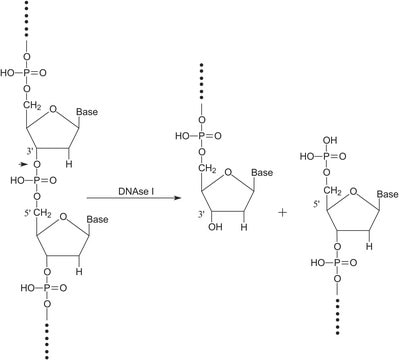
La désoxyribonucléase I ou DNase I est une endonucléase isolée dans le pancréas des bovins.
- Notre DNase I digère l'ADN double brin et l'ADN simple brin en oligonucléotides et en mononucléotides.
- La DNase pancréatique bovine se présente sous quatre formes différentes : les isoenzymes A, B, C et D. Leurs points isoélectriques sont les suivants : 5,22, 4,96, 5,06 et 4,78.3. L'isoenzyme A est la forme prédominante, les isoenzymes B et C étant présentes en plus faibles quantités et la forme D en quantités minimes.
- La structure de la DNase I ressemble à celle de l'exonucléase III. Elle comprend deux feuillets β centraux. Chaque feuillet β est composé de six brins β. Ce complexe de feuillets β est entouré de régions de boucles et de régions α-hélicoïdales importantes. Cette enzyme présente des similitudes structurales avec l'exonucléase III.[1]
Application
- Diminue la viscosité, pour de meilleurs rendements, en éliminant l'ADN lors de l'isolement de cellules primaires
- Incorporation de bases marquées dans l'ADN : coupure simple brin
- Marquage radioactif
- Bioprocédés : élimination de l'ADN
- Élimination de l'ADN génomique des préparations d'ARN avant RT-PCR
- Transcription in vitro
- Translation de coupure
- Footprinting à la DNase
- Régulation de la polymérisation de l'actine dans les cellules et régulation de l'actine dans l'apoptose cellulaire
- Fixation des protéines sur les acides nucléiques par réticulation UV
- La DNase joue un rôle dans la régulation de la polymérisation de l'actine dans les cellules et est impliquée dans le processus d'apoptose[1]
Produit utilisé pour éliminer l'ADN présent dans les échantillons de protéines.
Biochem/physiol Actions
La DNase I est une endonucléase qui agit sur les liaisons phosphodiester adjacentes à des pyrimidines et qui produit des polynucléotides ayant des groupements 5′-phosphate terminaux. En présence de Mg2+, la DNase I clive indépendamment chaque brin d'ADN et les sites de clivage sont aléatoires. Les deux brins d'ADN sont clivés approximativement au niveau du même site en présence de Mn2+. Les cations divalents tels que Mn2+, Ca2+, Co2+ et Zn2+ sont des activateurs de cette enzyme. Une concentration en Ca2+ de 5 mM la stabilise vis-à-vis de la digestion protéolytique. Il a été montré que le pH optimal se situe entre 7 et 8. La DNase I de pancréas de bovin est constituée de quatre éléments, A, B, C et D, qui peuvent être distingués par chromatographie. Le rapport molaire des éléments A, B et C est de respectivement 4:1:1. L'élément D est présent en très faible quantité. Le 2-mercaptoéthanol, les chélateurs, le dodécylsulfate de sodium (SDS) et l'actine sont connus pour inhiber l'activité de cette enzyme.
Features and Benefits
Notre désoxyribonucléase DNAse I est essentiellement dépourvue de RNAse, ce qui facilite la mise en œuvre du produit.
Physical form
Préparation brute, contient du chlorure de calcium
Preparation Note
Une solution de DNase I à 10 mg/ml dans du NaCl 0,15 M peut perdre < 10 % de son activité lorsqu'elle est conservée une semaine en aliquotes à −20 °C. La perte d'activité peut être d'environ 20 % si la même solution est conservée en aliquotes entre 2 et 8 °C. Elle reste active pendant 5 heures maximum à 60 °C entre pH 5 et pH 7 et devient inactive après moins de 10 minutes à 68 °C. Sa perte d'activité est de 6 % par heure dans un tampon acétate (pH 5,0) ou un tampon Tris (pH 7,2) à une concentration de 1 mg/ml.
Analysis Note
Protéine déterminée par la réaction du biuret.
Other Notes
Une unité Kunitz provoque une variation de A260 de 0,001 par minute et par ml à pH 5,0 et 25 °C, en utilisant comme substrat de l'ADN de type I ou III.
1 of 1
Cet article | |||
|---|---|---|---|
| description lyophilized powder, Protein ≥85 %, ≥400 Kunitz units/mg protein | description Type IV, lyophilized powder, ≥2,000 Kunitz units/mg protein | description Type II, lyophilized powder, Protein ≥80 %, ≥2,000 units/mg protein | description Type II-S, lyophilized powder, Protein ≥80 %, ≥2,000 units/mg protein |
| specific activity ≥400 Kunitz units/mg protein | specific activity ≥2,000 Kunitz units/mg protein | specific activity ≥2,000 units/mg protein | specific activity ≥2,000 units/mg protein |
| biological source bovine pancreas | biological source bovine pancreas | biological source bovine pancreas | biological source bovine pancreas |
| technique(s) DNA extraction: suitable | technique(s) DNA purification: suitable | technique(s) DNA extraction: suitable | technique(s) DNA purification: suitable |
| suitability suitable for molecular biology | suitability suitable for molecular biology | suitability suitable for molecular biology | suitability suitable for molecular biology |
| application(s) diagnostic assay manufacturing | application(s) diagnostic assay manufacturing | application(s) diagnostic assay manufacturing | application(s) diagnostic assay manufacturing |
| form lyophilized powder | form lyophilized powder | form lyophilized powder | form lyophilized powder |
Still not finding the right product?
Explore all of our products under Désoxyribonucléase I from bovine pancreas
Mot-clé
Danger
Codes de danger
Mentions de précaution
Hazard Classifications
Resp. Sens. 1
Classe de stockage
11 - Combustible Solids
Point d'éclair (°F)
Not applicable
Point d'éclair (°C)
Not applicable
EPI (équipement de protection individuelle)
Eyeshields, Gloves, type N95 (US)
Faites votre choix parmi les versions les plus récentes :
Déjà en possession de ce produit ?
Retrouvez la documentation relative aux produits que vous avez récemment achetés dans la Bibliothèque de documents.
-
What is the salt tolerance of this DNase I?
1 answer-
Helpful?
-
-
I would like to know if this product can be used to eliminate DNA from cells in tissue culture (12 wells chamber slide) before immunofluorescent staining? if it can be used - how?
1 answer-
This product can be used to eliminate DNA from cells in tissue culture. Concentration and incubation time should be optimized based on the specific application.
Helpful?
-
-
HOW CAN I PRESERVE DN25 DILUTED and filtered in culture medium? 4C or -20 C?. It will lose activity?
1 answer-
This product is soluble in 0.15 M NaCl at 5 mg/mL. Solutions prepared at 10 mg/mL in 0.15 M NaCl may lose up to 10% activity when stored for 1 week in aliquots at –20 °C. The same solutions stored in aliquots at 2-8 °C can lose up to 20% activity. Please see the link below to review the product datasheet for additional information:
https://www.sigmaaldrich.com/deepweb/assets/sigmaaldrich/product/documents/233/818/dn25pis-ms.pdfHelpful?
-
-
What is the recommended method for long-term storage of the 1 gram bottle of DN25 in solution?
1 answer-
The user bulletin provides guidance on the storage of DNase I once reconstituted. When stored in aliquots at -20°C, solutions of DNase I at 10 mg/mL in 0.15 M NaCl may lose 10% of activity over a week, while storing the same solutions at 2–8°C can result in a 20% activity loss. Alternatively, maintaining solutions at a minimum concentration of 1 mg protein/mL with 5 mM calcium chloride at -20°C can retain 90% activity for at least a year. Solutions with 0.1 mg protein/mL are less stable and may need gelatin as a stabilizer.
For applications not affected by glycerol, two storage buffer options are available as they do not freeze at -20°C:
• 20 mM sodium acetate (pH 6.5) with 5 mM CaCl2, 0.1 mM phenylmethylsulfonyl fluoride (PMSF), and 50% (v/v) glycerol, containing DNase I at 5 mg/mL.
• 10 mM Tris-HCl (pH 7.5) with 50 mM NaCl, 10 mM MgCl2, 1 mM DTT, and 50% (v/v) glycerol, with DNase I at 2 mg/mL.Helpful?
-
-
Hi I use the DNase during isolation of cells from lung tissue. Do I need to filter the DNase solution before usage?
1 answer-
This is not a sterile product. If sterility is required due to the specific application, solutions may be filter sterilized before use. Please see the link below to review the product datasheet:
https://www.sigmaaldrich.com/deepweb/assets/sigmaaldrich/product/documents/233/818/dn25pis-ms.pdfHelpful?
-
-
I use the DNase when I isolate lung cells from lung. Do I need to filter them before I use? I will culture the isolated lung cells.
1 answer-
Yes, please filter the DNase solution before use in cell culture, preferably with a 0.22 um filter. The powder is not sterilized as provided.
Helpful?
-