Saltar al contenido
Merck

148520

4-Chlorocatechol

97%

Iniciar sesión para ver los precios por organización y contrato.

Seleccione un Tamaño

1 G

US$ 371,00

US$ 371,00

PRECIOS SIN IMPUESTOS NACIONALES

Comprobar disponibilidad del carrito

Solicite una orden a granel

Acerca de este artículo

Fórmula lineal:
ClC6H3(OH)2
Número CAS:
Peso molecular:
144.56
EC Number:
MDL number:
UNSPSC Code:
12352100
PubChem Substance ID:
NACRES:
NA.22

Saltar a

Servicio técnico
¿Necesita ayuda? Nuestro equipo de científicos experimentados está aquí para ayudarle.
Permítanos ayudarle

Quality Level

assay

97%

mp

90-94 °C (lit.)

functional group

chloro

SMILES string

Oc1ccc(Cl)cc1O

InChI

1S/C6H5ClO2/c7-4-1-2-5(8)6(9)3-4/h1-3,8-9H

InChI key

WWOBYPKUYODHDG-UHFFFAOYSA-N

Comparar elementos similares

Ver comparación completa

Mostrar Diferencias

1 of 4

Este artículo
144940135585547093
assay

97%

assay

97%

assay

99%

assay

97%

Quality Level

100

Quality Level

100

Quality Level

100

Quality Level

100

mp

90-94 °C (lit.)

mp

151-154 °C (lit.)

mp

238-241 °C (lit.)

mp

110-115 °C (lit.)

functional group

chloro

functional group

carboxylic acid, chloro

functional group

carboxylic acid, chloro

functional group

chloro

General description

4-chlorocatechol was a major degradation product of 4-chloro-2-aminophenol (4C2AP)[1]. The degradation of 4-chlorocatechol was catalyzed by cphA-I enzyme[2].

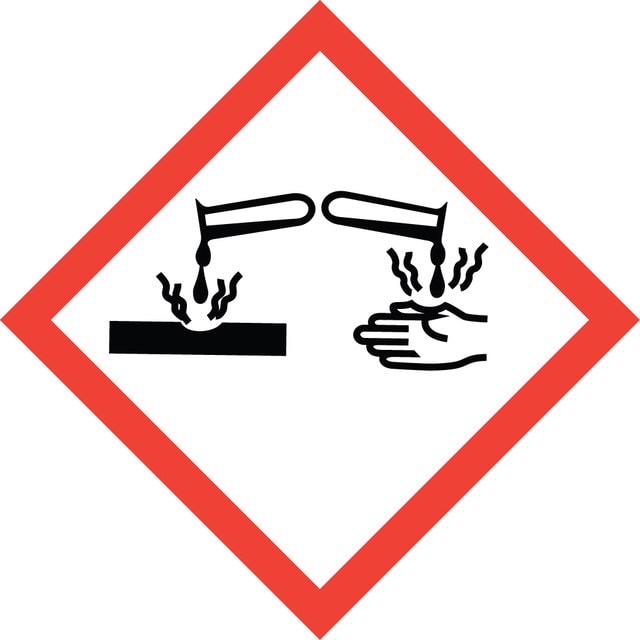
pictograms

Corrosion

signalword

Danger

hcodes

Hazard Classifications

Skin Corr. 1B

Clase de almacenamiento

8A - Combustible corrosive hazardous materials

wgk_germany

WGK 3

flash_point_f

Not applicable

flash_point_c

Not applicable

ppe

Eyeshields, Faceshields, Gloves, type P3 (EN 143) respirator cartridges


Elija entre una de las versiones más recientes:

Certificados de análisis (COA)

Lot/Batch Number

¿No ve la versión correcta?

Si necesita una versión concreta, puede buscar un certificado específico por el número de lote.

¿Ya tiene este producto?

Encuentre la documentación para los productos que ha comprado recientemente en la Biblioteca de documentos.

Visite la Librería de documentos

J K Kim et al.
Chemosphere, 69(5), 689-696 (2007-07-03)
The presence and impact of hydroxyl radicals generated via the catalytic decomposition of H(2)O(2) over heterogeneous copper catalysts were investigated by using two detection methods, an electron spin resonance-spin trapping method and a chemical probe method. Detection of the (5,5-dimethyl-1-pyrroline-N-oxide)-OH
A Farrell et al.
Biodegradation, 10(5), 353-362 (2000-06-28)
A mixed microbial community, specially designed to degrade a wide range of substituted aromatic compounds, was examined for its ability to degrade mono-chlorophenols as sole carbon source in aerobic batch cultures. The mixed culture degraded 2-, 3-, and 4-chlorophenol (1.56
Yingxun Du et al.
Journal of hazardous materials, 139(1), 108-115 (2006-07-28)
The role of oxygen in the degradation pathway of 4-CP by Fenton system was investigated in this paper. The degradation of 4-CP, changes of Fenton reagent's concentration and formation of the intermediates in Fenton/O2 system were respectively compared with those
M Klemba et al.
Applied and environmental microbiology, 66(8), 3255-3261 (2000-08-05)
The tcbR-tcbCDEF gene cluster, coding for the chlorocatechol ortho-cleavage pathway in Pseudomonas sp. strain P51, has been cloned into a Tn5-based minitransposon. The minitransposon carrying the tcb gene cluster and a kanamycin resistance gene was transferred to Pseudomonas putida KT2442
A Farrell et al.
Journal of industrial microbiology & biotechnology, 28(6), 316-324 (2002-05-29)
A bacterium, CP1, identified as Pseudomonas putida strain, was investigated for its ability to grow on and degrade mono-chlorophenols and phenols as sole carbon sources in aerobic shaking batch culture. The organism degraded up to 1.56 mM 2- and 3-chlorophenol

Questions

Reviews

No rating value

Active Filters

Nuestro equipo de científicos tiene experiencia en todas las áreas de investigación: Ciencias de la vida, Ciencia de los materiales, Síntesis química, Cromatografía, Analítica y muchas otras.

Póngase en contacto con el Servicio técnico