
If this product has an expiration or retest date, it will be shown on the Certificate of Analysis (COA, CofA). If there is no retest or expiration date listed on the product's COA, we do not have suitable stability data to determine a shelf life. For these products, the only date on the COA will be the release date; a retest, expiration, or use-by-date will not be displayed.
For all products, we recommend handling per defined conditions as printed in our product literature and website product descriptions. We recommend that products should be routinely inspected by customers to ensure they perform as expected.
For products without retest or expiration dates, our standard warranty of 1 year from the date of shipment is applicable.
For more information, please refer to the Product Dating Information document: https://www.sigmaaldrich.com/deepweb/assets/sigmaaldrich/marketing/global/documents/418/501/product-dating-information-06-25-mk.pdf
Fortfahren mit
S0389

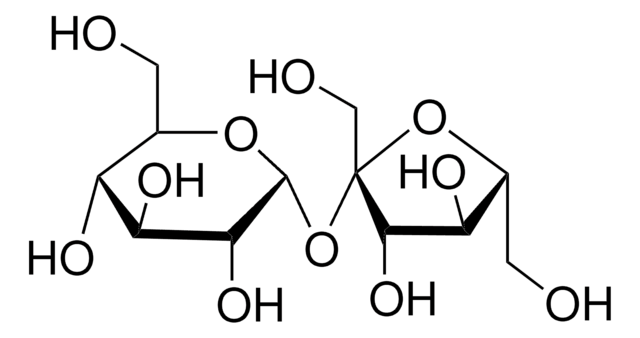
Saccharose
Molecular Biology, ≥99.5% (GC)
Synonym(e):
α-D-Glc-(1→2)-β-D-Fru, α-D-Glucopyranosyl-β-D-fructofuranosid, β-D-Fructofuranosyl-α-D-glucopyranosid, D-Sucrose, Zucker
Größe auswählen
| Größe/SKU | Verfügbarkeit | Preis |
|---|
Über diesen Artikel
biological source
sugar cane
Quality Segment
grade
Molecular Biology
assay
≥99.5% (GC)
form
crystals
technique(s)
HPLC: suitable, cryopreservation: suitable, electron microscopy: suitable, enzyme immunoassay: suitable, gas chromatography (GC): suitable, immunohistochemistry: suitable
impurities
≤0.1% free glucose
color
white
useful pH range
5.5-7 (25 °C, 342 g/L)
mp
185-187 °C (lit.)
solubility
H2O: soluble 50 g + 50 mL
cation traces
heavy metals (as Pb): ≤5 ppm
absorption
≤0.15 at 280 at 50%, ≤0.20 at 260 at 50%
suitability
suitable for molecular biology
application(s)
advanced drug delivery
agriculture
life science and biopharma
metabolomics
sample preservation
foreign activity
DNase, RNase, protease, none detected
storage temp.
room temp
SMILES string
OC[C@H]1O[C@H](O[C@]2(CO)O[C@H](CO)[C@@H](O)[C@@H]2O)[C@H](O)[C@@H](O)[C@@H]1O
InChI
1S/C12H22O11/c13-1-4-6(16)8(18)9(19)11(21-4)23-12(3-15)10(20)7(17)5(2-14)22-12/h4-11,13-20H,1-3H2/t4-,5-,6-,7-,8+,9-,10+,11-,12+/m1/s1
InChI key
CZMRCDWAGMRECN-UGDNZRGBSA-N
General description
Application
- zum Durchführen von Kryoprotektion für Nierengewebe
- als Komponente in festem Saatkeimmedium zum Auskeimen von Pollenkörnern
- im Triphenyl-Tetrazoliumchlorid(TTC)-Test zum Überprüfen der Lebensfähigkeit von Pollenkörnern
- bei der Kryoprotektion von fixiertem Hirngewebe für die Immunhistochemie
Biochem/physiol Actions
Features and Benefits
- Ideal für die Forschung in den Bereichen Molekularbiologie, Zellbiologie und Biochemie
- In Tests bestätigte niedrige Schwermetallkontamination zur Sicherstellung der Eignung für verschiedene Anwendungen
- Getestet auf DNase, RNase und Proteasen
- Saccharose für die Molekularbiologie, gewonnen aus Zuckerrohr
Other Notes
1 of 1
Dieser Artikel | ||
|---|---|---|
| description Molecular Biology, ≥99.5% (GC) | description ≥99.5% (GC), BioReagent, suitable for cell culture, suitable for insect cell culture | description ≥99.5% (GC), Grade II, suitable for plant cell culture |
| biological source sugar cane | biological source sugar cane | biological source sugar cane |
| technique(s) immunohistochemistry: suitable, cryopreservation: suitable, electron microscopy: suitable, HPLC: suitable, enzyme immunoassay: suitable, gas chromatography (GC): suitable | technique(s) cell culture | mammalian: suitable, cell culture | insect: suitable | technique(s) cell culture | plant: suitable |
| assay ≥99.5% (GC) | assay ≥99.5% (GC) | assay ≥99.5% (GC) |
| grade Molecular Biology | grade - | grade - |
| solubility H2O: soluble 50 g + 50 mL | solubility H2O: 500 mg/mL | solubility H2O: 0.5 g/mL, clear, colorless to faintly yellow |
| Quality Level 300 | Quality Level 300 | Quality Level 300 |
Still not finding the right product?
Explore all of our products under Saccharose
Lagerklasse
11 - Combustible Solids
WGK
WGK 1
Flammpunkt (°F)
Not applicable
Flammpunkt (°C)
Not applicable
PSA (Persönliche Schutzausrüstung)
Eyeshields, Gloves, type N95 (US)
Hier finden Sie alle aktuellen Versionen:
Besitzen Sie dieses Produkt bereits?
In der Dokumentenbibliothek finden Sie die Dokumentation zu den Produkten, die Sie kürzlich erworben haben.
-
How can I determine the shelf life / expiration / retest date of this product?
1 answer-
Helpful?
-
-
Can you provide information regarding the particle size or diameter of the crystals for this product (Sucrose, Sigma-Aldrich S0389)?
1 answer-
The particle size or diameter of the crystals is not tested for this product.
Helpful?
-
-
How is shipping temperature determined? And how is it related to the product storage temperature?
1 answer-
Products may be shipped at a different temperature than the recommended long-term storage temperature. If the product quality is sensitive to short-term exposure to conditions other than the recommended long-term storage, it will be shipped on wet or dry-ice. If the product quality is NOT affected by short-term exposure to conditions other than the recommended long-term storage, it will be shipped at ambient temperature. As shipping routes are configured for minimum transit times, shipping at ambient temperature helps control shipping costs for our customers. For more information, please refer to the Storage and Transport Conditions document: https://www.sigmaaldrich.com/deepweb/assets/sigmaaldrich/marketing/global/documents/316/622/storage-transport-conditions-mk.pdf
Helpful?
-