Accéder au contenu
MilliporeSigma

L5777

N-Lauroylsarcosine sodium salt

BioXtra, ≥97% (TLC)

Synonyme(s) :

N-Dodecanoyl-N-methylglycine sodium salt, Sarkosyl NL

Se connecter pour consulter les tarifs organisationnels et contractuels.

Sélectionner une taille de conditionnement

50 G

177,00 $

100 G

240,00 $

500 G

828,00 $

177,00 $


Veuillez contacter notre Service Clients pour connaître la disponibilité de ce produit.

Demander une commande groupée

A propos de cet article

Formule linéaire :
CH3(CH2)10CON(CH3)CH2COONa
Numéro CAS:
Poids moléculaire :
293.38
UNSPSC Code:
12161900
NACRES:
NA.25
PubChem Substance ID:
EC Number:
205-281-5
Beilstein/REAXYS Number:
5322974
MDL number:

Passer à

Service technique
Besoin d'aide ? Notre équipe de scientifiques expérimentés est là pour vous.
Laissez-nous vous aider

Nom du produit

N-Lauroylsarcosine sodium salt, BioXtra, ≥97% (TLC)

InChI key

KSAVQLQVUXSOCR-UHFFFAOYSA-M

InChI

1S/C15H29NO3.Na/c1-3-4-5-6-7-8-9-10-11-12-14(17)16(2)13-15(18)19;/h3-13H2,1-2H3,(H,18,19);/q;+1/p-1

SMILES string

[Na+].CCCCCCCCCCCC(=O)N(C)CC([O-])=O

description

anionic

product line

BioXtra

assay

≥97% (TLC)

form

powder

mol wt

micellar avg mol wt 600
average mol wt 600

aggregation number

2

impurities

≤0.1% Insoluble matter
≤0.1% Phosphorus (P)

CMC

14.6 mM (20-25°C)

solubility

H2O: 0.1 M, clear, colorless to very faintly yellow

density

(1,14 g/cm3 at 20 °C )

cation traces

Al: ≤0.0005%
Ca: ≤0.01%
Cu: ≤0.0005%
Fe: ≤0.005%
K: ≤0.01%
Mg: ≤0.005%
NH4+: ≤0.05%
Pb: ≤0.01%
Zn: ≤0.0005%

Quality Level

Vous recherchez des produits similaires ? Visite Guide de comparaison des produits

Comparer avec des articles similaires

Voir la comparaison complète

Montrer les différences

1 of 4

Cet article
6174561743L9150
form

powder

form

powder

form

powder

form

powder

assay

≥97% (TLC)

assay

≥97.0% (HPLC)

assay

≥99.0% (HPLC)

assay

≥94%

aggregation number

2

aggregation number

2

aggregation number

2

aggregation number

2

impurities

≤0.1% Insoluble matter, ≤0.1% Phosphorus (P)

impurities

≤7% water

impurities

DNases, none detected, RNases, none detected, insoluble matter, passes filter test, phosphatases, none detected, proteases, none detected

impurities

-

solubility

H2O: 0.1 M, clear, colorless to very faintly yellow

solubility

H2O: very soluble 293 g/L at 20 °C

solubility

H2O: 1 M at 20 °C, clear, colorless

solubility

H2O: 100 mg/mL, clear to slightly hazy, colorless to faintly yellow

description

anionic

description

anionic

description

anionic

description

anionic

Application

N-Lauroylsarcosine sodium salt has been used in a study to assess involvement of histamine released from epidermal keratinocytes. [1] It has also been used in a study to develop a simple method for extracting DNA from Cryptosporidium oocysts. [2]

General description

N-Lauroylsarcosine sodium salt is an anionic surfactant.

Other Notes

Anionic surfactant.

pictograms

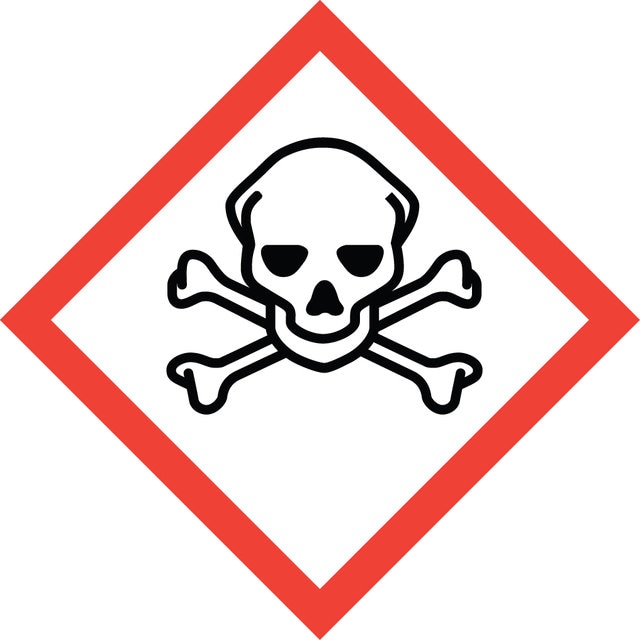
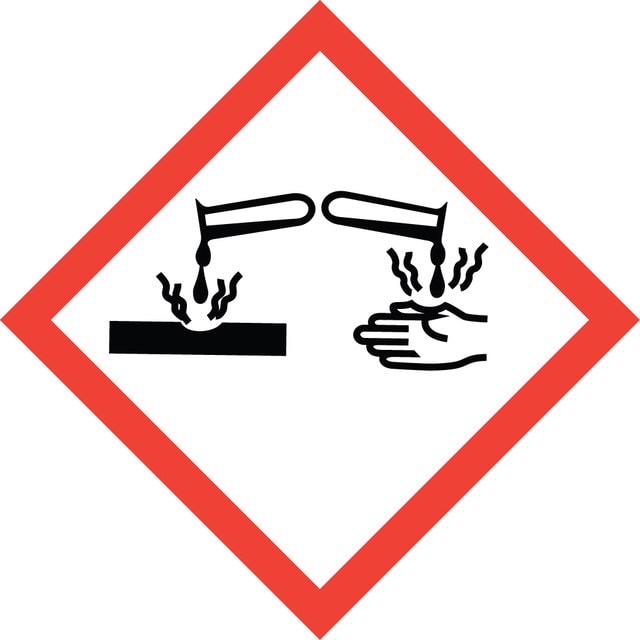
Skull and crossbonesCorrosion

signalword

Danger

Hazard Classifications

Acute Tox. 2 Inhalation - Eye Dam. 1 - Skin Irrit. 2

Classe de stockage

6.1A - Combustible acute toxic Cat. 1 and 2 / very toxic hazardous materials

wgk

WGK 1

flash_point_f

512.6 °F - closed cup

flash_point_c

267 °C - closed cup

ppe

Eyeshields, Gloves, type N95 (US)


Faites votre choix parmi les versions les plus récentes :

Certificats d'analyse (COA)

Lot/Batch Number

Vous ne trouvez pas la bonne version ?

Si vous avez besoin d'une version particulière, vous pouvez rechercher un certificat spécifique par le numéro de lot.

Déjà en possession de ce produit ?

Retrouvez la documentation relative aux produits que vous avez récemment achetés dans la Bibliothèque de documents.

Consulter la Bibliothèque de documents

Takahiro Sekikawa et al.
New biotechnology, 29(1), 139-143 (2011-09-20)
Detection of low amounts of Cryptosporidium oocysts in raw water sources is considered an important component in the management, prevention and control of Cryptosporidium in drinking water supplies as Cryptosporidium causes massive waterborne outbreaks worldwide. As Cryptosporidium has a robust
Yoshihiro Inami et al.
Yakugaku zasshi : Journal of the Pharmaceutical Society of Japan, 132(11), 1225-1230 (2012-11-06)
The primary function of surfactants is to remove dirt, exfoliated corneum cells, and microorganisms from the skin. However, the use of toiletries such as soaps and shampoos containing surfactants may cause adverse effects such as cutaneous irritation, dryness, and itching.
Sang Su Kwak et al.
Nature communications, 11(1), 1377-1377 (2020-03-15)
The relationship between amyloid-β (Aβ) species and tau pathology in Alzheimer's disease (AD) is not fully understood. Here, we provide direct evidence that Aβ42/40 ratio, not total Aβ level, plays a critical role in inducing neurofibrillary tangles (NTFs) in human
Gültekin Tamgüney et al.
Proceedings of the National Academy of Sciences of the United States of America, 106(35), 15002-15006 (2009-08-27)
Prions are infectious proteins that cause fatal neurodegenerative diseases. Because astrocytic gliosis marked by the deposition of fibrils composed of GFAP is a prominent feature of prion disease, we asked whether GFAP might be used as a surrogate marker for
Linda A Terry et al.
Veterinary research, 42, 65-65 (2011-05-20)
Classical scrapie is a naturally transmitted prion disease of sheep and goats. Contaminated environments may contribute to the spread of disease and evidence from animal models has implicated urine, blood, saliva, placenta and faeces as possible sources of the infection.

Questions

Reviews

No rating value

Active Filters

Notre équipe de scientifiques dispose d'une expérience dans tous les secteurs de la recherche, notamment en sciences de la vie, science des matériaux, synthèse chimique, chromatographie, analyse et dans de nombreux autres domaines..

Contacter notre Service technique