


If this product has an expiration or retest date, it will be shown on the Certificate of Analysis (COA, CofA). If there is no retest or expiration date listed on the product's COA, we do not have suitable stability data to determine a shelf life. For these products, the only date on the COA will be the release date; a retest, expiration, or use-by-date will not be displayed.
For all products, we recommend handling per defined conditions as printed in our product literature and website product descriptions. We recommend that products should be routinely inspected by customers to ensure they perform as expected.
For products without retest or expiration dates, our standard warranty of 1 year from the date of shipment is applicable.
For more information, please refer to the Product Dating Information document: https://www.sigmaaldrich.com/deepweb/assets/sigmaaldrich/marketing/global/documents/418/501/product-dating-information-06-25-mk.pdf
1.00029

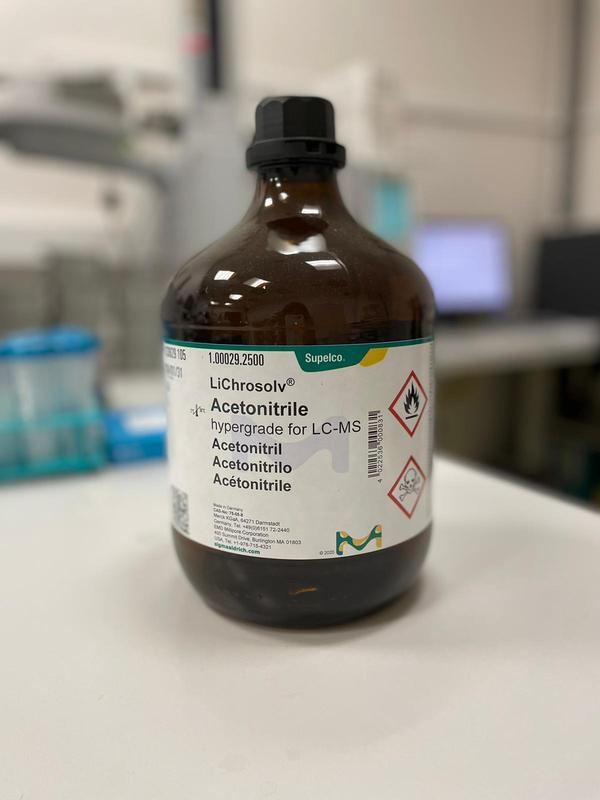
Acetonitrile
≥99.9% (GC), suitable for LC/MS, LiChrosolv®
Synonym(s):
ACN, Cyanomethane, Ethyl nitrile, Methyl cyanide
Select a Size
About This Item
LC/MS: suitable
97 hPa ( 20 °C)
Skip To
Product Name
Acetonitrile, hypergrade for LC-MS LiChrosolv®
Agency
suitable for ASTM® 7968
suitable for ASTM® 7979
suitable for DIN 38407-42
suitable for EPA 1633
suitable for EPA 8327
suitable for GB 31604.35-2016
suitable for GB 5009.253-2016
suitable for ISO 21675 2019
Quality Level
reg. compliance
suitable for FDA C-010.02
vapor density
1.41 (vs air)
vapor pressure
72.8 mmHg ( 20 °C)
97 hPa ( 20 °C)
product line
LiChrosolv®
Assay
≥99.9% (GC)
form
liquid
autoignition temp.
524 °C
973 °F
expl. lim.
16 %
technique(s)
HPLC: suitable
LC/MS: suitable
impurities
≤0.0001 meq/g Acidity
≤0.0002 meq/g Alkalinity
≤0.01% Water
≤10 ppb Al (Aluminium)
≤10 ppb Ca (Calcium)
≤10 ppb Fe (Iron)
≤10 ppb Mg (Magnesium)
≤5 ppb Any further metal (ICP-MS)
≤5 ppb K (Potassium)
≤50 ppb Na (Sodium)
evapn. residue
≤1.0 mg/L
color
APHA: ≤10
transmittance
191 nm, ≥25%
195 nm, ≥85%
200 nm, ≥96%
215 nm, ≥98%
230 nm, ≥99%
refractive index
n20/D 1.344 (lit.)
bp
81-82 °C (lit.)
SMILES string
CC#N
mp
−45 °C (lit.)
transition temp
flash point 2 °C
density
0.786 g/mL at 25 °C (lit.)
application(s)
PFAS testing
format
neat
storage temp.
2-30°C
InChI
1S/C2H3N/c1-2-3/h1H3
InChI key
WEVYAHXRMPXWCK-UHFFFAOYSA-N
Looking for similar products? Visit Product Comparison Guide
1 of 4
This Item | 1.00030 | 1.14291 | 1.03725 |
|---|---|---|---|
| Quality Level 100 | Quality Level 200 | Quality Level 100 | Quality Level 200 |
| assay ≥99.9% (GC) | assay ≥99.9% (GC) | assay ≥99.8% (GC) | assay ≥99.9% (GC) |
| technique(s) LC/MS: suitable | technique(s) HPLC: suitable | technique(s) HPLC: suitable | technique(s) UHPLC: suitable |
| form liquid | form liquid | form liquid | form liquid |
| density 0.786 g/mL at 25 °C (lit.) | density 0.786 g/mL at 25 °C (lit.) | density 0.786 g/mL at 25 °C (lit.) | density 0.786 g/mL at 25 °C (lit.) |
| vapor density 1.41 (vs air) | vapor density 1.41 (vs air) | vapor density 1.41 (vs air) | vapor density 1.41 (vs air) |
General description
Application
Preparation Note
Other Notes
Legal Information
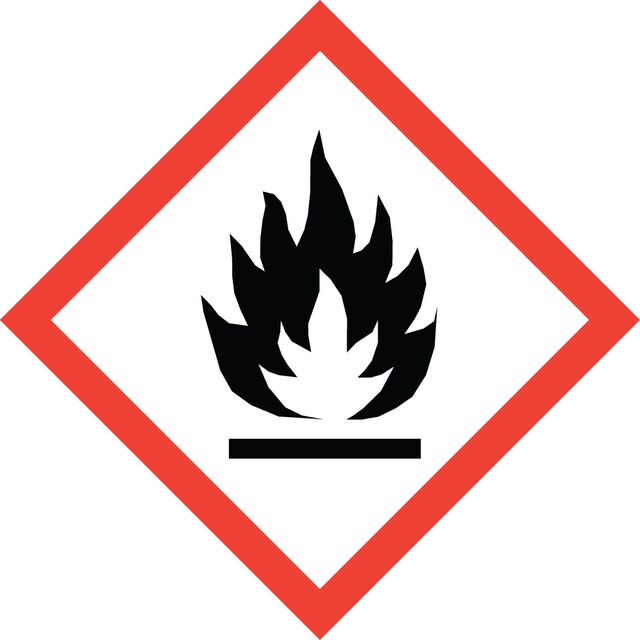
Signal Word
Danger
Hazard Statements
Precautionary Statements
Hazard Classifications
Acute Tox. 4 Dermal - Acute Tox. 4 Inhalation - Acute Tox. 4 Oral - Eye Irrit. 2 - Flam. Liq. 2
Storage Class Code
3 - Flammable liquids
WGK
WGK 2
Flash Point(F)
35.6 °F - closed cup
Flash Point(C)
2.0 °C - closed cup
Certificates of Analysis (COA)
Search for Certificates of Analysis (COA) by entering the products Lot/Batch Number. Lot and Batch Numbers can be found on a product’s label following the words ‘Lot’ or ‘Batch’.
Already Own This Product?
Find documentation for the products that you have recently purchased in the Document Library.
Articles
The article describes the use of difluoroacetic acid (DFA) as an effective alternative to acid modifiers, formic acid (FA) and trifluoroacetic acid (TFA) in the LC-UV/MS analysis of proteins.
For use as a marker in SDS-PAGE; Albumin from chicken egg white, For use as a marker in SDS-PAGE; L-Lactic Dehydrogenase from rabbit muscle, Type XI, lyophilized powder, 600-1,200 units/mg protein
In this article we provide a complete workflow of quantification and identification of acylcarnitines in dried blood spots (DBS) using stable isotope-labeled (SIL) acylcarnitines CRMs by FIA-MS/MS.
Pistachios 45% fat complicates pesticide analysis. But Z-Sep+ sorbent cleanup after QuEChERS extraction can reduce background for reliable results.
Protocols
Test your food for fipronil contamination using our analytical standards, certified reference materials, solvents, and columns for analysis.
An optimized LC-MS/MS based workflow for low artifact tryptic digestion and peptide mapping of monoclonal antibody, adalimumab (Humira) using filter assisted sample preparation (FASP).
A step-by-step protocol for released N-linked glycan analysis of the monoclonal antibody adalimumab, based on UHPLC-FLR-MS and procainamide labeling.
Separation of various acids and compounds by molecular weight: PAA, PEI, PIDADMACl, PAS, cationic dextran, chitosan
-
How can I determine the shelf life / expiration / retest date of this product?
1 answer-
Helpful?
-
-
How is shipping temperature determined? And how is it related to the product storage temperature?
1 answer-
Products may be shipped at a different temperature than the recommended long-term storage temperature. If the product quality is sensitive to short-term exposure to conditions other than the recommended long-term storage, it will be shipped on wet or dry-ice. If the product quality is NOT affected by short-term exposure to conditions other than the recommended long-term storage, it will be shipped at ambient temperature. As shipping routes are configured for minimum transit times, shipping at ambient temperature helps control shipping costs for our customers. For more information, please refer to the Storage and Transport Conditions document: https://www.sigmaaldrich.com/deepweb/assets/sigmaaldrich/marketing/global/documents/316/622/storage-transport-conditions-mk.pdf
Helpful?
-
Active Filters
-
Perfect ANC
At spark-lab we have been using ACN for LC-MS / MS for years. It meets our quality requirements in 100%.
Helpful?

Our team of scientists has experience in all areas of research including Life Science, Material Science, Chemical Synthesis, Chromatography, Analytical and many others.
Contact Technical Service