646547

Tris(2-carboxyethyl)phosphine hydrochloride solution
0.5 M, pH 7.0(aqueous solution; pH was adjusted with ammonium hydroxide)
Synonyma:
TCEP
Přihlásit pro zobrazení organizačních a smluvních cen.
Vybrat velikost
Změnit zobrazení
O této položce
Empirický vzorec (Hillův zápis):
C9H15O6P · HCl
Číslo CAS:
Molekulová hmotnost:
286.65
NACRES:
NA.25
PubChem Substance ID:
UNSPSC Code:
12352128
MDL number:
Technický servis
Potřebujete pomoc? Náš tým zkušených odborníků je vám k dispozici.
Dovolte nám, abychom vám pomohliQuality Segment
concentration
0.5 M
refractive index
n
pH
7.0(aqueous solution; pH was adjusted with ammonium hydroxide)
density
1.041 g/mL at 25 °C
SMILES string
Cl.OC(=O)CCP(CCC(O)=O)CCC(O)=O
InChI
1S/C9H15O6P.ClH/c10-7(11)1-4-16(5-2-8(12)13)6-3-9(14)15;/h1-6H2,(H,10,11)(H,12,13)(H,14,15);1H
InChI key
PBVAJRFEEOIAGW-UHFFFAOYSA-N
General description
Tris (2-carboxyethyl) phosphine (TCEP) is very effective in cleaving disulfide bonds in aqueous solution. It dissolves in water and is odorless, unlike other trialkylphosphines (tributylphosphine). It is also less toxic than 2-mercaptoethanol. These advantages make it better than the other reducing agents.
It belongs to the trialkylphosphine class.
Application
Tris (2-carboxyethyl) phosphine (TCEP) can be used in several downstream applications including SDS-PAGE, mass spectrometry, labeling with cysteine specific tags, and modification of cysteine containing compounds. It prevents oxidation of protein samples, which makes it a useful buffer component as it helps to preserve enzymatic activity. It has been used in the reduction and measurement of glutathione.
Biochem/physiol Actions
As a non-mercaptan reducing agent, it avoids the toxicity inherent in thiol-containing compounds. It is capable of disrupting the botulinum neurotoxin B heavy-chain/light-chain complex that is held together by a single disulfide bond, and that is responsible for endocytosis, and ultimately the toxicity, of the toxin. Since disulfide-coupled subunits are characteristic of many toxins (e.g., ricin, snake venom, and all BoNT serotypes), it may be useful as a rescue prophylactic in cases of toxin administration.
Tris(2-carboxyethyl)phosphine hydrochloride solution reduces the disulfide bonds and leaves other functional groups intact in proteins.
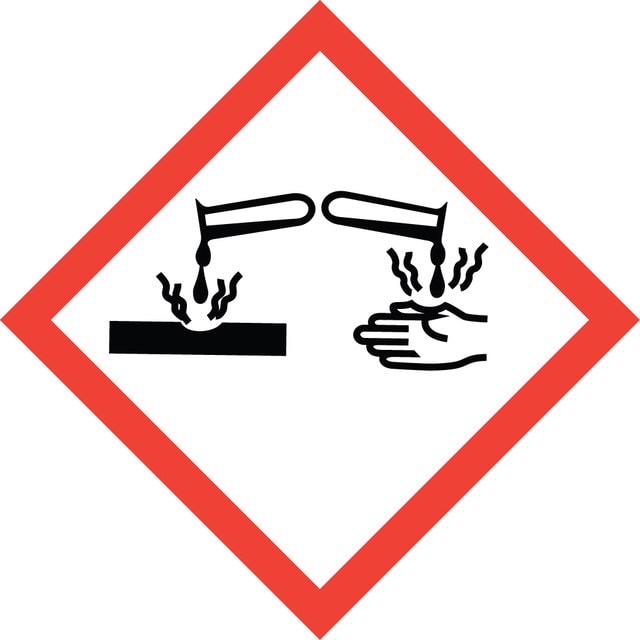
Výstražné slovo
Danger
Kódy nebezpečí
Hazard Classifications
Eye Dam. 1 - Skin Corr. 1B
Skladovací třída
8A - Combustible corrosive hazardous materials
PPE (osobní ochranné prostředky)
Faceshields, Gloves, Goggles, type ABEK (EN14387) respirator filter
Vyberte jednu z posledních verzí:
Již tento produkt vlastníte?
Dokumenty související s produkty, které jste v minulosti zakoupili, byly za účelem usnadnění shromážděny ve vaší Knihovně dokumentů.