Skip to Content
Merck

442305

Bis(ethylenediamine)copper(II) hydroxide solution

1.0 M in H2O

Synonym(s):

Copper(II)-ethylenediame complex

Sign In to View Organizational & Contract Pricing

Select a Size

1 L

CZK 2,340.00

CZK 2,340.00


Please contact Customer Service for Availability

Request a Bulk Order

About This Item

Linear Formula:
Cu(H2NCH2CH2NH2)2(OH)2
CAS Number:
Molecular Weight:
217.76
MDL number:
UNSPSC Code:
12352303
PubChem Substance ID:
NACRES:
NA.23

Skip To

Technical Service
Need help? Our team of experienced scientists is here for you.
Let Us Assist

form

liquid

Quality Level

reaction suitability

reagent type: catalyst
core: copper

concentration

1.0 M in H2O

density

1.086 g/mL at 25 °C

SMILES string

O[Cu]O.NCCN.NCCN

InChI

1S/2C2H8N2.Cu.2H2O/c2*3-1-2-4;;;/h2*1-4H2;;2*1H2/q;;+2;;/p-2

InChI key

WATCRQGYOIZIHC-UHFFFAOYSA-L

Looking for similar products? Visit Product Comparison Guide

Compare Similar Items

View Full Comparison

Show Differences

1 of 4

This Item
C7631209198289787
Quality Level

200

Quality Level

100

Quality Level

200

Quality Level

100

density

1.086 g/mL at 25 °C

density

-

density

-

density

-

form

liquid

form

powder or crystals

form

crystals

form

powder

reaction suitability

reagent type: catalyst
core: copper

reaction suitability

-

reaction suitability

-

reaction suitability

-

concentration

1.0 M in H2O

concentration

-

concentration

-

concentration

≥57.0% Cu (EDTA titration)

General description

Bis(ethylenediamine)copper(II) hydroxide solution is a stable complex formed by copper (Cu) ions with ethylenediamine. It is a transition metal solution that can be used as a catalyst for electrochemical reduction process.[1][2]

Application

Bis(ethylenediamine)copper(II) hydroxide has been used to evaluate cation exchange capacity (CEC) of clays by copper absorption.[3]
Copper(II) ethylenediamine complex may be used to evaluate the cation exchange capacity (CEC) of clay materials.[1] It may also be used to modify polyoxoniobate, which is a class of polyoxometalates (POMs) that finds potential application in photocatalytic H2 production.[4]

Pictograms

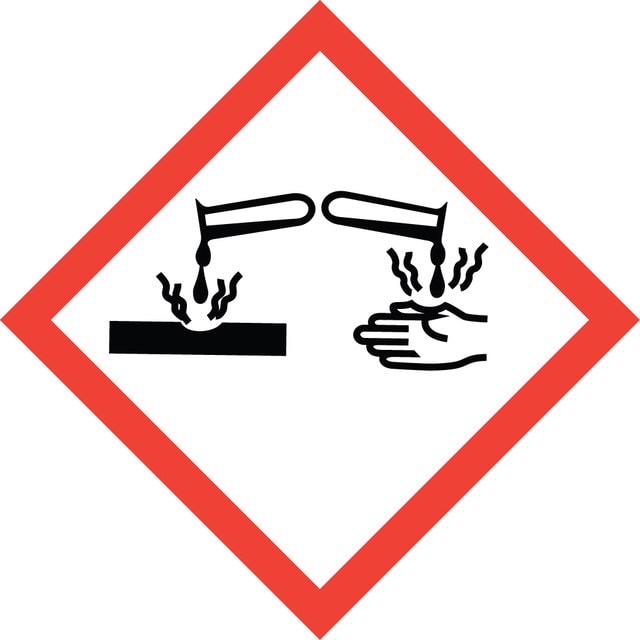
Corrosion

Signal Word

Danger

Hazard Statements

Hazard Classifications

Eye Dam. 1 - Skin Corr. 1B

Storage Class Code

6.1B - Non-combustible acute toxic Cat. 1 and 2 / very toxic hazardous materials

WGK

WGK 3

Flash Point(F)

Not applicable

Flash Point(C)

Not applicable

Personal Protective Equipment

dust mask type N95 (US), Eyeshields, Gloves

Choose from one of the most recent versions:

Certificates of Analysis (COA)

Lot/Batch Number

Don't see the Right Version?

If you require a particular version, you can look up a specific certificate by the Lot or Batch number.

Already Own This Product?

Find documentation for the products that you have recently purchased in the Document Library.

Visit the Document Library

CEC of clays: measurement by adsorption of a copper ethylenediamine complex
Bergaya F and Vayer M
Applied Clay Science, 12(3), 275-280 (1997)
Determination of the cation exchange capacity (CEC) of clay minerals using the complexes of copper (II) ion with triethylenetetramine and tetraethylenepentamine.
Lorenz P, et al.
Clays and Clay Minerals, 47, 386-388 (1999)
Far-infrared and electronic spectra of some bis (ethylenediamine) and related complexes of copper (II) and the relevance of these data to tetragonal distortion and bond strengths.
Lever ABP and Mantovani E
Inorganic Chemistry, 10(4), 817-826 (1971)
A copper (ii)-ethylenediamine modified polyoxoniobate with photocatalytic H2 evolution activity under visible light irradiation.
Wang Z, et al.
Dalton Transactions, 41(33), 9882-9884 (2012)

Questions

Reviews

No rating value

Active Filters

Our team of scientists has experience in all areas of research including Life Science, Material Science, Chemical Synthesis, Chromatography, Analytical and many others.

Contact Technical Service