Skip to Content
Merck

32319

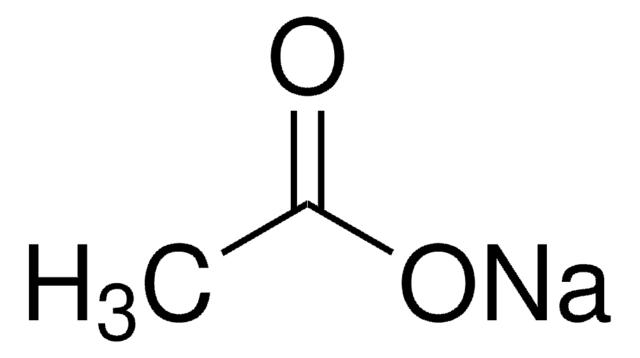
Sodium acetate

puriss. p.a., ACS reagent, reag. Ph. Eur., anhydrous

Synonym(s):

Acetic acid sodium salt

Sign In to View Organizational & Contract Pricing.

Select a Size

500 G

CZK 2,500.00

1 KG

CZK 4,780.00

CZK 2,500.00


Please contact Customer Service for Availability

Request a Bulk Order

About This Item

Linear Formula:
CH3COONa
CAS Number:
Molecular Weight:
82.03
UNSPSC Code:
12352302
NACRES:
NA.21
PubChem Substance ID:
EC Number:
204-823-8
Beilstein/REAXYS Number:
3595639
MDL number:

Skip To

Technical Service
Need help? Our team of experienced scientists is here for you.
Let Us Assist

Product Name

Sodium acetate, puriss. p.a., ACS reagent, reag. Ph. Eur., anhydrous

InChI key

VMHLLURERBWHNL-UHFFFAOYSA-M

InChI

1S/C2H4O2.Na/c1-2(3)4;/h1H3,(H,3,4);/q;+1/p-1

SMILES string

[Na+].CC([O-])=O

grade

ACS reagent
puriss. p.a.

agency

reag. Ph. Eur.

assay

≥99.0% (perchloric acid titration)

form

solid

autoignition temp.

1112 °F

impurities

≤0.01% in water soluble matter

loss

≤1% loss on drying, 120 °C

pH

7.5-9.2 (20 °C, 5%)

pKa 

4.76 (acetic acid)

mp

>300 °C (dec.) (lit.)

anion traces

chloride (Cl-): ≤0.002%
phosphate (PO43-): ≤0.001%
sulfate (SO42-): ≤0.003%

cation traces

Al: ≤10 mg/kg
Ca: ≤0.005%
Cd: ≤5 mg/kg
Cu: ≤5 mg/kg
Fe: ≤0.001%
K: ≤200 mg/kg
Mg: ≤0.002%
Pb: ≤5 mg/kg
Zn: ≤5 mg/kg
heavy metals: ≤0.001% (by ICP-OES)

suitability

in accordance for appearance of solution

Quality Level

Looking for similar products? Visit Product Comparison Guide

Related Categories

Compare Similar Items

View Full Comparison

Show Differences

1 of 4

This Item
1.06281W302475S5636
assay

≥99.0% (perchloric acid titration)

assay

-

assay

≥99%

assay

≥99%

grade

ACS reagent, puriss. p.a.

grade

-

grade

FG, Fragrance grade, Halal, Kosher, anhydrous, natural (US)

grade

-

Quality Level

200

Quality Level

500

Quality Level

300

Quality Level

200

form

solid

form

solid

form

solid

form

powder, solid

pH

7.5-9.2 (20 °C, 5%)

pH

7.5-9.2 (20 °C, 30 g/L in H2O)

pH

-

pH

8.9 (25 °C, 100 mg/mL in water, 0.1 M agueous sodium acetate solution)

impurities

≤0.01% in water soluble matter

impurities

-

impurities

-

impurities

≤0.001% hevay metals (as lead), ≤0.01% insoluble matter

Application

Sodium acetate can be used as a catalyst to synthesize:
  • 1,2-Dihydropyridines by reacting 3-formylchromones, N-nucleophiles, and active methylene molecules[1].
  • 2(3H)-Furanone derivatives by using cinnamaldehyde and 5-aryl-2(3H) furanone[2].

Storage Class

11 - Combustible Solids

wgk

WGK 1

flash_point_f

Not applicable

flash_point_c

Not applicable


Choose from one of the most recent versions:

Certificates of Analysis (COA)

Lot/Batch Number

Don't see the Right Version?

If you require a particular version, you can look up a specific certificate by the Lot or Batch number.

Already Own This Product?

Find documentation for the products that you have recently purchased in the Document Library.

Visit the Document Library

Synthesis, Characterization and Photophysical Properties of New 2 (3H) Furanone Derivatives
Soliman M, et al.
Journal of Molecular Structure, 134543-134543 (2022)
A Facile Route to Synthesize 1, 2-Dihydropyridine and 1, 6 Pyrimidinone Analogues from 4-Oxo-4H-Chromene-3-Carbaldehyde
Bari A
Journal of Heterocyclic Chemistry, 53, 461-466 (2016)
Mari Endo et al.
Journal of gastroenterology, 49(6), 1026-1039 (2013-07-13)
Daikenchuto (DKT), a gastrointestinal prokinetic Japanese herbal medicine, is prescribed for patients with postoperative ileus (POI) and adhesive bowel obstruction following abdominal surgery. Several mechanisms for the amelioration of POI by DKT have been suggested; however, it has remained unclear
Claire E Mason et al.
Journal of the American Society for Mass Spectrometry, 24(2), 274-285 (2013-01-04)
Single-stranded DNA-binding proteins (SSBs) are ubiquitous oligomeric proteins that bind with very high affinity to single-stranded DNA and have a variety of essential roles in DNA metabolism. Nanoelectrospray ionization mass spectrometry (nanoESI-MS) was used to monitor subunit exchange in full-length
Andrew D Shaw et al.
Annals of surgery, 255(5), 821-829 (2012-04-04)
To assess the association of 0.9% saline use versus a calcium-free physiologically balanced crystalloid solution with major morbidity and clinical resource use after abdominal surgery. 0.9% saline, which results in a hyperchloremic acidosis after infusion, is frequently used to replace

Questions

Reviews

No rating value

Active Filters

Our team of scientists has experience in all areas of research including Life Science, Material Science, Chemical Synthesis, Chromatography, Analytical and many others.

Contact Technical Service