


If this product has an expiration or retest date, it will be shown on the Certificate of Analysis (COA, CofA). If there is no retest or expiration date listed on the product's COA, we do not have suitable stability data to determine a shelf life. For these products, the only date on the COA will be the release date; a retest, expiration, or use-by-date will not be displayed.
For all products, we recommend handling per defined conditions as printed in our product literature and website product descriptions. We recommend that products should be routinely inspected by customers to ensure they perform as expected.
For products without retest or expiration dates, our standard warranty of 1 year from the date of shipment is applicable.
For more information, please refer to the Product Dating Information document: https://www.sigmaaldrich.com/deepweb/assets/sigmaaldrich/marketing/global/documents/418/501/product-dating-information-06-25-mk.pdf
T6508

Trifluoroacetic acid
ReagentPlus®, 99%
Synonym(s):
TFA
Select a Size
CZK 883.00
CZK 1,380.00
CZK 1,640.00
CZK 3,150.00
CZK 3,210.00
CZK 11,700.00
CZK 13,300.00
CZK 18,200.00
CZK 22,300.00
CZK 27,400.00
About This Item
Skip To
Product Name
Trifluoroacetic acid, ReagentPlus®, 99%
InChI
1S/C2HF3O2/c3-2(4,5)1(6)7/h(H,6,7)
SMILES string
OC(C(F)(F)F)=O
InChI key
DTQVDTLACAAQTR-UHFFFAOYSA-N
vapor density
3.9 (vs air)
vapor pressure
97.5 mmHg ( 20 °C)
product line
ReagentPlus®
assay
99%
form
liquid
Quality Level
concentration
99%
impurities
≤0.05% water
refractive index
n20/D 1.3 (lit.)
pH
1 (10 g/L)
bp
72.4 °C (lit.)
mp
−15.4 °C (lit.)
solubility
ethanol: soluble 0.33 mL/mL
density
1.489 g/mL at 20 °C (lit.)
Looking for similar products? Visit Product Comparison Guide
Related Categories
1 of 4
This Item | 91707 | 74564 | 900518 |
|---|---|---|---|
| assay 99% | assay ≥99.0% (GC) | assay ≥99.0% (GC) | assay ≥99.0% |
| Quality Level 200 | Quality Level 200 | Quality Level 100 | Quality Level 100 |
| form liquid | form liquid | form - | form liquid |
| solubility ethanol: soluble 0.33 mL/mL | solubility water: soluble | solubility H2O: soluble | solubility - |
| pH 1 (10 g/L) | pH 1 (20 °C, 1 g/L) | pH - | pH - |
| density 1.489 g/mL at 20 °C (lit.) | density 1.489 g/mL at 20 °C (lit.) | density 1.489 g/mL at 20 °C (lit.) | density 1.489 g/mL at 20 °C (lit.) |
Application
- For the cleavage of nitrogen and oxygen protecting groups such as N-Boc, N-benzyloxymethyl, benzyl ether, p-methoxybenzyl ether, t-butyl ether, t-butyloxymethyl ether, triphenylmethyl ether, and dimethyl acetals.[1][2][3]
- In the Baeyer–Villiger oxidation reactions in combination with sodium percarbonate.[1],·
- For the C-H trifluoromethylation of arenes.[4]
TFA can also be used as:
- A solvent in atom transfer cyclization reactions and polymer processes.[2]
- A catalyst in the synthesis of ε-caprolactam via Beckmann rearrangement of cyclohexanone oxime in aprotic solvents.[5]
General description
- High-Quality Biotech Solvents: Designed for optimal laboratory performance with low water content and minimal residues.
- Ideal for RNA Extraction: Essential for genetic testing and research applications like PCR.
- Ensures Integrity of Genetic Material: Promotes reliable and reproducible results.
- Industry Compliant: Suitable for both academic and commercial laboratories, enhancing research efficiency.
Packaging
Legal Information
signalword
Danger
hcodes
Hazard Classifications
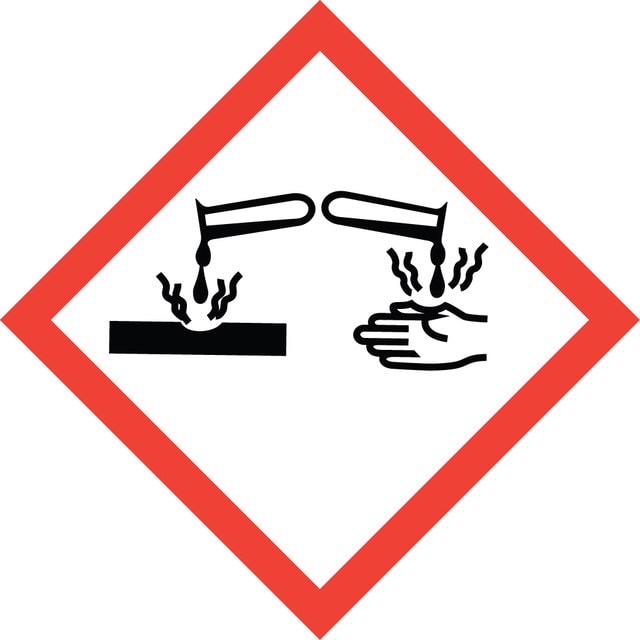
Acute Tox. 4 Inhalation - Aquatic Chronic 3 - Eye Dam. 1 - Skin Corr. 1A
Storage Class
8A - Combustible corrosive hazardous materials
wgk
WGK 2
Choose from one of the most recent versions:
Already Own This Product?
Find documentation for the products that you have recently purchased in the Document Library.
Articles
Acid and base chart lists the strength of acids and bases (strongest to weakest) in order. Simple to use laboratory reference chart for scientists, researchers and lab technicians.
Tabulka kyselin a zásad uvádí sílu kyselin a zásad v pořadí od nejsilnější po nejslabší. Jednoduchá referenční tabulka pro vědce, výzkumné pracovníky a laboranty.
Protocols
Fmoc resin cleavage and deprotection are crucial steps for peptide synthesis, yielding the desired peptide after resin detachment.
Štěpení a deprotekce Fmoc pryskyřice jsou rozhodujícími kroky pro syntézu peptidů, které po oddělení pryskyřice poskytují požadovaný peptid.
-
How can I determine the shelf life / expiration / retest date of this product?
1 answer-
Helpful?
-
-
How is shipping temperature determined? And how is it related to the product storage temperature?
1 answer-
Products may be shipped at a different temperature than the recommended long-term storage temperature. If the product quality is sensitive to short-term exposure to conditions other than the recommended long-term storage, it will be shipped on wet or dry-ice. If the product quality is NOT affected by short-term exposure to conditions other than the recommended long-term storage, it will be shipped at ambient temperature. As shipping routes are configured for minimum transit times, shipping at ambient temperature helps control shipping costs for our customers. For more information, please refer to the Storage and Transport Conditions document: https://www.sigmaaldrich.com/deepweb/assets/sigmaaldrich/marketing/global/documents/316/622/storage-transport-conditions-mk.pdf
Helpful?
-
-
What volume of TFA is in each ampule of T6508? Thank you!
1 answer-
As mentioned in the 'DESCRIPTION' section, each ampoule is 1 mL.
Helpful?
-
Active Filters
Our team of scientists has experience in all areas of research including Life Science, Material Science, Chemical Synthesis, Chromatography, Analytical and many others.
Contact Technical Service