
70794

BugBuster® GST-Bind Purification Kit
Affinity purification of GST fusion proteins
Größe auswählen
Über diesen Artikel
Hersteller/Markenname
Novagen®
Lagerbedingungen
OK to freeze
Allgemeine Beschreibung
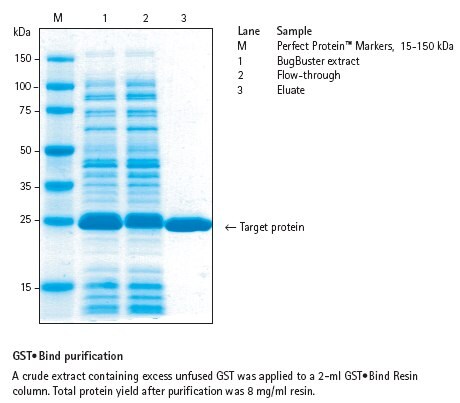
Sonstige Hinweise
•10,000 UBenzonase Nuclease, purity >90%
•10 mlGST•Bind Resin
•pkg/4Chromatography Columns
•2 x 100 ml10X GST Bind/Wash Buffer
•40 ml10X Glutathione Reconstitution Buffer
•1 gGlutathione, Reduced
Rechtliche Hinweise
Haftungsausschluss
Signalwort
Warning
H-Sätze
Gefahreneinstufungen
Flam. Liq. 3
Lagerklassenschlüssel
3 - Flammable liquids
Flammpunkt (°F)
96.8 °F
Flammpunkt (°C)
36 °C
Analysenzertifikate (COA)
Suchen Sie nach Analysenzertifikate (COA), indem Sie die Lot-/Chargennummer des Produkts eingeben. Lot- und Chargennummern sind auf dem Produktetikett hinter den Wörtern ‘Lot’ oder ‘Batch’ (Lot oder Charge) zu finden.
Besitzen Sie dieses Produkt bereits?
In der Dokumentenbibliothek finden Sie die Dokumentation zu den Produkten, die Sie kürzlich erworben haben.
Verwandter Inhalt
Traditionally, protein purification from E. coli consists of four distinct phases: harvest, bacterial cell lysis, lysate clarification and protein purification. Bacterial lysis typically requires several time-consuming, hands-on steps, such as freeze/thaw cycles and sonication. These harsh lysis techniques may negatively impact protein quality and contribute to sample-to-sample variability. To maintain protein activity and integrity, detergent-based lysis buffers are routinely used to avoid mechanical protein extraction methods. Regardless of the lysis method used, centrifugation is traditionally required to pellet unwanted cell debris and permit recovery of the clarified lysate. The final step, purification, is frequently performed using affinity media specific for expressed epitope tags. Agarose-based media have typically been used, either as a slurry in microcentrifuge tubes or packed into gravity-driven or spin columns. While easier to manipulate, columns are greatly affected by lysate consistency and carryover of cell debris, which can lead to clogging of the column frits.
Unser Team von Wissenschaftlern verfügt über Erfahrung in allen Forschungsbereichen einschließlich Life Science, Materialwissenschaften, chemischer Synthese, Chromatographie, Analytik und vielen mehr..
Setzen Sie sich mit dem technischen Dienst in Verbindung