Saltar al contenido
Merck

771937

Platinum

nanopowder, 200 nm particle size (SEM), 99.9% (metals basis)

Sinónimos:

Platinum black, Platinum element

Iniciar sesión para ver los precios por organización y contrato.

Seleccione un Tamaño

En este momento no podemos mostrarle ni los precios ni la disponibilidad

Acerca de este artículo

Fórmula empírica (notación de Hill):
Pt
Número CAS:
Peso molecular:
195.08
Número CE:
Número MDL:
Código UNSPSC:
11101803
ID de la sustancia en PubChem:
NACRES:
NA.23

Saltar a

Servicio técnico
¿Necesita ayuda? Nuestro equipo de científicos experimentados está aquí para ayudarle.
Permítanos ayudarle

Nivel de calidad

Ensayo

99.9% (metals basis)

Formulario

nanopowder

idoneidad de la reacción

reagent type: catalyst
core: platinum

resistividad

10.6 μΩ-cm, 20°C

tamaño de partícula

200 nm (SEM)

bp

3827 °C (lit.)

mp

1772 °C (lit.)

densidad

21.45 g/cm3 (lit.)

cadena SMILES

[Pt]

InChI

1S/Pt

Clave InChI

BASFCYQUMIYNBI-UHFFFAOYSA-N

Comparar elementos similares

Ver comparación completa

Mostrar Diferencias

1 of 4

Este artículo
204013349364267260
form

nanopowder

form

powder

form

foil

form

foil

assay

99.9% (metals basis)

assay

99.995% trace metals basis

assay

99.99% trace metals basis

assay

99.99% trace metals basis

resistivity

10.6 μΩ-cm, 20°C

resistivity

10.6 μΩ-cm, 20°C

resistivity

10.6 μΩ-cm, 20°C

resistivity

10.6 μΩ-cm, 20°C

mp

1772 °C (lit.)

mp

1772 °C (lit.)

mp

1772 °C (lit.)

mp

1772 °C (lit.)

bp

3827 °C (lit.)

bp

3827 °C (lit.)

bp

3827 °C (lit.)

bp

3827 °C (lit.)

density

21.45 g/cm3 (lit.)

density

21.45 g/cm3 (lit.)

density

21.45 g/cm3 (lit.)

density

21.45 g/cm3 (lit.)

Descripción general

Platinum nanopowder has a high catalytic activity and is used widely in catalysis, batteries, fuel cells, capacitors and sensors. They are used in the synthesis of counter electrode in dyes sensitized solar cells. Since it is difficult to directly use platinum nanoparticle as the electrode, they are usually surface supported on graphene or multi-walled carbon nanotubes.[1]

Aplicación

Nanoscale platinum powders possess improved reaction rates compared to bulk powders owing to their high surface area. Platinum nanopowders have found use in applications including in fuel cells and oxidation catalysts.

Características y beneficios

High catalytic functionality, high conductivity and chemical stability in an acid-base environment. [2]

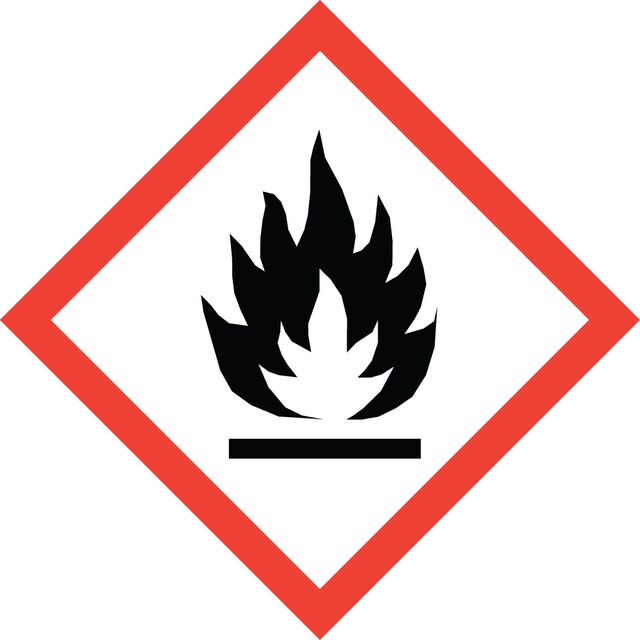
Pictogramas

Flame

Palabra de señalización

Danger

Frases de peligro

Clasificaciones de peligro

Flam. Sol. 1

Código de clase de almacenamiento

4.1B - Flammable solid hazardous materials

Clase de riesgo para el agua (WGK)

nwg

Punto de inflamabilidad (°F)

Not applicable

Punto de inflamabilidad (°C)

Not applicable


Elija entre una de las versiones más recientes:

Certificados de análisis (COA)

Lot/Batch Number

¿No ve la versión correcta?

Si necesita una versión concreta, puede buscar un certificado específico por el número de lote.

¿Ya tiene este producto?

Encuentre la documentación para los productos que ha comprado recientemente en la Biblioteca de documentos.

Visite la Librería de documentos

A Biologically-Inspired Electrochemical Half-Cell for Light-Driven Generation of Hydrogen
Rebecca A. Grimme and John H. Golbeck
Material Matters, 3(4) (2008)
Electrodeposited platinum nanoparticles on the multi-walled carbon nanotubes and its electrocatalytic for nitric oxide
Zhang, L., Fang, Z., Zhao, G. C., & Wei, X. W.
International Journal of Electrochemical Science, 3(6), 746-754 (2008)
Yu;X.;Ye;S.;
Journal of Power Sources, 172(1), 145-154 (2007)
Keith B Male et al.
The Analyst, 132(12), 1254-1261 (2008-03-06)
Platinum nanoparticles were electrodeposited by a multi-potential step technique onto a multi-walled carbon nanotube (MWCNT) film pre-casted on a glassy carbon (GC) or boron-doped diamond (BDD) electrode. The MWCNT network consisted of Pt nanoparticles with an average diameter of 120
Fabrication of platinum nanoparticle counter electrode for highly efficient dye-sensitized solar cells by controlled thermal reduction time
Hoa, N. T. Q., Dao, V. D., & Choi, H. S.
J. Mater. Sci., 49(14), 4973-4978 (2014)

Artículos

TiO2 exhibits wide band gap semiconductor and memristor properties electronically, with high opacity and UV absorbance optically.

Professors summarize recent 2D materials synthesis advancements and biosensing applications in various fields.

Controlled synthesis of metal clusters regulates ligands and atoms, advancing metal nanomaterial synthesis.

Catalytic water splitting produces hydrogen crucial for renewable energy, petroleum refining, and chemical industry applications like methanol production.

Ver todo

Preguntas

Revisiones

Sin puntuación

Filtros activos

Nuestro equipo de científicos tiene experiencia en todas las áreas de investigación: Ciencias de la vida, Ciencia de los materiales, Síntesis química, Cromatografía, Analítica y muchas otras.

Póngase en contacto con el Servicio técnico