
40-1012

Methyl Red solution
pH 4.2-6.2
Iniciar sesión para ver los posibles precios especiales de su organización
Seleccione un Tamaño
Acerca de este artículo
Fórmula empírica (notación de Hill):
C15H15N3O2
Número CAS:
Peso molecular:
269.30
Beilstein:
1843037
Número MDL:
Código UNSPSC:
12352107
ID de la sustancia en PubChem:
Servicio técnico
¿Necesita ayuda? Nuestro equipo de científicos experimentados está aquí para ayudarle.
Permítanos ayudarleServicio técnico
¿Necesita ayuda? Nuestro equipo de científicos experimentados está aquí para ayudarle.
Permítanos ayudarleFormulario
liquid
disponibilidad
available only in Japan
pH
4.2-6.2
cadena SMILES
CN(C)c1ccc(cc1)\N=N\c2ccccc2C(O)=O
InChI
1S/C15H15N3O2/c1-18(2)12-9-7-11(8-10-12)16-17-14-6-4-3-5-13(14)15(19)20/h3-10H,1-2H3,(H,19,20)/b17-16+
Clave InChI
CEQFOVLGLXCDCX-WUKNDPDISA-N
¿Está buscando productos similares? Visita Guía de comparación de productos
Aplicación
for titration
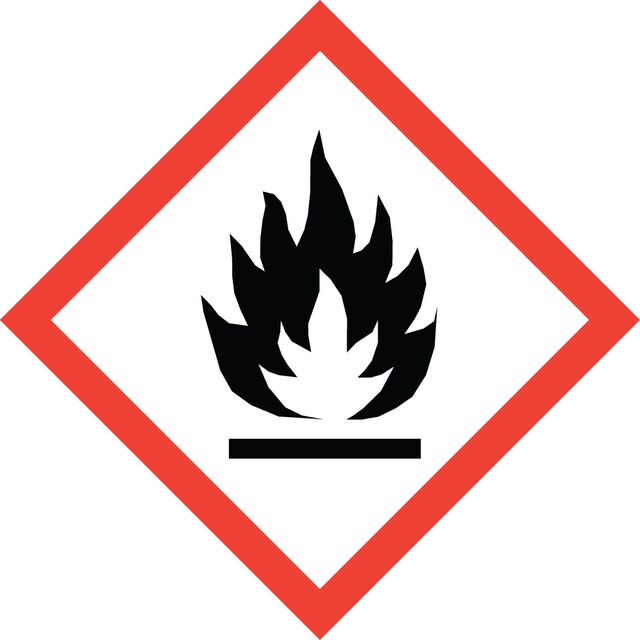

Palabra de señalización
Danger
Frases de peligro
Consejos de prudencia
Clasificaciones de peligro
Eye Irrit. 2 - Flam. Liq. 2
Código de clase de almacenamiento
3 - Flammable liquids
Clase de riesgo para el agua (WGK)
WGK 1
Punto de inflamabilidad (°F)
55.4 °F
Punto de inflamabilidad (°C)
13 °C
Elija entre una de las versiones más recientes:
¿Ya tiene este producto?
Encuentre la documentación para los productos que ha comprado recientemente en la Biblioteca de documentos.
Chan-Ju Wang et al.
Acta crystallographica. Section F, Structural biology and crystallization communications, 66(Pt 1), 2-7 (2010-01-09)
Azoreductase 1 from Pseudomonas aeruginosa strain PAO1 (paAzoR1) catalyses the activation of the prodrug balsalazide and reduces the azo dye methyl red using reduced nicotinamide adenine dinucleotide cofactor as an electron donor. To investigate the mechanism of the enzyme, a
Oana Alexandru et al.
Journal of neuro-oncology, 102(1), 9-18 (2010-07-17)
A major focus of brain cancer research today is to translate understanding of glioma biology into advances in treatment, by exploring the potential of target therapy. Here we investigated the ability of three compounds belonging to the chemical class of
Yuyi Yang et al.
Bioresource technology, 130, 517-521 (2013-01-17)
Azo dyes are toxic and carcinogenic and are often present in industrial effluents. In this research, azoreductase and glucose 1-dehydrogenase were coupled for both continuous generation of the cofactor NADH and azo dye removal. The results show that 85% maximum
Danmeng Shuai et al.
Environmental science & technology, 44(5), 1773-1779 (2010-02-11)
Azo dyes are widespread pollutants and potential cocontaminants for nitrate; we evaluated their effect on catalytic reduction of a suite of oxyanions, diatrizoate, and N-nitrosodimethylamine (NDMA). The azo dye methyl orange significantly enhanced (less than or equal to a factor
Taiga Fujii et al.
Chemistry (Weinheim an der Bergstrasse, Germany), 18(35), 10865-10872 (2012-07-26)
Asymmetric dye clusters with a single fluorophore (Cy3) and multiple quenchers (4'-methylthioazobenzene-4-carboxylate, methyl red, and 4'-dimethylamino-2-nitroazobenzene-4-carboxylate) were prepared. The dye and one-to-five quenchers were tethered through D-threoninol to opposite strands of a DNA duplex. NMR analysis revealed that the clusters
Nuestro equipo de científicos tiene experiencia en todas las áreas de investigación: Ciencias de la vida, Ciencia de los materiales, Síntesis química, Cromatografía, Analítica y muchas otras.
Póngase en contacto con el Servicio técnico