Saltar al contenido
Merck

256366

2-Butoxyethanol

spectrophotometric grade, ≥99.0%

Sinónimos:

2-Butoxyethanol, Butyl glycol

Iniciar sesión para ver los posibles precios especiales de su organización

Seleccione un Tamaño

En este momento no podemos mostrarle ni los precios ni la disponibilidad

Acerca de este artículo

Fórmula lineal:
CH3(CH2)3OCH2CH2OH
Número CAS:
Peso molecular:
118.17
Beilstein:
1732511
Número CE:
Número MDL:
Código UNSPSC:
12352104
ID de la sustancia en PubChem:
NACRES:
NA.21
Bp:
169-172.5 °C (lit.)

Saltar a

Servicio técnico
¿Necesita ayuda? Nuestro equipo de científicos experimentados está aquí para ayudarle.
Permítanos ayudarle

grado

spectrophotometric grade

densidad de vapor

4.1 (vs air)

presión de vapor

<1 mmHg ( 20 °C)
10 mmHg ( 81 °C)

Ensayo

≥99.0%

Formulario

liquid

temp. de autoignición

473 °F

lim. expl.

10.6 %

técnicas

UV/Vis spectroscopy: suitable

impurezas

≤0.1% water

residuo de evap.

<0.001%

índice de refracción

n20/D 1.419 (lit.)

bp

169-172.5 °C (lit.)

mp

−75 °C (lit.)

densidad

0.902 g/mL at 25 °C (lit.)

λ

H2O reference

Absorción UV

λ: 230 nm Amax: 1.0
λ: 250 nm Amax: 0.10
λ: 275 nm Amax: 0.05
λ: 300-400 nm Amax: 0.01

cadena SMILES

CCCCOCCO

InChI

1S/C6H14O2/c1-2-3-5-8-6-4-7/h7H,2-6H2,1H3

Clave InChI

POAOYUHQDCAZBD-UHFFFAOYSA-N

¿Está buscando productos similares? Visita Guía de comparación de productos

Comparar elementos similares

Ver comparación completa

Mostrar Diferencias

1 of 4

Este artículo
53071CRM782638.01554
technique(s)

UV/Vis spectroscopy: suitable

technique(s)

HPLC: suitable, gas chromatography (GC): suitable

technique(s)

-

technique(s)

-

assay

≥99.0%

assay

≥99.5% (GC)

assay

-

assay

≥99% (GC)

grade

spectrophotometric grade

grade

analytical standard

grade

certified reference material, TraceCERT®

grade

-

Quality Level

200

Quality Level

100

Quality Level

300

Quality Level

200

form

liquid

form

-

form

-

form

liquid

UV absorption

λ: 230 nm Amax: 1.0, λ: 275 nm Amax: 0.05, λ: 250 nm Amax: 0.10, λ: 300-400 nm Amax: 0.01

UV absorption

-

UV absorption

-

UV absorption

-

Descripción general

Ethylene glycol butyl ether is a member of the glycol ether family. It is commonly used as a solvent for pharmaceuticals, agricultural chemicals hydraulic fluids, resins, and varnishes. Ethylene glycol butyl ether or 2-Butoxyethanol (BEG) has an amphiphilic character, it can be utilized to stabilize emulsions, particularly in oil spill dispersants.

Aplicación

Ethylene glycol butyl ether is used as a co-solvent:,In the preparation of conductive inks.

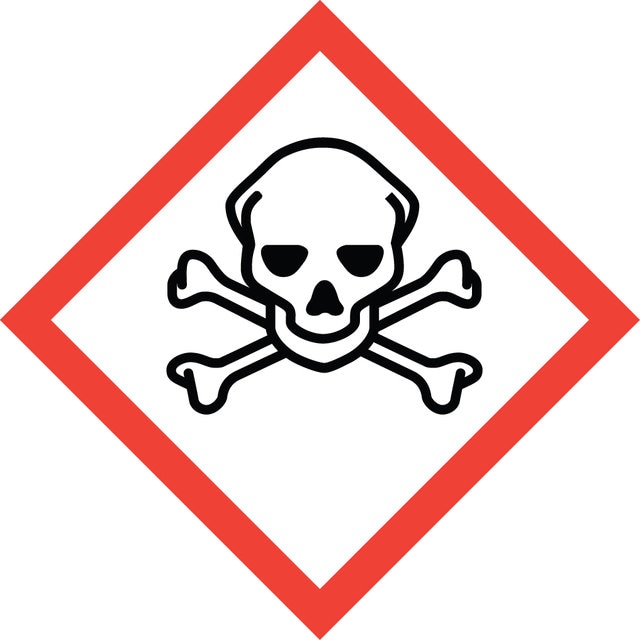
Pictogramas

Skull and crossbones

Palabra de señalización

Danger

Frases de peligro

Clasificaciones de peligro

Acute Tox. 3 Inhalation - Acute Tox. 4 Oral - Eye Irrit. 2 - Skin Irrit. 2

Código de clase de almacenamiento

6.1C - Combustible acute toxic Cat.3 / toxic compounds or compounds which causing chronic effects

Clase de riesgo para el agua (WGK)

WGK 1

Punto de inflamabilidad (°F)

152.6 °F - Pensky-Martens closed cup

Punto de inflamabilidad (°C)

67 °C - Pensky-Martens closed cup


Elija entre una de las versiones más recientes:

Certificados de análisis (COA)

Lot/Batch Number

¿No ve la versión correcta?

Si necesita una versión concreta, puede buscar un certificado específico por el número de lote.

¿Ya tiene este producto?

Encuentre la documentación para los productos que ha comprado recientemente en la Biblioteca de documentos.

Visite la Librería de documentos

B S Dean et al.
Journal of toxicology. Clinical toxicology, 30(4), 557-563 (1992-01-01)
Ethylene glycol butyl ether, CAS 111-76-2, an ingredient in many popular commercial window/glass cleaners, is known to produce equal if not greater toxicity than ethylene glycol when administered to animals. Treatment recommendations for human poisonings are based upon animal data
Reproductive toxicology. Ethylene glycol monobutyl ether.
Environmental health perspectives, 105 Suppl 1, 217-218 (1997-02-01)
G Amir et al.
The British journal of oral & maxillofacial surgery, 49(1), 21-25 (2009-12-26)
Female rats develop haemolytic anaemia and disseminated thrombosis and infarction in multiple organs, including bone, when exposed to 2-butoxyethanol (BE). There is growing evidence that vascular occlusion of the subchondral bone may play a part in some cases of osteoarthritis.
Lisa M Kamendulis et al.
Toxicology, 270(2-3), 131-136 (2010-02-16)
2-Butoxyethanol increases hemangiosarcomas selectively in male mouse liver after chronic inhalation through mechanisms that have not fully been elucidated. Hemolysis, a primary toxic effect associated with 2-butoxyethanol exposure in rodents, increased hemosiderin (iron) deposition in Kupffer cells in the liver.
Gintautas Korinth et al.
Toxicology letters, 170(2), 97-103 (2007-04-07)
We determined percutaneous absorption kinetics of 2-butoxyethanol (BE) in volunteers using microdialysis. Four male volunteers were dermally exposed twice to 90% and 50% aqueous solutions (v/v) of BE for 4.5h. To determine percutaneous absorption kinetics the concentration of BE was

Preguntas

Revisiones

Sin puntuación

Filtros activos

Nuestro equipo de científicos tiene experiencia en todas las áreas de investigación: Ciencias de la vida, Ciencia de los materiales, Síntesis química, Cromatografía, Analítica y muchas otras.

Póngase en contacto con el Servicio técnico