Skip to Content
Merck

697079

Titanium tetrachloride

packaged for use in deposition systems

Synonym(s):

Titanium(IV) chloride, TTC, Titanium tetrachloride

Sign In to View Organizational & Contract Pricing.

Select a Size


About This Item

Linear Formula:
TiCl4
CAS Number:
Molecular Weight:
189.68
NACRES:
NA.23
PubChem Substance ID:
UNSPSC Code:
12352103
EC Number:
231-444-5
MDL number:
Technical Service
Need help? Our team of experienced scientists is here for you.
Let Us Assist
Technical Service
Need help? Our team of experienced scientists is here for you.
Let Us Assist

Product Name

Titanium tetrachloride, packaged for use in deposition systems

InChI key

XJDNKRIXUMDJCW-UHFFFAOYSA-J

InChI

1S/4ClH.Ti/h4*1H;/q;;;;+4/p-4

SMILES string

Cl[Ti](Cl)(Cl)Cl

vapor pressure

50 mmHg ( 55 °C)
9.6 mmHg ( 20 °C)

assay

≥99.995% (trace metals analysis)

form

liquid

reaction suitability

core: titanium
reagent type: catalyst

bp

135-136 °C (lit.)

mp

−25 °C (lit.)

density

1.73 g/mL at 20 °C (lit.)

Quality Level

Looking for similar products? Visit Product Comparison Guide

Application

Titanium tetrachloride may be used in the vapor synthesis of titania powder by oxidaition. It may be used as a catalyst in cross and asymmetric aldol reactions. Other possible uses of titanium tetrachloride is in the synthesis of :
  • γ,δ-unsaturated alcohols from allylsilanes and carbonyl compounds,
  • N-Phosphinoylimines and N-sulphonylimines from aromatic aldehydes,
  • Homoallyl ethers from allylsilanes and acetals.6

General description
Atomic number of base material: 22 Titanium

pictograms

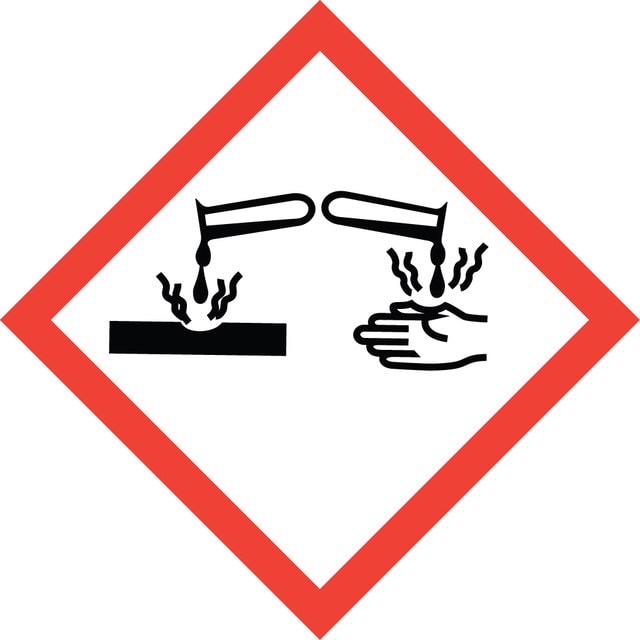
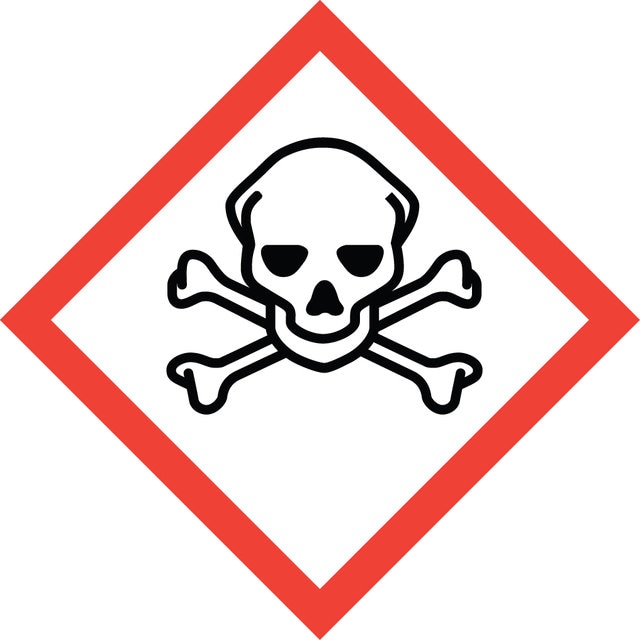
Skull and crossbonesCorrosion

signalword

Danger

Hazard Classifications

Acute Tox. 1 Inhalation - Eye Dam. 1 - Skin Corr. 1B - STOT SE 3

target_organs

Respiratory system

supp_hazards

Storage Class

6.1A - Combustible acute toxic Cat. 1 and 2 / very toxic hazardous materials

wgk

WGK 1

flash_point_f

Not applicable

flash_point_c

Not applicable

ppe

Faceshields, Gloves, Goggles, type ABEK (EN14387) respirator filter


Choose from one of the most recent versions:

Certificates of Analysis (COA)

Lot/Batch Number

Don't see the Right Version?

If you require a particular version, you can look up a specific certificate by the Lot or Batch number.

Already Own This Product?

Find documentation for the products that you have recently purchased in the Document Library.

Visit the Document Library

M T Crimmins et al.
The Journal of organic chemistry, 66(3), 894-902 (2001-06-30)
Asymmetric aldol additions using chlorotitanium enolates of N-acyloxazolidinone, oxazolidinethione, and thiazolidinethione propionates proceed with high diastereoselectivity for the Evans or non-Evans syn product depending on the nature and amount of the base used. With 1 equiv of titanium tetrachloride and
The titanium tetrachloride induced synthesis of N-phosphinoylimines and N-sulphonylimines directly from aromatic aldehydes
Jennings WB and Lovely CJ
Tetrahedron, 47(29), 5561-5568 (1991)
New cross-aldol reactions. Reactions of silyl enol ethers with carbonyl compounds activated by titanium tetrachloride
Mukaiyama T, et al.
Journal of the American Chemical Society, 96(24), 7503-7509 null
Syntheses of γ,δ-unsaturated alcohols from allylsilanes and carbonyl compounds in the presence of titanium tetrachloride
Hosomi A and Sakurai H
Tetrahedron Letters, 17(16), 1295-1298 (1976)
Hossein Noyan et al.
PloS one, 10(6), e0130658-e0130658 (2015-06-23)
To understand the molecular pathways underlying the cardiac preconditioning effect of short-term caloric restriction (CR). Lifelong CR has been suggested to reduce the incidence of cardiovascular disease through a variety of mechanisms. However, prolonged adherence to a CR life-style is

Articles

Nanomaterials are considered a route to the innovations required for large-scale implementation of renewable energy technologies in society to make our life sustainable.

Atomic Layer Deposition (ALD) technology ensures uniform coating on complex 3D surfaces with precise chemisorption cycles.

The properties of many devices are limited by the intrinsic properties of the materials that compose them.

Continuous efficiency improvements in photovoltaic devices result from material advancements and manufacturing innovation.

Our team of scientists has experience in all areas of research including Life Science, Material Science, Chemical Synthesis, Chromatography, Analytical and many others.

Contact Technical Service