

If this product has an expiration or retest date, it will be shown on the Certificate of Analysis (COA, CofA). If there is no retest or expiration date listed on the product's COA, we do not have suitable stability data to determine a shelf life. For these products, the only date on the COA will be the release date; a retest, expiration, or use-by-date will not be displayed.
For all products, we recommend handling per defined conditions as printed in our product literature and website product descriptions. We recommend that products should be routinely inspected by customers to ensure they perform as expected.
For products without retest or expiration dates, our standard warranty of 1 year from the date of shipment is applicable.
For more information, please refer to the Product Dating Information document: https://www.sigmaaldrich.com/deepweb/assets/sigmaaldrich/marketing/global/documents/418/501/product-dating-information-06-25-mk.pdf
41639

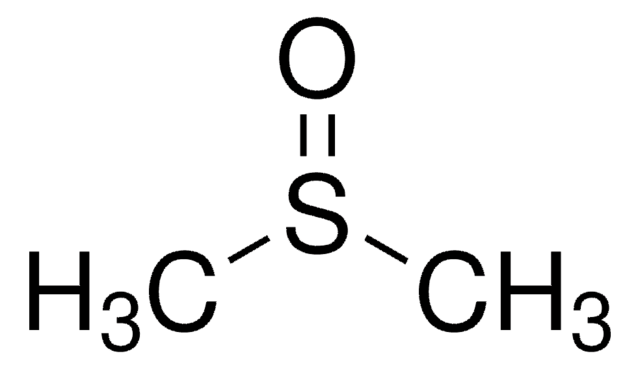
Dimethyl sulfoxide
BioUltra, Molecular Biology, ≥99.5% (GC)
Synonym(s):
DMSO
Select a Size
₹16,129.25
₹42,986.08
About This Item
Skip To
Product Name
Dimethyl sulfoxide, BioUltra, Molecular Biology, ≥99.5% (GC)
InChI key
IAZDPXIOMUYVGZ-UHFFFAOYSA-N
InChI
1S/C2H6OS/c1-4(2)3/h1-2H3
SMILES string
CS(C)=O
grade
Molecular Biology
vapor density
2.7 (vs air)
vapor pressure
0.42 mmHg ( 20 °C)
product line
BioUltra
assay
≥99.5% (GC)
form
liquid
autoignition temp.
573 °F
expl. lim.
42 %, 63 °F
technique(s)
GC/GC: suitable
impurities
Dnases, none detected
RNases, none detected
insoluble matter, passes filter test
phosphatases, none detected
proteases, none detected
≤0.001% free acid (as CH3COOH)
evapn. residue
≤0.005%
color
colorless
refractive index
n20/D 1.479 (lit.)
n20/D 1.479
bp
189 °C (lit.)
mp
16-19 °C (lit.)
solubility
H2O: miscible (completely)
density
1.10 g/mL (lit.)
cation traces
Al: ≤0.5 mg/kg
Ba: ≤0.1 mg/kg
Bi: ≤0.1 mg/kg
Ca: ≤0.5 mg/kg
Cd: ≤0.05 mg/kg
Co: ≤0.02 mg/kg
Cr: ≤0.02 mg/kg
Cu: ≤0.02 mg/kg
Fe: ≤0.5 mg/kg
K: ≤0.5 mg/kg
Li: ≤0.1 mg/kg
Mg: ≤0.1 mg/kg
Mn: ≤0.02 mg/kg
Mo: ≤0.1 mg/kg
Na: ≤1 mg/kg
Ni: ≤0.5 mg/kg
Pb: ≤0.1 mg/kg
Sr: ≤0.1 mg/kg
Zn: ≤0.1 mg/kg
λ
neat
UV absorption
λ: 280 nm Amax: 0.22
suitability
suitable for molecular biology
Quality Level
Looking for similar products? Visit Product Comparison Guide
1 of 4
This Item | D5879 | 41640 | PHR1309 |
|---|---|---|---|
| assay ≥99.5% (GC) | assay ≥99.5% | assay ≥99.9% (GC) | assay - |
| grade for molecular biology | grade - | grade ACS reagent, puriss. p.a. | grade certified reference material, pharmaceutical secondary standard |
| Quality Level 200 | Quality Level 200 | Quality Level 300 | Quality Level 300 |
| solubility H2O: miscible (completely) | solubility H2O: soluble(lit.), acetone: soluble(lit.), benzene: soluble(lit.), chloroform: soluble(lit.), ethanol: soluble(lit.) | solubility - | solubility - |
| form liquid | form liquid | form liquid | form - |
| vapor density 2.7 (vs air) | vapor density 2.7 (vs air) | vapor density 2.7 (vs air) | vapor density - |
Application
Disclaimer
General description
Other Notes
Storage Class
10 - Combustible liquids
wgk
WGK 1
flash_point_f
188.6 °F - closed cup
flash_point_c
87 °C - closed cup
ppe
Eyeshields, Gloves, type ABEK (EN14387) respirator filter
Choose from one of the most recent versions:
Already Own This Product?
Find documentation for the products that you have recently purchased in the Document Library.
Related Content
Find high-purity biochemicals for every workflow. Explore BioUltra, Molecular Biology, BioReagent, and reagent-grade materials qualified for performance.
-
How can I determine the shelf life / expiration / retest date of this product?
1 answer-
Helpful?
-
-
How is shipping temperature determined? And how is it related to the product storage temperature?
1 answer-
Products may be shipped at a different temperature than the recommended long-term storage temperature. If the product quality is sensitive to short-term exposure to conditions other than the recommended long-term storage, it will be shipped on wet or dry-ice. If the product quality is NOT affected by short-term exposure to conditions other than the recommended long-term storage, it will be shipped at ambient temperature. As shipping routes are configured for minimum transit times, shipping at ambient temperature helps control shipping costs for our customers. For more information, please refer to the Storage and Transport Conditions document: https://www.sigmaaldrich.com/deepweb/assets/sigmaaldrich/marketing/global/documents/316/622/storage-transport-conditions-mk.pdf
Helpful?
-
-
Dimethyl sulfoxide (DMSO) should be a liquid. Why did it arrive as a solid?
1 answer-
DMSO supercools easily, and re-melts slowly at room temperature. The melting point is 16-19 °C. The solidified product can be re-liquefied by warming to room temperature without detriment to the product.
Helpful?
-
-
Does DMSO have any synthetic utility?
1 answer-
DMSO has been used to oxidize thiols and disulfides to sulfonic acids, hydrolysis of epoxides, thioalkylation of phenols, and oxidation of primary alcohols and halides, and esters of primary alcohols to aldehydes.
Helpful?
-
-
What is the Department of Transportation shipping information for this product?
1 answer-
Transportation information can be found in Section 14 of the product's (M)SDS.To access the shipping information for this material, use the link on the product detail page for the product.
Helpful?
-
-
What is the DMSO dissolved in?
1 answer-
DMSO is not dissolved in any solvent. It is a pure chemical compound that is a liquid at room temperature.
Helpful?
-
-
Where does DMSO come from?
1 answer-
DMSO is known to have been isolated from tree bark in the past. It is now a commericially synthesized solvent.
Helpful?
-
-
Is Dimethyl sulfoxide a sterile product?
1 answer-
No, this product is not considered sterile. Product Nos. D2560 and D2438 are sterile-filtered.
Helpful?
-
-
What type of filter is used to sterile-filter Dimethyl sulfoxide (DMSO)?
1 answer-
DMSO can be sterile-filtered through a 0.2 micron PTFE filter. The sterility testing is per the current US Pharmacopoeia method.
Helpful?
-
-
What is the molarity of DMSO?
1 answer-
DMSO will have a molarity of 14.1M, based on a density of 1.1 g/mL and a molecular weight of 78.13 g/mol.
Helpful?
-
Active Filters
Our team of scientists has experience in all areas of research including Life Science, Material Science, Chemical Synthesis, Chromatography, Analytical and many others.
Contact Technical Service