Skip to Content
Merck

P5561

Propionic acid

BioReagent, suitable for insect cell culture, ~98%

Synonym(s):

Acid C3, Propanoic acid, Propanyl acid

Sign In to View Organizational & Contract Pricing.

Select a Size

1 L

PLN 215.00

PLN 215.00


Please contact Customer Service for Availability

Request a Bulk Order

About This Item

Linear Formula:
CH3CH2COOH
CAS Number:
Molecular Weight:
74.08
UNSPSC Code:
12352207
NACRES:
NA.71
PubChem Substance ID:
EC Number:
201-176-3
Beilstein/REAXYS Number:
506071
MDL number:

Skip To

Technical Service
Need help? Our team of experienced scientists is here for you.
Let Us Assist

Product Name

Propionic acid, BioReagent, suitable for insect cell culture, ~98%

SMILES string

CCC(O)=O

InChI

1S/C3H6O2/c1-2-3(4)5/h2H2,1H3,(H,4,5)

InChI key

XBDQKXXYIPTUBI-UHFFFAOYSA-N

vapor density

2.55 (vs air)

vapor pressure

2.4 mmHg ( 20 °C)

product line

BioReagent

assay

~98%

autoignition temp.

955 °F

expl. lim.

12.1 %

technique(s)

cell culture | insect: suitable

refractive index

n20/D 1.386 (lit.)

bp

141 °C (lit.)

mp

−24-−23 °C (lit.)

solubility

H2O: soluble

density

0.99 g/mL at 25 °C (lit.)
0.993 g/mL at 25 °C (lit.)

Quality Level

Looking for similar products? Visit Product Comparison Guide

Related Categories

Compare Similar Items

View Full Comparison

Show Differences

1 of 4

This Item
40290794425P1386
assay

~99%

assay

≥99.5%

assay

≥99.5% (GC)

assay

≥99.5%

Quality Level

100

Quality Level

200

Quality Level

100

Quality Level

200

solubility

H2O: soluble

solubility

H2O: soluble

solubility

H2O: soluble

solubility

-

bp

141 °C (lit.)

bp

141 °C (lit.)

bp

141 °C (lit.)

bp

141 °C (lit.)

density

0.99 g/mL at 25 °C (lit.), 0.993 g/mL at 25 °C (lit.)

density

0.993 g/mL at 25 °C (lit.)

density

0.993 g/mL at 25 °C (lit.)

density

0.993 g/mL at 25 °C (lit.)

vapor pressure

2.4 mmHg ( 20 °C)

vapor pressure

2.4 mmHg ( 20 °C)

vapor pressure

2.4 mmHg ( 20 °C)

vapor pressure

2.4 mmHg ( 20 °C)

Application

Use in insect cell culture to inhibit mold growth.

General description

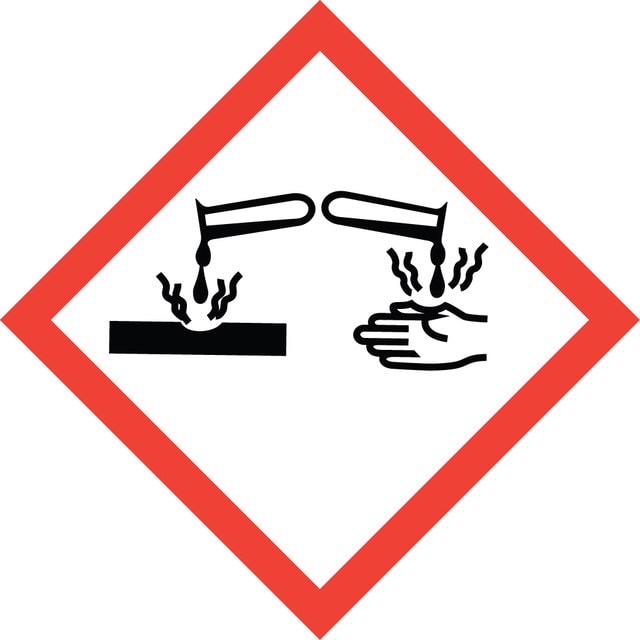
Propionic acid (PA) is a naturally occurring carboxylic acid, which in its pure state exists as a colorless corrosive liquid with an unpleasant odor. It is miscible in water. Industrially it is produced by hydrocarboxylation of ethylene in presence nickel carbonyl as a catalyst.[1] PA has been found to reduce food intake, lower the fatty acids content in plasma and liver, might improve tissue insulin sensitivity and exerts immunosuppressive actions.[2] Propionic acid is an excellent raw material as it is stable, cheap and safe and can even be used as a food additive.[3]

signalword

Danger

Hazard Classifications

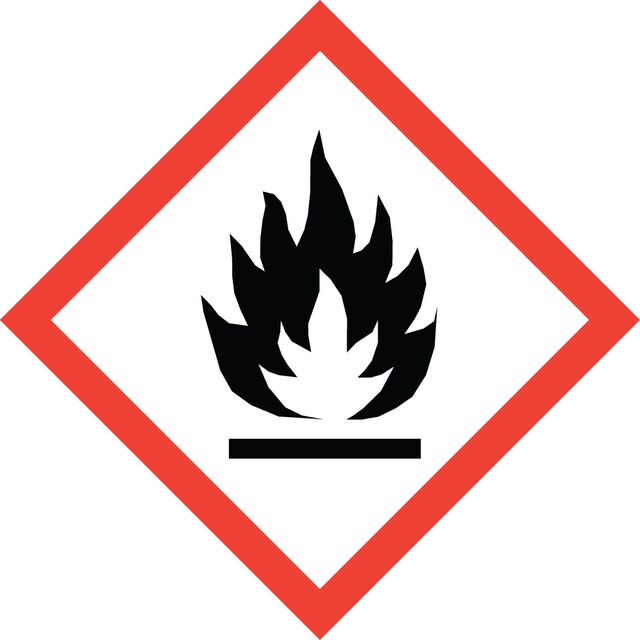
Eye Dam. 1 - Flam. Liq. 3 - Skin Corr. 1B - STOT SE 3

target_organs

Respiratory system

Storage Class

3 - Flammable liquids

wgk

WGK 1

flash_point_f

129.2 °F - closed cup

flash_point_c

54 °C - closed cup

ppe

Faceshields, Gloves, Goggles, type ABEK (EN14387) respirator filter


Choose from one of the most recent versions:

Certificates of Analysis (COA)

Lot/Batch Number

Don't see the Right Version?

If you require a particular version, you can look up a specific certificate by the Lot or Batch number.

Already Own This Product?

Find documentation for the products that you have recently purchased in the Document Library.

Visit the Document Library

Biological effects of propionic acid in humans; metabolism, potential applications and underlying mechanisms
Sa'ad, H., et al.
Molecular and Cellular Biology, 1801 (11), 1175-1183 (2010)
Nucleophilic ?-Carbon Activation of Propionic Acid as a 3-Carbon Synthon by Carbene Organocatalysis
Jin, Zhichao, et al.
Chemistry?A European Journal , 21 (26), 9360-9363 (2015)
Flour and Breads and their Fortification in Health and Disease Prevention.
Victor R. Preedy, Ronald Ross Watson, Vinood B
Technology & Engineering, 476-476 (2011)
Weiqiang Chen et al.
Journal of virology, 89(1), 581-593 (2014-10-24)
The recent global resurgence of arthritogenic alphaviruses, in particular chikungunya virus (CHIKV), highlights an urgent need for the development of therapeutic intervention strategies. While there has been significant progress in defining the pathophysiology of alphaviral disease, relatively little is known
R De Kanter et al.
Xenobiotica; the fate of foreign compounds in biological systems, 32(5), 349-362 (2002-06-18)
1. Organ-specific biotransformation was studied in human and rat liver, lung, kidney and small intestine slices and compared on a protein basis, using four model substances. 2. Deethylation of lidocaine was highest in liver slices from both man and rat

Questions

Reviews

No rating value

Active Filters

Our team of scientists has experience in all areas of research including Life Science, Material Science, Chemical Synthesis, Chromatography, Analytical and many others.

Contact Technical Service