


The minimum purity of this product is 98%. The lot-specific purity is verified in the product Certificate of Analysis. Please see the link below to review a sample or lot-specific Certificate
https://www.sigmaaldrich.com/product/sigma/c1919#product-documentation
Przejdź do
C1919

Chloramphenicol
BioReagent, suitable for plant cell culture
Synonim(y):
D-(−)-threo-2,2-Dichloro-N-[β-hydroxy-α-(hydroxymethyl)-β-(4-nitrophenyl)ethyl]acetamide, D-(−)-threo-2-Dichloroacetamido-1-(4-nitrophenyl)-1,3-propanediol, D-threo-2,2-Dichloro-N-[β-hydroxy-α-(hydroxymethyl)-4-nitrophenethyl]acetamide, Chloromycetin
Zaloguj się, aby wyświetlić ceny organizacyjne i kontraktowe.
Wybierz wielkość
Zmień widok
| Rozmiar/SKU | Dostępność | Cena netto |
|---|---|---|
5 g | Skontaktuj się z Obsługą Klienta, aby uzyskać informacje na temat dostępności | 167,00 zł |
25 g | Skontaktuj się z Obsługą Klienta, aby uzyskać informacje na temat dostępności | 472,00 zł |
100 g | Skontaktuj się z Obsługą Klienta, aby uzyskać informacje na temat dostępności | 1550,00 zł 1162,50 zł |
Informacje o tej pozycji
Wzór liniowy:
Cl2CHCONHCH(CH2OH)CH(OH)C6H4NO2
Numer CAS:
Masa cząsteczkowa:
323.13
UNSPSC Code:
51102831
NACRES:
NA.76
PubChem Substance ID:
EC Number:
200-287-4
Beilstein/REAXYS Number:
2225532
MDL number:
167,00 zł
Skontaktuj się z Obsługą Klienta, aby uzyskać informacje na temat dostępności
Pomoc techniczna
Potrzebujesz pomocy? Nasz zespół doświadczonych naukowców chętnie Ci pomoże.
Pozwól nam pomócproduct line
BioReagent
Quality Segment
form
powder
technique(s)
cell culture | plant: suitable
impurities
Endotoxin, tested
mp
149-153 °C (lit.)
antibiotic activity spectrum
Gram-negative bacteria, Gram-positive bacteria, mycobacteria, mycoplasma
application(s)
agriculture
mode of action
protein synthesis | interferes
storage temp.
2-8°C
SMILES string
OC[C@@H](NC(=O)C(Cl)Cl)[C@H](O)c1ccc(cc1)[N+]([O-])=O
InChI
1S/C11H12Cl2N2O5/c12-10(13)11(18)14-8(5-16)9(17)6-1-3-7(4-2-6)15(19)20/h1-4,8-10,16-17H,5H2,(H,14,18)/t8-,9-/m1/s1
InChI key
WIIZWVCIJKGZOK-RKDXNWHRSA-N
Gene Information
human ... CYP1A2(1544)
General description
Chemical structure: phenicole
Application
Chloramphenicol is a synthetic antibiotic, isolated from strains of Streptomyces venezuelae. It is often used for bacterial selection in molecular biology applications at 10-20 μg/mL and as a selection agent for transformed cells containing chloramphenicol reistance genes.
Biochem/physiol Actions
Mode of Action: Chloramphenicol inhibits bacterial protein synthesis by blocking the peptidyl transferase step by binding to the 50S ribosomal subunit and preventing attachment of aminoacyl tRNA to the ribosome. It also inhibits mitochondrial and chloroplast protein synthesis and ribosomal formation of (p)ppGpp, de-pressing rRNA transcription.
Mode of Resistance: Use of chloramphenicol acetyltransferase will acetylate the product and inactivate it.
Antimicrobial Spectrum: This is a broad spectrum antibiotic against gram-positive and gram-negative bacteria, and is used mainly for ophthalmic and veterinary purposes.
Mode of Resistance: Use of chloramphenicol acetyltransferase will acetylate the product and inactivate it.
Antimicrobial Spectrum: This is a broad spectrum antibiotic against gram-positive and gram-negative bacteria, and is used mainly for ophthalmic and veterinary purposes.
Preparation Note
Stock solutions can be prepared directly in the vial at any recommended concentration. A solution at 50 mg/mL in ethanol yields a clear, very faint, yellow solution. Degradation of chloramphenicol in aqueous solution is catalyzed by general acids and bases. This rate of degradation is independent of the ionic strength and pH.
Other Notes
Keep container tightly closed in a dry and well-ventilated place, Light sensitive. Storage class (TRGS 510): Non-combustible, acute toxic Cat.3 / toxic hazardous materials or hazardous materials causing chronic effects
Disclaimer
Stock solutions should be stored at 2-8°C and are stable at 37°C for 5 days. Aqueous solutions are neutral and stable over a wide pH range, with 50% hydrolysis occurring after 290 days. Use of a borax buffered solution reduces this number to 14%. Solutions should be protected from light as photochemical decomposition results in a yellowing of the solution. Heating aqueous solutions at 115°C for 30 minutes results in a 10% loss of chloramphenicol.
Ta strona może zawierać tekst przetłumaczony maszynowo.
1 of 1
Ta pozycja | |||
|---|---|---|---|
| description BioReagent, suitable for plant cell culture | description meets USP testing specifications | description VETRANAL®, analytical standard | description British Pharmacopoeia (BP) Reference Standard |
| antibiotic activity spectrum Gram-positive bacteria, mycobacteria, Gram-negative bacteria, mycoplasma | antibiotic activity spectrum viruses | antibiotic activity spectrum - | antibiotic activity spectrum - |
| mode of action protein synthesis | interferes | mode of action protein synthesis | interferes | mode of action - | mode of action - |
| technique(s) cell culture | plant: suitable | technique(s) - | technique(s) gas chromatography (GC): suitable, HPLC: suitable | technique(s) - |
| Quality Level 200 | Quality Level 200 | Quality Level 100 | Quality Level - |
| product line BioReagent | product line - | product line VETRANAL® | product line - |
| form powder | form crystalline | form - | form powder |
Still not finding the right product?
Explore all of our products under Chloramphenicol
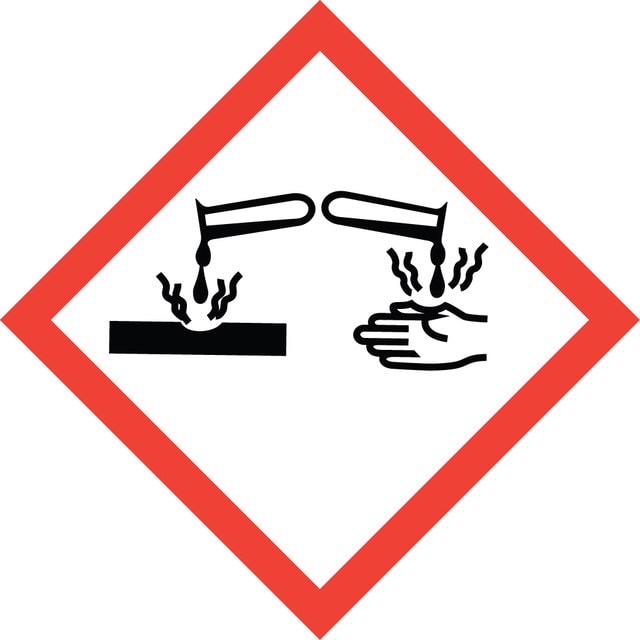
Słowo ostrzegawcze
Danger
Kody zagrożeń
Hazard Classifications
Carc. 2 - Eye Dam. 1 - Repr. 2
Klasa składowania
11 - Combustible Solids
Co się dzieje?
WGK 3
PPE (środki ochrony indywidualnej)
Eyeshields, Gloves, type P3 (EN 143) respirator cartridges
Wybierz jedną z najnowszych wersji:
Masz już ten produkt?
Dokumenty związane z niedawno zakupionymi produktami zostały zamieszczone w Bibliotece dokumentów.
-
What is the purity of this product?
1 answer-
Helpful?
-
-
How can I determine the shelf life / expiration / retest date of this product?
1 answer-
If this product has an expiration or retest date, it will be shown on the Certificate of Analysis (COA, CofA). If there is no retest or expiration date listed on the product's COA, we do not have suitable stability data to determine a shelf life. For these products, the only date on the COA will be the release date; a retest, expiration, or use-by-date will not be displayed.
For all products, we recommend handling per defined conditions as printed in our product literature and website product descriptions. We recommend that products should be routinely inspected by customers to ensure they perform as expected.
For products without retest or expiration dates, our standard warranty of 1 year from the date of shipment is applicable.
For more information, please refer to the Product Dating Information document: https://www.sigmaaldrich.com/deepweb/assets/sigmaaldrich/marketing/global/documents/418/501/product-dating-information-06-25-mk.pdfHelpful?
-
-
How is shipping temperature determined? And how is it related to the product storage temperature?
1 answer-
Products may be shipped at a different temperature than the recommended long-term storage temperature. If the product quality is sensitive to short-term exposure to conditions other than the recommended long-term storage, it will be shipped on wet or dry-ice. If the product quality is NOT affected by short-term exposure to conditions other than the recommended long-term storage, it will be shipped at ambient temperature. As shipping routes are configured for minimum transit times, shipping at ambient temperature helps control shipping costs for our customers. For more information, please refer to the Storage and Transport Conditions document: https://www.sigmaaldrich.com/deepweb/assets/sigmaaldrich/marketing/global/documents/316/622/storage-transport-conditions-mk.pdf
Helpful?
-