
266434

Soda lime
ACS reagent, granular, +100 mesh particle size
Sign In to View Organizational & Contract Pricing
Select a Size
Pricing and availability is not currently available.
About This Item
CAS Number:
MDL number:
UNSPSC Code:
12352300
PubChem Substance ID:
NACRES:
NB.24
Skip To
grade
ACS reagent
form
granular
impurities
≤1% Fines
loss
≤7% loss on drying
particle size
+100 mesh
capacity
≥19.0 % absorption capacity (CO2)
SMILES string
[OH-].[Na+].O=[Ca]
InChI
1S/Ca.Na.H2O.O/h;;1H2;/q;+1;;/p-1
InChI key
HUAUNKAZQWMVFY-UHFFFAOYSA-M
Looking for similar products? Visit Product Comparison Guide
Application
- Speciation of tin ions in oxide glass containing iron oxide through solvent extraction and inductively coupled plasma atomic emission spectrometry after the decomposition utilizing ascorbic acid.: This study discusses the application of soda lime in the decomposition process for the speciation of tin ions, highlighting its role in enhancing analytical accuracy in complex material analysis (Saijo et al., 2022).
- Absorption of nitrogen dioxide and nitric oxide by soda lime.: Discusses the capacity of soda lime to absorb harmful gases, highlighting its potential applications in environmental protection and workplace safety (Ishibe et al., 1995).
Preparation Note
Variable mixture of sodium hydroxide with calcium oxide/hydroxide.
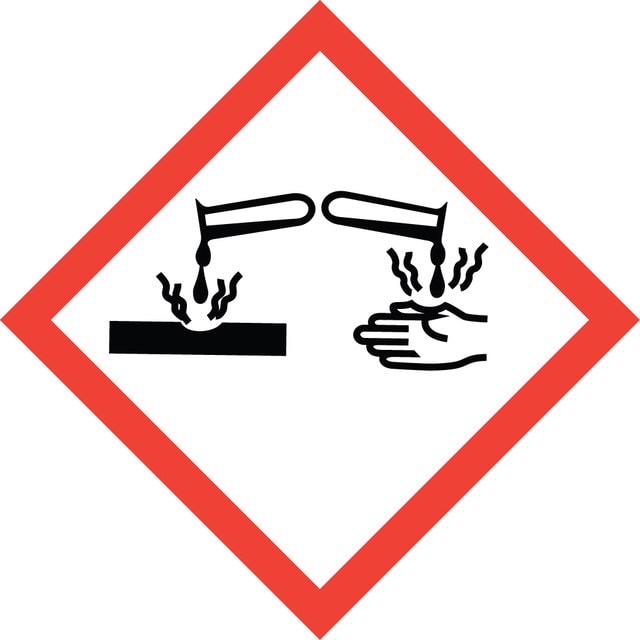
Signal Word
Danger
Hazard Statements
Precautionary Statements
Hazard Classifications
Eye Dam. 1 - Skin Corr. 1A
Storage Class Code
8A - Combustible corrosive hazardous materials
WGK
WGK 3
Flash Point(F)
Not applicable
Flash Point(C)
Not applicable
Choose from one of the most recent versions:
Already Own This Product?
Find documentation for the products that you have recently purchased in the Document Library.
M Morio et al.
Anesthesiology, 77(6), 1155-1164 (1992-12-01)
Sevoflurane previously has been reported to undergo extensive degradation in the presence of soda lime. To more completely characterize the extent and significnce of this reaction, we studied degradation of sevoflurane with and without soda lime, as well as the
Nadine Schibille
PloS one, 6(4), e18970-e18970 (2011-04-29)
The chemical characterisation of archaeological glass allows the discrimination between different glass groups and the identification of raw materials and technological traditions of their production. Several lines of evidence point towards the large-scale production of first millennium CE glass in
Stella H North et al.
Analytical chemistry, 82(1), 406-412 (2009-12-17)
Glass microscope slides are considered by many as the substrate of choice for microarray manufacturing due to their amenability to various surface chemistry modifications. The use of silanes to attach various functional groups onto glass slides has provided a versatile
An unusual cause of anesthesia circuit blockade by SODASORB PRE-PAK.
Srikiran Ramarapu et al.
Anesthesia and analgesia, 115(2), 477-477 (2012-07-25)
Farah Mohammadesmaeili et al.
Water environment research : a research publication of the Water Environment Federation, 82(4), 342-350 (2010-05-04)
Lime and soda-ash softening of reclaimed water reverse osmosis concentrates as a pretreatment step for concentration by seawater reverse osmosis was the focus of this study. The objectives were removal of the potential fouling minerals of calcium, magnesium, and silica
Active Filters
Our team of scientists has experience in all areas of research including Life Science, Material Science, Chemical Synthesis, Chromatography, Analytical and many others.
Contact Technical Service