

Carbon analysis provides an idea as to the percentage of carbon that exists in sodium dodecyl sulfate. Residue testing can be performed after solution preparation and filtration. The mass of retentate after a solution is filtered would allow the determination of the amount of insoluble material present. Unfortunately, this test is not performed on this product as this product is not a solution.
L4509

Sodium dodecyl sulfate

ReagentPlus®, ≥98.5% (GC)
Sodium dodecyl sulfate
Synonym(s):
Dodecyl sodium sulfate, Dodecyl sulfate sodium salt, Lauryl sulfate sodium salt, SDS, Sodium lauryl sulfate
Sign In to View Organizational & Contract Pricing.
Select a Size
10 G
$83.40
25 G
$122.00
100 G
$214.00
250 G
$411.00
500 G
$712.00
1 KG
$1,060.00
About This Item
Linear Formula:
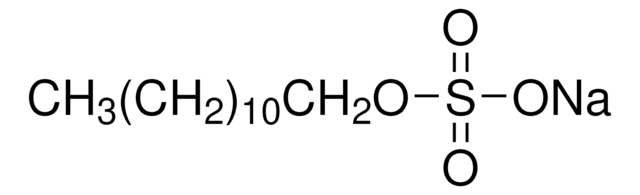
CH3(CH2)11OSO3Na
CAS Number:
Molecular Weight:
288.38
NACRES:
NA.21
PubChem Substance ID:
eCl@ss:
39093306
UNSPSC Code:
12161900
EC Number:
205-788-1
MDL number:
Beilstein/REAXYS Number:
3599286
Skip To
Product Name
Sodium dodecyl sulfate, ReagentPlus®, ≥98.5% (GC)
InChI key
DBMJMQXJHONAFJ-UHFFFAOYSA-M
InChI
1S/C12H26O4S.Na/c1-2-3-4-5-6-7-8-9-10-11-12-16-17(13,14)15;/h2-12H2,1H3,(H,13,14,15);/q;+1/p-1
SMILES string
[Na+].CCCCCCCCCCCCOS([O-])(=O)=O
biological source
synthetic
description
anionic
product line
ReagentPlus®
assay
≥98.5% (GC)
form
powder
mol wt
micellar avg mol wt 18,000
Quality Level
greener alternative product characteristics
Catalysis
Learn more about the Principles of Green Chemistry.
sustainability
Greener Alternative Product
aggregation number
62
impurities
<2.0% water (Karl Fischer)
CMC
7-10 mM (20-25°C)
mp
204-207 °C (lit.)
transition temp
cloud point >100 °C
solubility
water: soluble
density
0.425 g/cm3
cation traces
Na: 7.0-9.0%
HLB
40
greener alternative category
Looking for similar products? Visit Product Comparison Guide
1 of 4
This Item | 436143 | L3771 | 71725 |
|---|---|---|---|
| form powder | form solid | form powder | form powder |
| assay ≥98.5% (GC) | assay ≥99.0% | assay ≥98.5% (GC) | assay ≥99.0% (GC) |
| aggregation number 62 | aggregation number - | aggregation number 62 | aggregation number 62 |
| impurities <2.0% water (Karl Fischer) | impurities ≤0.06 meq/g Titr. Base, ≥96.0% fatty alcohols, <4.0% unsulfated alcohols | impurities ≤2.0% water (Karl Fischer) | impurities DNases, none detected, RNases, none detected, insoluble matter, passes filter test, phosphatases, none detected, proteases, none detected |
| HLB 40 | HLB 40 | HLB 40 | HLB 40 |
| CMC 7-10 mM (20-25°C) | CMC - | CMC 7-10 mM (20-25°C) | CMC 7-10 mM (20-25°C) |
Application
Sodium dodecyl sulphate (SDS) has been used:
- in the characterization of Enterobacteriaceae strain based on sensitivity to selective compounds[1]
- to treat human skin in vitro and in vivo to evaluate the role of nuclear localization of 27-kDa heat shock protein (HSP27) in potential skin irritation[2]
- in the decellularization of porcine heart valve tissue[3]
- to treat sperm for in vitro induction of sperm decondensation[4]
Anionic detergent
Biochem/physiol Actions
Sodium dodecyl sulphate (SDS) helps to quickly disrupt the biological membranes. It is usually used as one of the major constituent of several reagents, that are used to purify nucleic acids. SDS can block the activity of RNase and deoxyribonuclease (DNase).[5]
Features and Benefits
- Suitable for Cell Biology and Biochemical Research
- High purity chemical suitable for multiple research applications
General description
Sodium dodecyl sulfate (SDS), or sodium lauryl sulfate, is widely recognized as an anionic surfactant within the organosulfate class of organic compounds. Its effectiveness as a detergent spans both ionic and anionic conditions. SDS plays a critical role as a protein denaturant, facilitating the solubilization and denaturation of proteins in procedures like protein extraction and SDS-PAGE. Its significance in the electrophoretic separation of proteins and lipids establishes its indispensability for the examination of these molecules in diverse biological experiments. In conclusion, Sodium dodecyl sulfate proves to be an indispensable element in the exploration of biological molecules within the realms of biochemical and cell biology research.
We are committed to bringing you Greener Alternative Products, which adhere to one or more of The 12 Principles of Greener Chemistry. This product is used as a surfactant to enhance catalysis. Click here for more information.
Other Notes
For additional information on our range of Biochemicals, please complete this form.
Legal Information
ReagentPlus is a registered trademark of Merck KGaA, Darmstadt, Germany
comparable product
Product No.
Description
Pricing
signalword
Danger
Hazard Classifications
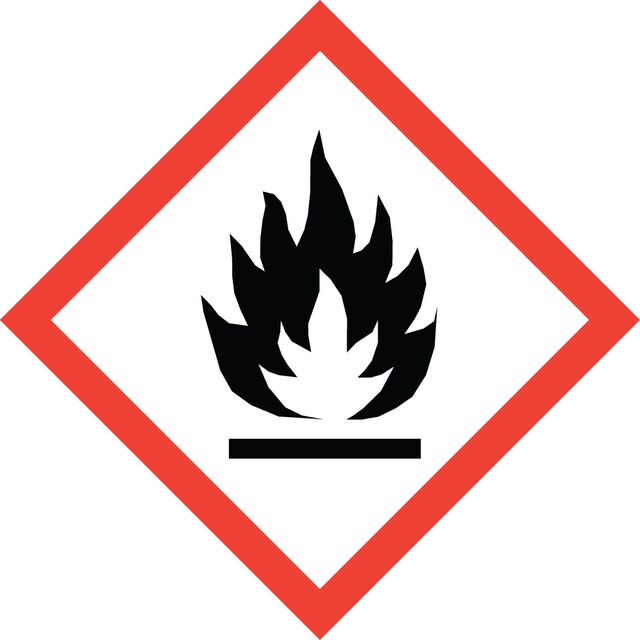
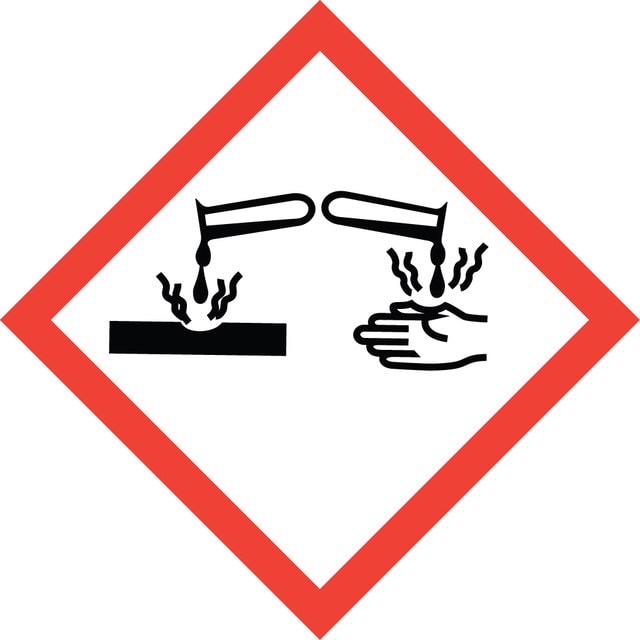
Acute Tox. 4 Inhalation - Acute Tox. 4 Oral - Aquatic Chronic 3 - Eye Dam. 1 - Flam. Sol. 2 - Skin Irrit. 2 - STOT SE 3
target_organs
Respiratory system
Storage Class
4.1B - Flammable solid hazardous materials
wgk
WGK 2
flash_point_f
338.0 °F
flash_point_c
170 °C
ppe
Eyeshields, Faceshields, Gloves, type P3 (EN 143) respirator cartridges
Choose from one of the most recent versions:
Already Own This Product?
Find documentation for the products that you have recently purchased in the Document Library.
A rapid and reliable alternative to ISO 21528-1: 2004 for detection of Enterobacteriaceae
Joosten H, et al.
International Journal of Food Microbiology, 125(3), 344-346 (2008)
Resilient ribonucleases
RNA Methodologies: A Laboratory Guide for Isolation and Characterization, 32-45 (1993)
Utility of light scatter in the morphological analysis of sperm
Zucker RM, et al.
Cytometry, 39-47 (1992)
Induction of HSP27 nuclear immunoreactivity during stress is modulated by vitamin C
Boxman ILA, et al.
Experimental Dermatology, 11(6), 509-517 (2002)
Minimally immunogenic decellularized porcine valve provides in situ recellularization as a stentless bioprosthetic valve.
Iwai S, et al.
Journal of Artificial Organs : The Official Journal of the Japanese Society for Artificial Organs, 10(1), 29-35 (2007)
-
I want to verify if SDs is clean in instrument, does TOC analysis allow to determine if residu still in solution
1 answer-
Helpful?
-
-
How can I determine the shelf life / expiration / retest date of this product?
1 answer-
If this product has an expiration or retest date, it will be shown on the Certificate of Analysis (COA, CofA). If there is no retest or expiration date listed on the product's COA, we do not have suitable stability data to determine a shelf life. For these products, the only date on the COA will be the release date; a retest, expiration, or use-by-date will not be displayed.
For all products, we recommend handling per defined conditions as printed in our product literature and website product descriptions. We recommend that products should be routinely inspected by customers to ensure they perform as expected.
For products without retest or expiration dates, our standard warranty of 1 year from the date of shipment is applicable.
For more information, please refer to the Product Dating Information document: https://www.sigmaaldrich.com/deepweb/assets/sigmaaldrich/marketing/global/documents/418/501/product-dating-information-06-25-mk.pdfHelpful?
-
-
How is shipping temperature determined? And how is it related to the product storage temperature?
1 answer-
Products may be shipped at a different temperature than the recommended long-term storage temperature. If the product quality is sensitive to short-term exposure to conditions other than the recommended long-term storage, it will be shipped on wet or dry-ice. If the product quality is NOT affected by short-term exposure to conditions other than the recommended long-term storage, it will be shipped at ambient temperature. As shipping routes are configured for minimum transit times, shipping at ambient temperature helps control shipping costs for our customers. For more information, please refer to the Storage and Transport Conditions document: https://www.sigmaaldrich.com/deepweb/assets/sigmaaldrich/marketing/global/documents/316/622/storage-transport-conditions-mk.pdf
Helpful?
-
Active Filters
Our team of scientists has experience in all areas of research including Life Science, Material Science, Chemical Synthesis, Chromatography, Analytical and many others.
Contact Technical Service