



If this product has an expiration or retest date, it will be shown on the Certificate of Analysis (COA, CofA). If there is no retest or expiration date listed on the product's COA, we do not have suitable stability data to determine a shelf life. For these products, the only date on the COA will be the release date; a retest, expiration, or use-by-date will not be displayed.
For all products, we recommend handling per defined conditions as printed in our product literature and website product descriptions. We recommend that products should be routinely inspected by customers to ensure they perform as expected.
For products without retest or expiration dates, our standard warranty of 1 year from the date of shipment is applicable.
For more information, please refer to the Product Dating Information document: https://www.sigmaaldrich.com/deepweb/assets/sigmaaldrich/marketing/global/documents/418/501/product-dating-information-06-25-mk.pdf
53829-U

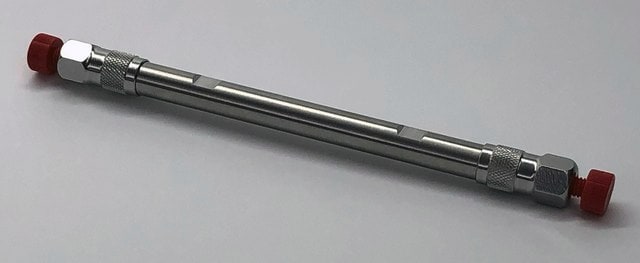
Ascentis® Express C18 (2.7 μm) HPLC Column
L × I.D. 15 cm × 4.6 mm, pk of 1 ea
Synonym(s):
Core-shell (SPP) Fused Core C18 HPLC column
Select a Size
$1,460.00
$1,460.00
Estimated to ship TODAYDetails
About This Item
Skip To
material
stainless steel column
Agency
suitable for USP L1
product line
Ascentis®
feature
endcapped
packaging
pk of 1 ea
manufacturer/tradename
Ascentis®
parameter
60 °C temp. range
600 bar max. pressure (9000 psi)
technique(s)
HPLC: suitable
LC/MS: suitable
UHPLC-MS: suitable
UHPLC: suitable
L × I.D.
15 cm × 4.6 mm
surface area
135 m2/g
impurities
<5 ppm metals
matrix
Fused-Core particle platform
superficially porous particle
matrix active group
C18 (octadecyl) phase
particle size
2.7 μm
pore size
90 Å
operating pH
2-9
application(s)
food and beverages
separation technique
reversed phase
Looking for similar products? Visit Product Comparison Guide
Related Categories
1 of 4
This Item | 582711-U | 53827-U | 50630-U |
|---|---|---|---|
| matrix active group C18 (octadecyl) phase | matrix active group C18 (octadecyl) phase | matrix active group C18 (octadecyl) phase | matrix active group C18 (octadecyl) phase |
| separation technique reversed phase | separation technique reversed phase | separation technique reversed phase | separation technique - |
| particle size 2.7 μm | particle size 2.7 μm | particle size 2.7 μm | particle size std dev 2.7 μm |
| L × I.D. 15 cm × 4.6 mm | L × I.D. 5 cm × 1 mm | L × I.D. 10 cm × 4.6 mm | L × I.D. 10 cm × 1.5 mm |
| agency suitable for USP L1 | agency suitable for USP L1 | agency suitable for USP L1 | agency suitable for USP L1 |
| pore size 90 Å | pore size 90 Å | pore size 90 Å | pore size 90 Å |
General description
Visit the Ascentis Express home page for more information on this new column technology.
Application
Legal Information
related product
used together
Choose from one of the most recent versions:
Already Own This Product?
Find documentation for the products that you have recently purchased in the Document Library.
Articles
Ascentis® Express C18 is the first choice when starting a new separation method.
Derivatization of Aliphatic Amines - Results from the Supelco Ascentis Express column show higher peak resolution, and improved peak shapes than typical chromatograms.
Compendial methods from the USP (United States Pharmacopeia) are widely used in pharmaceutical drug product and raw materials testing. However, not all methods in the USP use modern technologies. In chromatographic methods, it is not uncommon that older brands of columns are specified. Therefore, the USP methods are under continuous revision to improve existing procedures or to allow the user to obtain better results.
Sigma-Aldrich presents an article on serum lipidomics profiling using an Ascentis Express Fused-Core C18 column.
Protocols
Investigate bile acid roles in gut hormone profiles and glycemic control, vital for clinical labs exploring potential mechanisms.
Related Content
Accurately detect and quantify trace nitrosamines (NDMA, NDEA, NEIPA, NDIPA, NDBA, etc.) in pharmaceutical drugs using our complete product portfolio and application guides for LC-MS and GC-MS. Order high-quality reference standards, columns, filters & more.
Ibuprofen and impurity separation using Ascentis Express 90Å C18 column with excellent peak shape and low quantification limits.
Bile Acids (BA) are synthesized in the liver and play important roles in cholesterol homeostasis, absorption of vitamins and lipids, and various key metabolic processes.
Chromatograms
-
How can I determine the shelf life / expiration / retest date of this product?
1 answer-
Helpful?
-
-
How is shipping temperature determined? And how is it related to the product storage temperature?
1 answer-
Products may be shipped at a different temperature than the recommended long-term storage temperature. If the product quality is sensitive to short-term exposure to conditions other than the recommended long-term storage, it will be shipped on wet or dry-ice. If the product quality is NOT affected by short-term exposure to conditions other than the recommended long-term storage, it will be shipped at ambient temperature. As shipping routes are configured for minimum transit times, shipping at ambient temperature helps control shipping costs for our customers. For more information, please refer to the Storage and Transport Conditions document: https://www.sigmaaldrich.com/deepweb/assets/sigmaaldrich/marketing/global/documents/316/622/storage-transport-conditions-mk.pdf
Helpful?
-
-
can this column be used at higher pH (pH 9)?
1 answer-
As noted in the 'PROPERTIES' section, this column has an operating pH of 2 - 9.
Helpful?
-
-
What are the recommended long-term storage conditions for the Ascentis® Express C18, 2.7 μm HPLC Column?
1 answer-
For long-term storage of silica-based, reversed-phase columns like the Ascentis® Express C18, 2.7 μm HPLC Column, it is recommended to store them in 100% acetonitrile. For shorter periods of storage (up to 3 or 4 days), it is generally safe to store the column in most common mobile phases. However, when using buffers, it is advised to protect both the column and the HPLC equipment by flushing the column with the mobile phase that does not contain the buffer. This can be accomplished by flushing the column with a mixture of the mobile phase without the buffer (e.g., when using 60/40 ACN/buffer, flush the column with 60/40 ACN/H2O). This flushing step helps eliminate any risk of corrosion from salts and ensures quick re-equilibration of the column with the original mobile phase. Additionally, before storing the column, it is important to tightly seal the end-fittings with the provided end plugs to prevent the packing material from drying out.
Helpful?
-
-
What is the part number for Phenomenex Kinetex C18 column with dimensions of 150mm (15cm) x 4.6mm ID x 2.6μm particle size?
1 answer-
Unfortunately, we do not provide the Kinetex C18 column from Phenomenex. However, we offer our own alternative with similar characteristics, the Ascentis Express C18 column with a particle size of 2.7μm. The specific part number for this column is 538229-U. Please note that the minimal difference of 1μm in particle size should not significantly impact its performance.
Helpful?
-
-
How can I measure my instrument bandwidth (IBW) and determine what Ascentis® Express HPLC Columns can be used with minimal efficiency loss created by too much internal instrument volume?
1 answer-
The Guide to Dispersion Measurement has simple instructions on how to measure IBW and can be found at sigma-aldrich.com/express.
Helpful?
-
-
What flow rate should I use with Ascentis® Express HPLC Columns?
1 answer-
Based on the minimum in the van Deemter curves, higher flows than 5um particle columns are required in order to maximize Ascentis Express column efficiency. The suggested starting point for flow rate for Ascentis Express columns: 1.6 mL/min for 4.6 mm ID; 0.8 mL/min for 3.0 mm ID; and 0.4mL/min for 2.1 mm ID.
Helpful?
-
-
Can I use Ascentis Express on any type of HPLC system?
1 answer-
Ascentis Express HPLC columns are capable of use on standard HPLC systems as well as UHPLC systems. Columns are packed in high pressure hardware capable of withstanding the pressures used in UHPLC systems.
Helpful?
-
-
What is the Department of Transportation shipping information for this product?
1 answer-
Transportation information can be found in Section 14 of the product's (M)SDS.To access the shipping information for this material, use the link on the product detail page for the product.
Helpful?
-
-
Is there anything special I need to do to my HPLC system to use Ascentis Express?
1 answer-
Nothing special is required to use Ascentis Express HPLC columns. To obtain the full benefits of Ascentis Express, one should minimize dispersion in the HPLC system (tubing, detector flow cell) as well as confirm the detector response system is set at a fast level. For more information, request Guidelines for Optimizing Systems for Ascentis Express Columns (T407102).
Helpful?
-
Active Filters
Our team of scientists has experience in all areas of research including Life Science, Material Science, Chemical Synthesis, Chromatography, Analytical and many others.
Contact Technical Service