Skip to Content
Merck

33117

Cyclohexane

puriss. p.a., ACS reagent, ≥99.5% (GC)

Sign In to View Organizational & Contract Pricing.

Select a Size


About This Item

Empirical Formula (Hill Notation):
C6H12
CAS Number:
Molecular Weight:
84.16
UNSPSC Code:
12191502
NACRES:
NA.21
PubChem Substance ID:
EC Number:
203-806-2
Beilstein/REAXYS Number:
1900225
MDL number:
Assay:
≥99.5% (GC)
Technique(s):
GC/GC: suitable
Bp:
80.7 °C (lit.)
Vapor pressure:
168.8 mmHg ( 37.7 °C)
77 mmHg ( 20 °C)
Technical Service
Need help? Our team of experienced scientists is here for you.
Let Us Assist
Technical Service
Need help? Our team of experienced scientists is here for you.
Let Us Assist

Product Name

Cyclohexane, puriss. p.a., ACS reagent, ≥99.5% (GC)

InChI key

XDTMQSROBMDMFD-UHFFFAOYSA-N

InChI

1S/C6H12/c1-2-4-6-5-3-1/h1-6H2

SMILES string

C1CCCCC1

grade

ACS reagent
puriss. p.a.

vapor density

2.9 (vs air)

vapor pressure

168.8 mmHg ( 37.7 °C)
77 mmHg ( 20 °C)

assay

≥99.5% (GC)

form

liquid

autoignition temp.

500 °F

expl. lim.

9 %

technique(s)

GC/GC: suitable

impurities

≤0.001% free acid (as HCl)
≤0.001% non-volatile matter
≤0.01% water (Karl Fischer)
≤0.05% aromatic substances (as C6H6)
≤0.05% cyclohexene (C6H10)

color

APHA: ≤10

refractive index

n20/D 1.4250-1.4280
n20/D 1.426 (lit.)

bp

80.7 °C (lit.)

mp

4-7 °C (lit.)

transition temp

solidification point 5.5-6.5 °C

density

0.779 g/mL at 25 °C (lit.)

cation traces

Al: ≤0.5 mg/kg
B: ≤0.02 mg/kg
Ba: ≤0.1 mg/kg
Ca: ≤0.5 mg/kg
Cd: ≤0.05 mg/kg
Co: ≤0.02 mg/kg
Cr: ≤0.02 mg/kg
Cu: ≤0.02 mg/kg
Fe: ≤0.1 mg/kg
Mg: ≤0.1 mg/kg
Mn: ≤0.02 mg/kg
Ni: ≤0.02 mg/kg
Pb: ≤0.1 mg/kg
Sn: ≤0.1 mg/kg
Zn: ≤0.1 mg/kg

suitability

passes test for reaction against H2SO4

Quality Level

Looking for similar products? Visit Product Comparison Guide

Application

Cyclohexane has been used to prepare a 1.3M solution of sec-butyllithium. It may be used as a starting reagent for the synthesis of adipic acid and ε-caprolactam.

General description

Cyclohexane undergoes oxidation in the presence of various oxidants such as hydrogen peroxide, tert-butyl hydroperoxide and molecular oxygen.

Other Notes

Pertains only in Germany: unversteuert
The article number 33117-4X2.5L will be discontinued. Please order the single bottle 33117-2.5L which is physically identical with the same exact specifications.
The article number 33117-4X2.5L-M will be discontinued. Please order the single bottle 33117-2.5L-M which is physically identical with the same exact specifications.
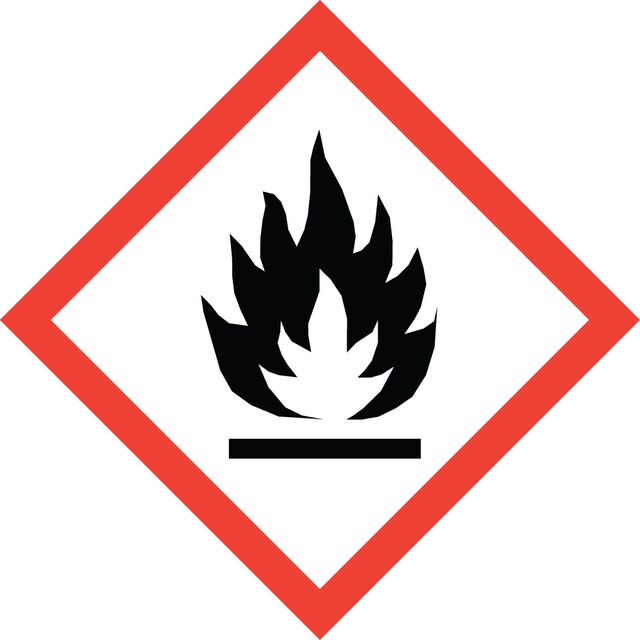

signalword

Danger

Hazard Classifications

Aquatic Acute 1 - Aquatic Chronic 1 - Asp. Tox. 1 - Flam. Liq. 2 - Skin Irrit. 2 - STOT SE 3

target_organs

Central nervous system

Storage Class

3 - Flammable liquids

wgk

WGK 2

flash_point_f

-4.0 °F - closed cup

flash_point_c

-20 °C - closed cup


Choose from one of the most recent versions:

Certificates of Analysis (COA)

Lot/Batch Number

Don't see the Right Version?

If you require a particular version, you can look up a specific certificate by the Lot or Batch number.

Already Own This Product?

Find documentation for the products that you have recently purchased in the Document Library.

Visit the Document Library

Cyclohexane oxidation continues to be a challenge.
Schuchardt ULF, et al.
Applied Catalysis A: General, 211(1), 1-17 (2001)
Hyperbranched nanomolecules: Regular polystyrene dendrigrafts.
Muchtar Z, et al.
Macromolecules, 34(22), 7595-7600 (2001)
Eagleson M.
Concise Encyclopedia Chemistry, 168-168 (1994)
Sandra Yucra et al.
Environmental health : a global access science source, 7, 59-59 (2008-11-19)
Organophosphates are broad class of chemicals widely used as pesticides throughout the world. We performed a cross-sectional study of associations between dialkylphosphate metabolites of organophosphates and semen quality among pesticide applicators in Majes (Arequipa), Peru. Thirty-one men exposed to organophosphate
Amanda L Pitts et al.
Journal of the American Chemical Society, 136(24), 8614-8625 (2014-05-16)
Carbon-hydrogen bond activation reactions of four cycloalkanes (C5H10, C6H12, C7H14, and C8H16) by the Cp'Rh(CO) fragments (Cp' = η(5)-C5H5 (Cp) or η(5)-C5Me5 (Cp*)) were modeled theoretically by combining density functional and coupled cluster theories, and their reaction rates were measured

Our team of scientists has experience in all areas of research including Life Science, Material Science, Chemical Synthesis, Chromatography, Analytical and many others.

Contact Technical Service