Skip to Content
Merck

03747

Ethylene glycol

BioUltra, ≥99.5% (GC)

Synonym(s):

1,2-Ethanediol

Sign In to View Organizational & Contract Pricing.

Select a Size


About This Item

Linear Formula:
HOCH2CH2OH
CAS Number:
Molecular Weight:
62.07
PubChem Substance ID:
eCl@ss:
39020501
UNSPSC Code:
12352137
NACRES:
NA.26
EC Number:
203-473-3
MDL number:
Beilstein/REAXYS Number:
505945
Assay:
≥99.5% (GC)
Technique(s):
affinity chromatography: suitable
Bp:
195-198 °C
Vapor pressure:
0.08 mmHg ( 20 °C)
Technical Service
Need help? Our team of experienced scientists is here for you.
Let Us Assist
Technical Service
Need help? Our team of experienced scientists is here for you.
Let Us Assist

Product Name

Ethylene glycol, BioUltra, ≥99.5% (GC)

SMILES string

OCCO
OCCO

InChI key

LYCAIKOWRPUZTN-UHFFFAOYSA-N

InChI

1S/C2H6O2/c3-1-2-4/h3-4H,1-2H2

vapor density

2.1 (vs air)

vapor pressure

0.08 mmHg ( 20 °C)

product line

BioUltra

assay

≥99.5% (GC)

form

liquid

autoignition temp.

752 °F

expl. lim.

15.3 %

technique(s)

affinity chromatography: suitable

impurities

insoluble matter, passes filter test
≤0.002% free acid (as CH3COOH)
≤0.1% water

refractive index

n20/D 1.431 (lit.)
n20/D 1.431

bp

195-198 °C

mp

−13 °C (lit.)

density

1.113 g/mL at 25 °C (lit.)

anion traces

chloride (Cl-): ≤10 mg/kg
sulfate (SO42-): ≤10 mg/kg

cation traces

Al: ≤0.5 mg/kg
As: ≤0.1 mg/kg
Ba: ≤0.1 mg/kg
Bi: ≤0.1 mg/kg
Ca: ≤0.5 mg/kg
Cd: ≤0.05 mg/kg
Co: ≤0.02 mg/kg
Cr: ≤0.02 mg/kg
Cu: ≤0.02 mg/kg
Fe: ≤0.1 mg/kg
K: ≤0.5 mg/kg
Li: ≤0.1 mg/kg
Mg: ≤0.1 mg/kg
Mn: ≤0.02 mg/kg
Mo: ≤0.1 mg/kg
Na: ≤1 mg/kg
Ni: ≤0.02 mg/kg
Pb: ≤0.1 mg/kg
Sr: ≤0.1 mg/kg
Zn: ≤0.1 mg/kg

λ

neat

UV absorption

λ: 260 nm Amax: ≤0.03
λ: 280 nm Amax: ≤0.01

Quality Level

Looking for similar products? Visit Product Comparison Guide

Other Notes
For desorption in immuno-affinity chromatography; Additive for the stabilization of urinary enzymes

pictograms

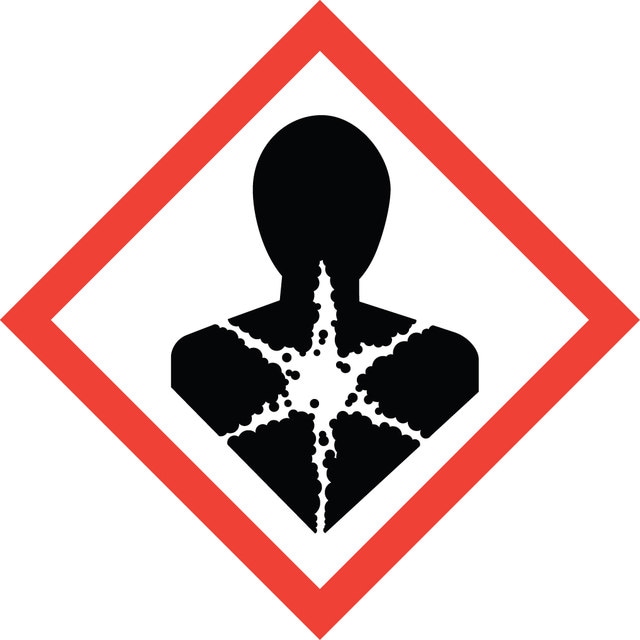
Health hazardExclamation mark

signalword

Warning

hcodes

Hazard Classifications

Acute Tox. 4 Oral - STOT RE 2 Oral

target_organs

Kidney

Storage Class

10 - Combustible liquids

wgk

WGK 1

flash_point_f

239.0 °F - open cup

flash_point_c

115 °C - open cup

ppe

Eyeshields, Faceshields, Gloves, type ABEK (EN14387) respirator filter


Choose from one of the most recent versions:

Certificates of Analysis (COA)

Lot/Batch Number

Don't see the Right Version?

If you require a particular version, you can look up a specific certificate by the Lot or Batch number.

Already Own This Product?

Find documentation for the products that you have recently purchased in the Document Library.

Visit the Document Library

J P Li et al.
Journal of biochemical and biophysical methods, 22(4), 311-320 (1991-05-01)
An affinity chromatography column packed with nonporous agarose beads derivatized with human growth hormone via carbonyldiimidazol was used for the purification of antibodies against human growth hormone from antiserum. Desorption with 1 M sodium chloride in 60% ethylene glycol at
K Jung et al.
Clinical biochemistry, 21(1), 53-57 (1988-01-01)
We examined the stability of N-acetyl-beta-D-glucosaminidase (EC 3.2.1.30), alanine aminopeptidase (EC 3.4.11.2), alkaline phosphatase (EC 3.1.3.1), gamma-glutamyltransferase (EC 2.3.2.2), and lysozyme (EC 3.2.1.17) in urine prepared by gel filtration and supplemented with albumin, or ethylene glycol, or ethylene glycol plus
P L Lim
Molecular immunology, 24(1), 11-15 (1987-01-01)
Comparative studies on the efficacies of various buffers in eluting absorbent-bound antibodies revealed the denaturative effect of 3 M KSCN on all three IgM antibodies but not on an IgG protein, and the generally weak eluting power of glycine-HCl buffer
Peter Mygind Leth et al.
Forensic science international, 155(2-3), 179-184 (2005-10-18)
Ethylene glycol (EG) can be found in many agents, such as antifreeze. Ingestion of EG may cause serious poisoning. Adults are typically exposed when EG is ingested as a cheap substitute for ethanol or in suicide-attempts. Children may be exposed
Andrea Marchionni et al.
ChemSusChem, 6(3), 518-528 (2013-02-14)
The electrooxidation of ethylene glycol (EG) and glycerol (G) has been studied: in alkaline media, in passive as well as active direct ethylene glycol fuel cells (DEGFCs), and in direct glycerol fuel cells (DGFCs) containing Pd-(Ni-Zn)/C as an anode electrocatalyst

Our team of scientists has experience in all areas of research including Life Science, Material Science, Chemical Synthesis, Chromatography, Analytical and many others.

Contact Technical Service