
If this product has an expiration or retest date, it will be shown on the Certificate of Analysis (COA, CofA). If there is no retest or expiration date listed on the product's COA, we do not have suitable stability data to determine a shelf life. For these products, the only date on the COA will be the release date; a retest, expiration, or use-by-date will not be displayed.
For all products, we recommend handling per defined conditions as printed in our product literature and website product descriptions. We recommend that products should be routinely inspected by customers to ensure they perform as expected.
For products without retest or expiration dates, our standard warranty of 1 year from the date of shipment is applicable.
For more information, please refer to the Product Dating Information document: https://www.sigmaaldrich.com/deepweb/assets/sigmaaldrich/marketing/global/documents/418/501/product-dating-information-06-25-mk.pdf
P2287

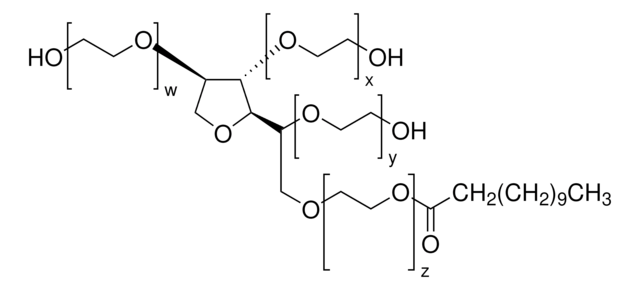
TWEEN® 20
viscous liquid, suitable for cell culture
Synonym(s):
Polysorbate 20, Polyethylene glycol sorbitan monolaurate, Polyoxyethylenesorbitan monolaurate
Select a Size
About This Item
Skip To
description
non-ionic
form
viscous liquid
mol wt
~1228
composition
lauric acid, ≥40% (balance primarily myristic, palmoyic, and stearic acids)
concentration
≥40.0%
technique(s)
cell culture | mammalian: suitable
refractive index
n20/D 1.468 (lit.)
CMC
0.06 mM (20-25°C)
transition temp
cloud point 76 °C
solubility
water: soluble (Water solubility: 0,0002 g/l at 20 °C - OECD Test Guideline 105)
density
1.095 g/mL at 25 °C (lit.)
1.1 g/cm3 at 25 °C (lit.)
HLB
16.7
application(s)
(ELISA and immunoassays)
SMILES string
CCCCCCCCCCCC(=O)OCCOCC(C1C(C(CO1)OCCO)OCCO)OCCO
InChI
1S/C26H50O10/c1-2-3-4-5-6-7-8-9-10-11-24(30)34-19-18-31-20-22(32-15-12-27)26-25(35-17-14-29)23(21-36-26)33-16-13-28/h22-23,25-29H,2-21H2,1H3
InChI key
HMFKFHLTUCJZJO-UHFFFAOYSA-N
Looking for similar products? Visit Product Comparison Guide
1 of 4
This Item | P9416 | P7949 | 93773 |
|---|---|---|---|
| technique(s) cell culture | mammalian: suitable | technique(s) - | technique(s) blocking: suitable, cell culture | mammalian: suitable, hybridization: suitable, protein purification: suitable, transformation: suitable | technique(s) DNA extraction: suitable, RNA extraction: suitable, cell culture | mammalian: suitable, protein purification: suitable |
| form viscous liquid | form viscous liquid | form viscous liquid | form viscous liquid |
| Quality Level 300 | Quality Level 300 | Quality Level 300 | Quality Level 200 |
| solubility water: soluble | solubility water: 100 mg/mL, clear, colorless to yellow | solubility - | solubility - |
| density 1.095 g/mL at 25 °C (lit.), 1.1 g/cm3 at 25 °C (lit.) | density 1.095 g/mL at 25 °C (lit.) | density 1.095 g/mL at 25 °C (lit.) | density 1.11 g/mL at 20 °C, 1.095 g/mL at 25 °C (lit.) |
| description non-ionic | description non-ionic | description non-ionic | description non-ionic |
General description
Application
TWEEN 20 has been used as a blocking agent for membrane based immunoassays at a typical concentration of 0.05%. TWEEN 20 can be used for lysing mammalian cells at a concentration of 0.005 to 0.5%.
Preparation Note
Legal Information
Disclaimer
Storage Class Code
10 - Combustible liquids
WGK
WGK 1
Flash Point(F)
527.0 °F - Pensky-Martens closed cup
Flash Point(C)
275 °C - Pensky-Martens closed cup
Personal Protective Equipment
Choose from one of the most recent versions:
Already Own This Product?
Find documentation for the products that you have recently purchased in the Document Library.
Articles
ผลิตภัณฑ์วัฒนธรรม Organoid เพื่อสร้างเนื้อเยื่อและเซลล์ต้นกำเนิดที่ได้จากสมอง 3 มิติลำไส้ลำไส้ลำไส้ปอดและมะเร็งรูปแบบ organoid เนื้องอก
Organoid culture products to generate tissue and stem cell derived 3D brain, intestinal, gut, lung and cancer tumor organoid models.
Related Content
Product Information Sheet
-
How can I determine the shelf life / expiration / retest date of this product?
1 answer-
Helpful?
-
-
Have you ever tested the pH of TWEEN 20?
1 answer-
The product does not have a quality specification for pH and, consequently, is not tested.
Helpful?
-
-
How is shipping temperature determined? And how is it related to the product storage temperature?
1 answer-
Products may be shipped at a different temperature than the recommended long-term storage temperature. If the product quality is sensitive to short-term exposure to conditions other than the recommended long-term storage, it will be shipped on wet or dry-ice. If the product quality is NOT affected by short-term exposure to conditions other than the recommended long-term storage, it will be shipped at ambient temperature. As shipping routes are configured for minimum transit times, shipping at ambient temperature helps control shipping costs for our customers. For more information, please refer to the Storage and Transport Conditions document: https://www.sigmaaldrich.com/deepweb/assets/sigmaaldrich/marketing/global/documents/316/622/storage-transport-conditions-mk.pdf
Helpful?
-
Active Filters
Our team of scientists has experience in all areas of research including Life Science, Material Science, Chemical Synthesis, Chromatography, Analytical and many others.
Contact Technical Service