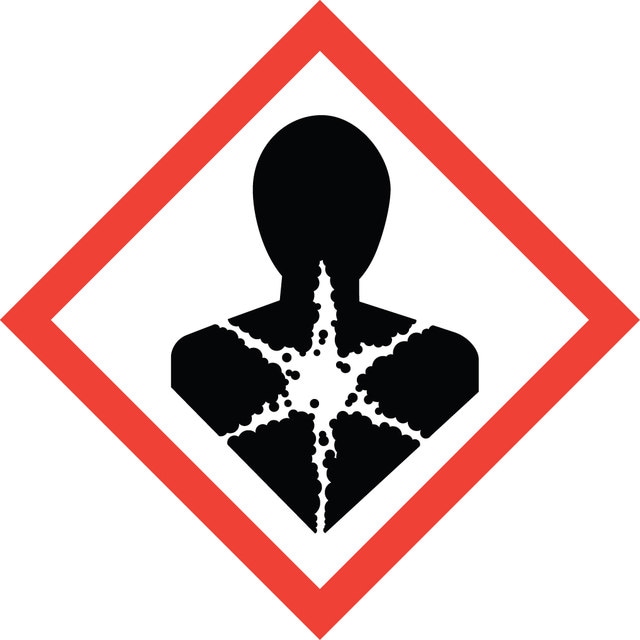
The Safety Data Sheet does state Evans Blue is a Category 1B carcinogen. In another section of the SDS there is a statement to seek approval for use. This would mean you should consult with your Safety Department about proper handling procedures. Dyes in solution pose less risk than if weighing out the dry dye to prepare staining solution. At a minimum, wear gloves, a lab coat and eye protection. The decision to wear a respirator should be made based on individual risk assessment.
Select a Size
$73.40
$292.00
$481.00
$73.40
Available to ship TODAYDetails
About This Item
Skip To
Product Name
Evans Blue, Dye content ≥75 %
InChI key
ATNOAWAQFYGAOY-GPTZEZBUSA-J
InChI
1S/C34H28N6O14S4.4Na/c1-15-11-17(3-7-21(15)37-39-23-9-5-19-25(55(43,44)45)13-27(57(49,50)51)31(35)29(19)33(23)41)18-4-8-22(16(2)12-18)38-40-24-10-6-20-26(56(46,47)48)14-28(58(52,53)54)32(36)30(20)34(24)42;;;;/h3-14,41-42H,35-36H2,1-2H3,(H,43,44,45)(H,46,47,48)(H,49,50,51)(H,52,53,54);;;;/q;4*+1/p-4/b39-37+,40-38+;;;;
SMILES string
[Na+].[Na+].[Na+].[Na+].Cc1cc(ccc1\N=N\c2ccc3c(cc(c(N)c3c2O)S([O-])(=O)=O)S([O-])(=O)=O)-c4ccc(\N=N\c5ccc6c(cc(c(N)c6c5O)S([O-])(=O)=O)S([O-])(=O)=O)c(C)c4
form
powder
composition
Dye content, ≥75%
technique(s)
titration: suitable
application(s)
diagnostic assay manufacturing
hematology
histology
storage temp.
room temp
Quality Level
Gene Information
human ... PTPN1(5770), PTPRF(5792)
Looking for similar products? Visit Product Comparison Guide
1 of 4
This Item | 302643 | B0149 | C8679 |
|---|---|---|---|
| technique(s) titration: suitable | technique(s) microbe id | staining: suitable | technique(s) microbe id | staining: suitable | technique(s) - |
| form powder | form powder | form powder | form powder |
| application(s) diagnostic assay manufacturing | application(s) diagnostic assay manufacturing | application(s) diagnostic assay manufacturing | application(s) diagnostic assay manufacturing |
| Quality Level 200 | Quality Level 200 | Quality Level 200 | Quality Level 200 |
| storage temp. room temp | storage temp. room temp | storage temp. room temp | storage temp. room temp |
| composition Dye content, ≥75% | composition Dye content, 60% | composition Dye content, ~50% | composition Dye content, ~80% |
Application
Biochem/physiol Actions
General description
signalword
Danger
hcodes
Hazard Classifications
Carc. 1B
Storage Class
6.1C - Combustible acute toxic Cat.3 / toxic compounds or compounds which causing chronic effects
wgk
WGK 3
flash_point_f
Not applicable
flash_point_c
Not applicable
Choose from one of the most recent versions:
Already Own This Product?
Find documentation for the products that you have recently purchased in the Document Library.
-
I am making a 0.5% w/v solution of Evans blue with distilled water. I am wearing a fit tested N95 and dissolving under a fume hood. Once my solution is made, can I prepare slides in a well ventilated lab, or is it suggested to do all work under the hood?
1 answer-
Helpful?
-
-
What amount and concentration should I use Evans-Blaun injecting it into the ear skin of a mouse to see Evans-Blue in the draining Lymphnodes afterwards?
1 answer-
This product has not been tested for any specific application, including in vivo use. Suitability would have to be determined experimentally by the end user. Historical information suggests that a concentration of 0.5% Evans Blue in PBS at pH 7.4 has been used successfully in staining tissue sections. This concentration may also be effective starting point for in vivo applications. Please refer to available literature for additional information.
Helpful?
-
-
How to prepare a stock 1% solution using E2129, and is ther any guidance on its use?
1 answer-
A 0.5% solution of Evans Blue in PBS, pH 7.4. Product P3813 should be used as the PBS, which will serve as the stock solution. For use, 3-4 drops should be added to 100 mL of PBS P3813. This should be used as the final rinse with a 5-minute wash. After rinsing briefly, coverslip the sample.
Helpful?
-
-
Should Evans Blue solutions for fluorescent assays be aged or cured for 7 days before use?
1 answer-
While some dyes require aging before use, there is no indication that Evans Blue solutions need to be aged or cured before use.
Helpful?
-
-
What is the stability of the E2129 solution once prepared?
1 answer-
The stability of the solution will depend on whether the solutions are sterile filtered or contaminated through routine use. It's recommended to store the solutions in the dark at 2-8°C.
Helpful?
-
-
How do I dilute 80% purity evans blue powder into a 2% solution with normal saline?
1 answer-
This product is soluble in water at 60 mg/mL. For typical laboratory staining applications, a 1X PBS solution is also commonly used. Solubility in normal saline has not been evaluated, but rates are expected to be similar. A 2% solution would be 20 mg/mL. The dye content is lot-specific and reported in the Certificate of Analysis. Please see the link below to access a sample or batch-specific Certificate:
https://www.sigmaaldrich.com/product/sigma/e2129#product-documentationHelpful?
-
-
What is the shelf life of Product E2129, Evans Blue?
1 answer-
This product has a retest date of 4 years. This information can be found on the Certificate of Analysis.
Helpful?
-
-
Can Evans Blue, Product E2129, be used as a counterstain for FITC?
1 answer-
This product can be used as a counterstain in immunohistochemistry when using FITC. After staining for immunofluorescence, dip sections in a 0.1% (w/v) in water solution of Evans Blue for 5-10 minutes. Rinse well in fresh PBS or water before coverslipping. Reference: Immunocytochemistry, Theory and Practice, p. 82 (1988).
Helpful?
-
-
What is the Department of Transportation shipping information for this product?
1 answer-
Transportation information can be found in Section 14 of the product's (M)SDS.To access the shipping information for this material, use the link on the product detail page for the product.
Helpful?
-
-
What is the solution stability of Product E2129, Evans Blue?
1 answer-
This product is rather stable in aqueous solution and may be autoclaved at 15 psi for 30 min. However, dye made up in physiological saline should not be autoclaved.
Helpful?
-
Active Filters
Our team of scientists has experience in all areas of research including Life Science, Material Science, Chemical Synthesis, Chromatography, Analytical and many others.
Contact Technical Service