
Direkt zum Inhalt
Merck

Fortfahren mit

204876

Komplement C1q, human

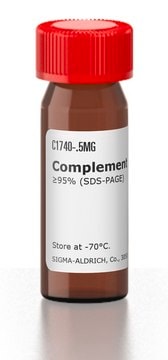
Complement C1q, Human, CAS 80295-33-6, is a native C1q complement component composed of 18 polypeptide chains consisting of three nonidentical A, B, C subunits of 29, 26, and 19 kDa, respectively.

Synonym(e):

Komplement C1q, human

Anmelden zur Ansicht der Organisations- und Vertragspreise.

Größe auswählen

Ansicht ändern
Größe/SKUVerfügbarkeitPreis
1 mg
Warenkorb auf Verfügbarkeit prüfen
€ 586,00

Über diesen Artikel

CAS-Nummer:
UNSPSC Code:
12352202
NACRES:
NA.77
MDL number:
Form:
liquid
Assay:
≥90% (SDS-PAGE)

€ 586,00


Warenkorb auf Verfügbarkeit prüfen

​
Technischer Dienst
Benötigen Sie Hilfe? Unser Team von erfahrenen Wissenschaftlern ist für Sie da.
Unterstützung erhalten


Quality Segment

assay

≥90% (SDS-PAGE)

form

liquid

manufacturer/tradename

Calbiochem®

storage condition

OK to freeze, avoid repeated freeze/thaw cycles

impurities

IgG, IgA, IgM, C3, C4, albumin, fibrinogen, α₂-macroglobulin, trace

shipped in

dry ice

storage temp.

−70°C

General description

Native humane Komplementkomponente C1q. Glykoprotein, bestehend aus 18 Polypeptidketten, die aus drei nichtidentischen Untereinheiten A, B und C mit einem Molekulargewicht von 29 kDa bzw. 26 kDa bzw. 19 kDa bestehen. Es kommt in normalem menschlichem Serum in Konzentrationen von 70 µg/mL vor. Es ist in zirkulierendem Blutplasma zu finden und bildet zusammen mit je zwei C1r- und zwei C1s-Molekülen die erste Komponente des Komplementsystems (C1). Die Aktivierung des Komplements über den klassischen Weg wird ausgelöst durch die Bindung von C1q an Immunkomplexe, die IgG oder IgM oder eine Reihe anderer aktivierender Substanzen umfassen, darunter auch C-reaktives Protein, Retroviren und Mitochondrien. Nach dieser Bindung von C1q werden C1r und C1s in proteolytische Enzyme umgewandelt, die verantwortlich für die Fortsetzung der Aktivierung über den klassischen Weg sind.

Biochem/physiol Actions

≥150,000 C1qH50 Einheiten/mg und ≥70% C1q-Aktivität in normalem menschlichem Serum auf mg/mg-Basis

Packaging

Die chargenspezifische Konzentration entnehmen Sie bitte dem Fläschchenetikett.

Physical form

In 300 mM NaCl, 10 mM HEPES, 40 % Glycerol, pH 7,2.

Preparation Note

Aus Serum hergestellt, das in zertifizierten Tests für HBsAg und Antikörper gegen HIV und HCV als negativ befunden wurde.
Nach dem erstmaligen Auftauen in Aliquote aufteilen und einfrieren (-70 °C).

Other Notes

Loos, M., et al. 1980. J. Immunol. 124, 59.
Kolb, W.P., et al. 1979. J. Immunol. 122, 2103.

Legal Information

CALBIOCHEM is a registered trademark of Merck KGaA, Darmstadt, Germany

Disclaimer

Toxizität: Standard-Handhabung (A)

Ähnliche Artikel vergleichen

Vollständigen Vergleich anzeigen

Unterschiede anzeigen

1 of 1

Dieser Artikel
C1740204910204896
description

Complement C1q, Human, CAS 80295-33-6, is a native C1q complement component composed of 18 polypeptide chains consisting of three nonidentical A, B, C subunits of 29, 26, and 19 kDa, respectively.

description

≥95% (SDS-PAGE)

description

Complement C9, Human, CAS 80295-59-6, is a native, single-chain glycoprotein present in normal human serum at 60 µg/ml.

description

Complement C8, Human, CAS 80295-58-5, is a native glycoprotein composed of three non-identical subunits of 64, (α), 64 (β), and 22 kDa (γ).

assay

≥90% (SDS-PAGE)

assay

≥95% (SDS-PAGE)

assay

≥95% (SDS-PAGE)

assay

≥85% (SDS-PAGE)

form

liquid

form

liquid

form

liquid

form

liquid

storage temp.

−70°C

storage temp.

−70°C

storage temp.

−70°C

storage temp.

−70°C

impurities

IgG, IgA, IgM, C3, C4, albumin, fibrinogen, α₂-macroglobulin, trace

impurities

-

impurities

IgG, IgA, IgM, albumin, C3, C4, C5, C6, C7, or C8, trace

impurities

IgG, IgA, IgM, albumin, C3, C4, C7, C9, trace

storage condition

OK to freeze, avoid repeated freeze/thaw cycles

storage condition

-

storage condition

avoid repeated freeze/thaw cycles, OK to freeze

storage condition

OK to freeze, avoid repeated freeze/thaw cycles

shipped in

dry ice

shipped in

dry ice

shipped in

wet ice

shipped in

dry ice


Lagerklasse

10 - Combustible liquids

WGK

WGK 2


Hier finden Sie alle aktuellen Versionen:

Analysenzertifikate (COA)

Lot/Batch Number

It looks like we've run into a problem, but you can still download Certificates of Analysis from our Dokumente section.

Wenn Sie Hilfe benötigen, wenden Sie sich bitte an Kundensupport

Besitzen Sie dieses Produkt bereits?

In der Dokumentenbibliothek finden Sie die Dokumentation zu den Produkten, die Sie kürzlich erworben haben.

Die Dokumentenbibliothek aufrufen


Questions

1–2 of 2 Questions  
  1. We are trying to find a commercial C1q that can be used for preclinical studies to establish mouise models. For this purpouse we need it only C1q and not contain C1r or C1s. Do you have information about the traces of C1r or C1s in this product?

    1 answer
    1. C1q is purified from pooled normal human plasma. C1q separated from C1r and C1s and from other stabilizing proteins tends to aggregate easily. Because it was isolated and studied in numerous research laboratories, many buffers have been used to stabilize concentrated C1q and prevent aggregation. This product is presented as In 10 mM HEPES, 300 mM NaCl pH 7.2, 40% glycerol.

      The protein concentration is of C1q; C1q has an extinction coefficient of E1%/280nm = 6.8. The functional activity is C1q activity in NHS on a mg/mg basis.

      This product is native, human C1q complement component. Glycoprotein composed of 18 polypeptide chains consisting of three nonidentical subunits, A, B, and C, of M.W. 29 kDa, 26 kDa, and 19 kDa, respectively. Present in normal human serum at 70 µg/ml. Found in circulating blood plasma complexed with two C1r and two C1s molecules to form the first component of complement (C1). Activation of complement via classical pathway is triggered by binding of C1q to immune complexes containing IgG or IgM or to a variety of other activating substances, including C-reactive protein, retroviruses, and mitochondria. Subsequent to C1q binding, C1r and C1s are converted to proteolytic enzymes that are responsible for continuation of activation via the classical pathway. This product is tested for purity but not for C1r and C1s content.

      Helpful?

  2. Is this product suitable for cell culture?

    1 answer
    1. This product has not been tested for use in cell culture. Note that product C1740, while not tested for cell culture applications, has been used successfully by researchers. Please see the link below to review this product, including the peer reviewed papers:
      https://www.sigmaaldrich.com/product/sigma/c1740

      Helpful?

Reviews

No rating value

Active Filters