

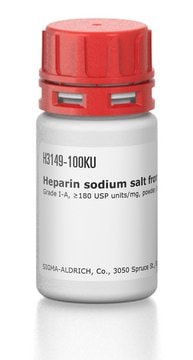


"Grade I-A" originates from product listings for heparin prior to the implementation of the current catalog numbering system. This older grading system has since been phased out, but the terminology was retained in the descriptions of some current products. The M-Clarity™ Program accurately defines the current quality classification system, along with specifications listed in the product Specification Sheet and/or Certificate of Analysis.
Fortfahren mit
H3393

Heparin Natriumsalz aus Schweinedarm
Grade I-A, ≥180 USP units/mg
Synonym(e):
Natrium-Heparin
Anmelden zur Ansicht der Organisations- und Vertragspreise.
Größe auswählen
Ansicht ändern
| Größe/SKU | Verfügbarkeit | Preis |
|---|
Über diesen Artikel
Preise und Verfügbarkeit sind derzeit nicht verfügbar.
Technischer Dienst
Benötigen Sie Hilfe? Unser Team von erfahrenen Wissenschaftlern ist für Sie da.
Unterstützung erhaltenbiological source
Porcine intestinal mucosa
Quality Segment
type
Grade I-A
form
powder
specific activity
≥180 USP units/mg
color
beige
useful pH range
5.0 - 7.5
solubility
H2O: 50 mg/mL, clear, colorless to faintly yellow
application(s)
advanced drug delivery
clinical research
diagnostic assay manufacturing
life science and biopharma
storage temp.
room temp
SMILES string
[Na+].[S](=O)(=O)(NC1C(OC(C(C1O[S](=O)(=O)O)OC4OC(C(C(C4O[S](=O)(=O)O)O)O)C(=O)O)CO)OC2C(OC(C(C2O)O[S](=O)(=O)O)OC3C(OC(C(C3O)NC(=O)C)O)CO[S](=O)(=O)O)C(=O)O)O
InChI key
JRTRSJGZMRQDHI-UHFFFAOYSA-N
General description
Heparin ist ein Glykosaminoglykan (GAG), das zur Familie der Mucopolysaccharide gehört und für seine starken gerinnungshemmenden Eigenschaften bekannt ist. Dieses stark sulfatierte Polysaccharid besteht aus D-Glucosamin und Hexuronsäure, die über glykosidische Bindungen miteinander verbunden sind. Es findet breite Anwendung in der biochemischen Forschung und in Zellkulturstudien.
Application
Heparinnatriumsalz aus der Darmschleimhaut von Schweinen wurde in dem Medium zur Befruchtung von Oozyten mit Spermien ergänzt. Heparin-Natriumsalz aus der Darmschleimhaut vom Schwein wird verwendet:
- zur Prüfung der Wirkung von Heparin auf den Fibroblasten-Wachstumsfaktor 21 (FGF21)-Signalweg
- bei der Immunfärbung von Gehirnschnitten von Mäusen
- zur Quantifizierung von weißen und roten Blutkörperchen in Sparus-aurata-Blutproben
- bei Antikoagulationstests und beim Inhibitionstest für SARS-CoV2 (schweres akutes respiratorisches Syndrom Coronavirus 2 )
Biochem/physiol Actions
Heparin ist vorwiegend für die Verzögerung der Blutgerinnung verantwortlich. Es verstärkt die Antithrombin-vermittelte Inaktivierung von Proteasen im Gerinnungsweg.
Heparin wird in Mastzellen und Mediatoren wie Histamin synthetisiert und wird mit Allergien und Entzündungsvorgängen in Verbindung gebracht Heparin wird zur Therapie von Venenthrombose und Lungenembolie, zur Prävention eines Thromboserezidivs nach einer Thrombolyse und zum Management arterieller Thrombosen bei Patienten mit akutem Herzinfarkt eingesetzt. Heparin übt eine entzündungshemmende Wirkung bei zahlreichen entzündlichen Erkrankungen wie Verbrennungen, Asthma bronchiale und Colitis ulcerosa aus.
Heparin wird in Mastzellen und Mediatoren wie Histamin synthetisiert und wird mit Allergien und Entzündungsvorgängen in Verbindung gebracht Heparin wird zur Therapie von Venenthrombose und Lungenembolie, zur Prävention eines Thromboserezidivs nach einer Thrombolyse und zum Management arterieller Thrombosen bei Patienten mit akutem Herzinfarkt eingesetzt. Heparin übt eine entzündungshemmende Wirkung bei zahlreichen entzündlichen Erkrankungen wie Verbrennungen, Asthma bronchiale und Colitis ulcerosa aus.
Other Notes
Füllen Sie bitte dieses Formular aus, um weitere Informationen zu unserem Sortiment an Biochemikalien zu erhalten.
Für einen umfassenden Überblick über unser vielfältiges Angebot an Polysacchariden für Ihre Forschung empfehlen wir Ihnen den Besuch unserer Seite zur Kategorie Kohlenhydrate.
Heparin für die Diagnostikum-Herstellung ist unter Produktnummer SRE0027 erhältlich.
Heparinlösungen dürfen nicht autoklaviert werden, da es bei hohen Temperaturen zu einer zusätzlichen Vernetzung der Zuckermoleküle kommen kann. Sie dürfen auch nicht eingefroren werden.
1 of 1
Dieser Artikel | |||
|---|---|---|---|
| description Grade I-A, ≥180 USP units/mg | description Grade I-A, ≥180 USP units/mg, powder, BioReagent, suitable for cell culture | description ≥180 USP units/mg | description ≥150 IU/mg (dry basis) |
| biological source Porcine intestinal mucosa | biological source Porcine intestinal mucosa | biological source Porcine intestinal mucosa | biological source Porcine intestinal mucosa |
| solubility H2O: 50 mg/mL, clear, colorless to faintly yellow | solubility H2O: 50 mg/mL | solubility H2O: 50 mg/mL, clear, colorless to faintly yellow | solubility H2O: 50 mg/mL, clear, colorless to faintly yellow |
| Quality Level 200 | Quality Level 200 | Quality Level 200 | Quality Level 200 |
| form powder | form powder | form powder | form powder |
| storage temp. room temp | storage temp. room temp | storage temp. 2-8°C | storage temp. room temp |
| useful pH range 5.0 - 7.5 | useful pH range - | useful pH range - | useful pH range - |
Still not finding the right product?
Explore all of our products under Heparin Natriumsalz aus Schweinedarm
Lagerklasse
11 - Combustible Solids
WGK
WGK 2
Flammpunkt (°F)
Not applicable
Flammpunkt (°C)
Not applicable
PSA (Persönliche Schutzausrüstung)
Eyeshields, Gloves, type N95 (US)
Hier finden Sie alle aktuellen Versionen:
Besitzen Sie dieses Produkt bereits?
In der Dokumentenbibliothek finden Sie die Dokumentation zu den Produkten, die Sie kürzlich erworben haben.
-
What does Grade I-A mean?
1 answer-
Helpful?
-
-
How can I determine the shelf life / expiration / retest date of this product?
1 answer-
If this product has an expiration or retest date, it will be shown on the Certificate of Analysis (COA, CofA). If there is no retest or expiration date listed on the product's COA, we do not have suitable stability data to determine a shelf life. For these products, the only date on the COA will be the release date; a retest, expiration, or use-by-date will not be displayed.
For all products, we recommend handling per defined conditions as printed in our product literature and website product descriptions. We recommend that products should be routinely inspected by customers to ensure they perform as expected.
For products without retest or expiration dates, our standard warranty of 1 year from the date of shipment is applicable.
For more information, please refer to the Product Dating Information document: https://www.sigmaaldrich.com/deepweb/assets/sigmaaldrich/marketing/global/documents/418/501/product-dating-information-06-25-mk.pdfHelpful?
-
-
How do I calculate how much Heparin sodium salt I need to prevent coagulation in a gallon of cow's blood? Would it have to be dissolved in a saline solution first?
1 answer-
The typical dosage of heparin for anticoagulation can vary based on the specific application and the type of blood product. For general anticoagulation, a common range is between 5 to 30 units of heparin per milliliter of blood. For cow's blood, the amount of this product needed will depend on the desired dosage and the volume of blood, which may be found in veterinary guidelines or literature. It is advisable to dissolve it in a saline solution or sterile water before use to ensure effective administration.
Helpful?
-
-
How is shipping temperature determined? And how is it related to the product storage temperature?
1 answer-
Products may be shipped at a different temperature than the recommended long-term storage temperature. If the product quality is sensitive to short-term exposure to conditions other than the recommended long-term storage, it will be shipped on wet or dry-ice. If the product quality is NOT affected by short-term exposure to conditions other than the recommended long-term storage, it will be shipped at ambient temperature. As shipping routes are configured for minimum transit times, shipping at ambient temperature helps control shipping costs for our customers. For more information, please refer to the Storage and Transport Conditions document: https://www.sigmaaldrich.com/deepweb/assets/sigmaaldrich/marketing/global/documents/316/622/storage-transport-conditions-mk.pdf
Helpful?
-
-
please, could you explain me if this Heparin H3393 in one 'high molecolar wieght heparin'?
1 answer-
This product is a porcine heparin with a molecular weight range of 15-19 kDa. This material is considered a "high molecular weight heparin." According to the literature, low molecular weight heparins are those with a molecular weight of less than 8000 Da. See the link below to review a publication that may be helpful:
https://www.ncbi.nlm.nih.gov/pmc/articles/PMC10141002/Helpful?
-
-
How many grams of sodium heparin, derived from porcine intestinal mucosa, are contained in a single vial?
1 answer-
This product is sold by units and vial content will vary from lot to lot. The minimum activity specification is 180 units/mg. The lot-specific activity is reported on the Certificate of Analysis. The following values indicate the least amounts will be present in each pack size:
10 KU: 56 mg
25 KU: 139 mg
50 KU: 278 mg
100 KU: 556 mg
250 KU: 1389 mg
500 KU: 2778 mg
1 MU: 5556 mgPlease see the link below to review a sample or lot specific Certificate:
https://www.sigmaaldrich.com/product/sial/h3393#product-documentationHelpful?
-
-
What is the molecular weight of Heparin sodium salt?
1 answer-
The molecular weight is determined in-house for the product. The correct molecular weight range for this product is 15-19kDa.
Helpful?
-
-
How much Heparin sodium salt, is used to prevent coagulation?
1 answer-
It is suggested to use 15 to 30 units per mL of blood.
Helpful?
-
-
What concentration of Heparin sodium salt, can I use to inhibit RNAse activity?
1 answer-
Heparin has been used at concentrations ranging from 100 to 500 μg/mL. This has been reported in the J. Biol. Chem., 248, 2095 (1973).
Helpful?
-
-
What is the best way to sterilize Heparin sodium salt?
1 answer-
Although solutions may be autoclaved at 121 °C for 5 to 10 minutes, we generally recommend sterile filtration. This is because prolonged autoclaving may have an effect on its activity.
Helpful?
-