
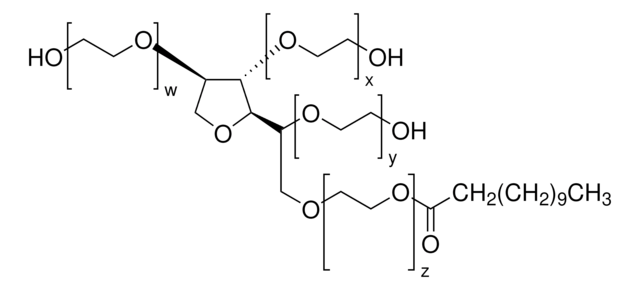
ECO surfactants are made using bio-based ethylene oxide (EO) from biomass ethanol, so they are completely renewable. Moreover, they are manufactured at a plant which runs on a high proportion of renewable energy, further reducing your carbon footprint when using ECO surfactants. Kindly review the following link for more information: https://www.sigmaaldrich.com/deepweb/assets/sigmaaldrich/marketing/global/documents/123/856/greener-surfactants-fl4874en-ms.pdf
Fortfahren mit
STS0200

ECO TWEEN® 20
viscous liquid
Nachhaltigkeitsmerkmale
Synonym(e):
TWEEN® 20, Polyethylenglykolsorbitanmonolaurat, Polyoxyethylensorbitanmonolaurat
Anmelden zur Ansicht der Organisations- und Vertragspreise.
Größe auswählen
Ansicht ändern
| Größe/SKU | Verfügbarkeit | Preis |
|---|---|---|
250 mL | Warenkorb auf Verfügbarkeit prüfen | € 57,20 |
1 L | Warenkorb auf Verfügbarkeit prüfen | € 171,00 |
Über diesen Artikel
Technischer Dienst
Benötigen Sie Hilfe? Unser Team von erfahrenen Wissenschaftlern ist für Sie da.
Unterstützung erhaltendescription
non-ionic
Quality Segment
assay
≥40%
form
viscous liquid
mol wt
~1228
composition
lauric acid, ≥40% (balance primarily myristic, palmitic, and stearic acids)
greener alternative product characteristics
Use of Renewable Feedstocks
Design for Degradation
Learn more about the Principles of Green Chemistry.
sustainability
Sustainability features
concentration
≥40.0% (GC)
impurities
≤3.0% water
refractive index
n20/D 1.468 (lit.)
CMC
0.06 mM (20-25°C)
mp
98.9 °C
acid number
≤2.2 mg KOH/g
hydroxyl value
96‑108 mg KOH/g
transition temp
cloud point 76 °C
solubility
water: 100 mg/mL, clear, faintly yellow to yellow
density
1.095 g/mL at 25 °C (lit.)
HLB
16.7
SMILES string
CCCCCCCCCCCC(=O)OCCOCC(C1C(C(CO1)OCCO)OCCO)OCCO
InChI
1S/C26H50O10/c1-2-3-4-5-6-7-8-9-10-11-24(30)34-19-18-31-20-22(32-15-12-27)26-25(35-17-14-29)23(21-36-26)33-16-13-28/h22-23,25-29H,2-21H2,1H3
InChI key
HMFKFHLTUCJZJO-UHFFFAOYSA-N
General description
ECO TWEEN® 20, also known as Polyoxyethylenesorbitan monolaurate, is a bio-based, nonionic detergent manufactured from a natural fatty acid. This surfactant, derived from natural sources, provides various functional advantages, such as detergency, emulsification, and wetting. Its versatility makes it well-suited for a variety of applications in biochemical and biological research, with common uses including cell lysis, protein extraction, nuclei isolation and cell fractionation.
We are committed to bringing you Greener Alternative Products, which adhere to one or more of The 12 Principles of Green Chemistry. This product is a biobased surfactant and is aligned with the 7th principle of Green Chemistry "Use of Renewable Feedstocks" and the 10th principle "Design for Degradation".
TWEEN 20 is a polyoxyethylene sorbitol ester that belongs to the polysorbate family. It is a nonionic detergent having a molecular weight of 1,225 daltons, assuming 20 ethylene oxide units, 1 sorbitol, and 1 lauric acid as the primary fatty acid. The ethylene oxide subunits are responsible for the hydrophilic nature of the surfactant, while the hydrocarbon chains provide the hydrophobic environment. Sorbitol forms the backbone ring to which the ethylene oxide polymers are attached.
TWEEN 20 is a polyoxyethylene sorbitol ester that belongs to the polysorbate family. It is a nonionic detergent having a molecular weight of 1,225 daltons, assuming 20 ethylene oxide units, 1 sorbitol, and 1 lauric acid as the primary fatty acid. The ethylene oxide subunits are responsible for the hydrophilic nature of the surfactant, while the hydrocarbon chains provide the hydrophobic environment. Sorbitol forms the backbone ring to which the ethylene oxide polymers are attached.
Application
Anionisches Reinigungsmittel
TWEEN 20 is a nonionic detergent widely used in biochemical applications. It has been used as an emulsifying agent for the preparation of stable oil-in-water emulsions. TWEEN 20 has been used in pre-extraction of membranes to remove peripheral proteins (used at 2% for extraction of membrane-bound proteins).
TWEEN 20 has been used as a blocking agent for membrane based immunoassays at a typical concentration of 0.05%. TWEEN 20 can be used for lysing mammalian cells at a concentration of 0.005 to 0.5%.
TWEEN 20 has been used as a blocking agent for membrane based immunoassays at a typical concentration of 0.05%. TWEEN 20 can be used for lysing mammalian cells at a concentration of 0.005 to 0.5%.
Features and Benefits
- 100 % Renewable
- 100 % Bio-based
- Certified to the USDA BioPreferred Program
- Lower carbon footprint than petrochemical-based versions
- High-purity chemical suitable for a wide variety of research applications
Preparation Note
TWEEN 20 is miscible in water (100mg/mL), yielding a clear, yellow solution. It is also miscible with alcohol, dioxane, and ethyl acetate. TWEEN 20 is insoluble in liquid paraffin and fixed oils.
Other Notes
For additional information on our range of Biochemicals, please complete this form.
Legal Information
ECO TWEEN is a registered trademark of Croda Inc.
TWEEN is a registered trademark of Croda International PLC
1 of 1
Dieser Artikel | |||
|---|---|---|---|
| description viscous liquid | description viscous liquid | description BioXtra, viscous liquid | description viscous liquid, suitable for cell culture |
| form viscous liquid | form viscous liquid | form viscous liquid | form viscous liquid |
| assay ≥40% | assay >40% (GC) | assay - | assay - |
| impurities ≤3.0% water | impurities ≤3.0% water | impurities ≤0.05% Phosphorus (P) | impurities - |
| mp 98.9 °C | mp - | mp - | mp - |
| mol wt ~1228 | mol wt ~1228 | mol wt ~1228 | mol wt ~1228 |
| CMC 0.06 mM (20-25°C) | CMC 0.06 mM (20-25°C) | CMC 0.06 mM (20-25°C) | CMC 0.06 mM (20-25°C) |
Lagerklasse
10 - Combustible liquids
Was ist los?
WGK 1
Flammpunkt (°F)
527.0 °F - Pensky-Martens closed cup
Flammpunkt (°C)
275 °C - Pensky-Martens closed cup
Hier finden Sie alle aktuellen Versionen:
Besitzen Sie dieses Produkt bereits?
In der Dokumentenbibliothek finden Sie die Dokumentation zu den Produkten, die Sie kürzlich erworben haben.
-
Why is this 'eco' tween ? CAS 9005-64-5
1 answer-
Helpful?
-