
The 1 gram quantity is packaged in a 5mL polypropylene tube with a polypropylene cap and the 10 gram quantity is packaged in a 50 mL white HDPE bottle with a red polypropylene cap, as shown below.
Fortfahren mit
53747

Hyaluronsäure Natriumsalz aus Streptococcus equi sp.
bacterial glycosaminoglycan polysaccharide
1 of 1 reviewers received a sample product or took part in a promotion
Synonym(e):
Poly-(β-glucuronsäure-[1→3]-β-N-acetylglucosamin-[1→4]), abwechslungsweise
Anmelden zur Ansicht der Organisations- und Vertragspreise.
Größe auswählen
Ansicht ändern
| Größe/SKU | Verfügbarkeit | Preis |
|---|---|---|
1 g | Warenkorb auf Verfügbarkeit prüfen | € 93,60 |
10 g | Warenkorb auf Verfügbarkeit prüfen | € 478,00 |
Über diesen Artikel
CAS-Nummer:
MDL number:
UNSPSC Code:
51202002
PubChem Substance ID:
NACRES:
NA.25
Technischer Dienst
Benötigen Sie Hilfe? Unser Team von erfahrenen Wissenschaftlern ist für Sie da.
Unterstützung erhaltenbiological source
(Streptococcus equi)
Quality Segment
form
powder or crystals
mol wt
~1.5-1.8 x 10E6 Da
impurities
≤1% protein
color
white
solubility
H2O: 5 mg/mL, clear, colorless
storage temp.
−20°C
SMILES string
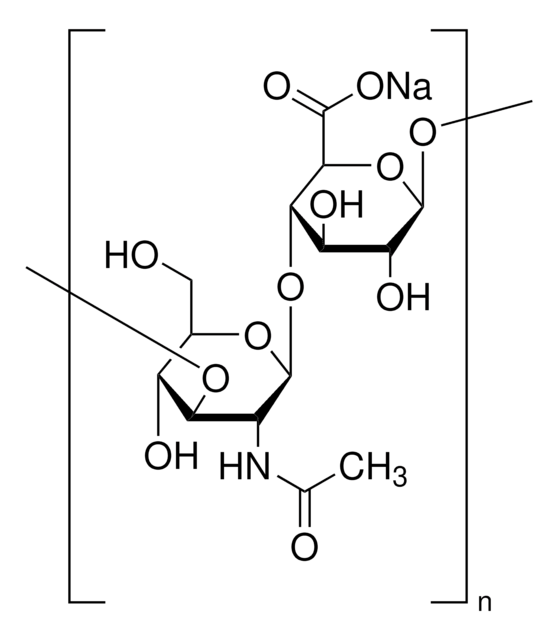
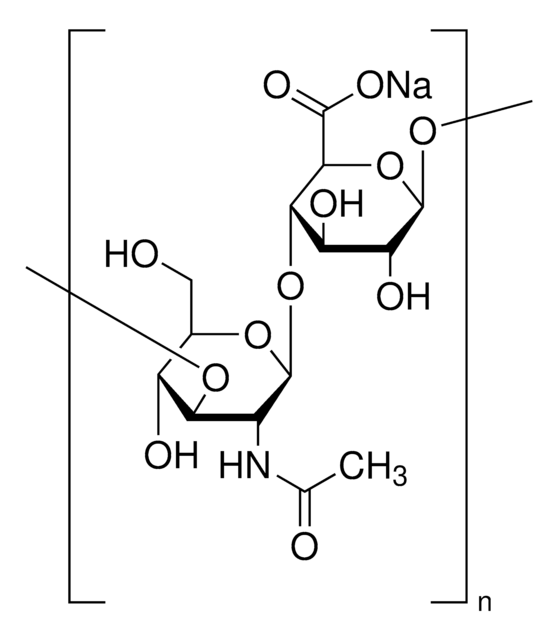
[Na+].CC(=O)N[C@@H]1C[C@H](O)[C@@H](CO)O[C@H]1O[C@H]2[C@H](O)[C@@H](O)[C@H](O)O[C@@H]2C([O-])=O
InChI
1S/C28H44N2O23.Na/c1-5(33)29-9-18(11(35)7(3-31)47-25(9)46)49-28-17(41)15(39)20(22(53-28)24(44)45)51-26-10(30-6(2)34)19(12(36)8(4-32)48-26)50-27-16(40)13(37)14(38)21(52-27)23(42)43;/h7-22,25-28,31-32,35-41,46H,3-4H2,1-2H3,(H,29,33)(H,30,34)(H,42,43)(H,44,45);/q;+1/t7-,8-,9-,10-,11-,12-,13+,14+,15-,16-,17-,18-,19-,20+,21+,22+,25-,26+,27-,28-;/m1./s1
InChI key
YWIVKILSMZOHHF-QJZPQSOGSA-N
General description
Hyaluronsäure (HA), eine essenzielle Komponente der extrazellulären Matrix im zentralen Nervensystem, ist ein vielseitiges Makromolekül, das im Bindegewebe aller Wirbeltiere vorkommt. Dieses supramolekulare Glykosaminoglykan ist ein polyanionisches natürliches Polymer, das als lineares Polysaccharid vorliegt. Es besteht aus Glucuronsäure und N-Acetylglucosamin-Repeats durch eine β-1,4-Bindung. HA kommt reichlich in Augen, Gelenken und Herzklappen vor.
Application
Hyaluronsäure-Natriumsalz aus Streptococcus equi wird wie folgt verwendet:
- mit Methacrylsäureanhydrid für die Synthese eines vernetzbaren methacrylierten Hydrogels (Coll-MeHa)
- in phosphatgepufferter Kochsalzlösung (PBS), um das PBS-Bad zu ersetzen und die Schmiermittelzusammensetzung zu variieren
- bei der Herstellung von Schmiermittel zum Untersuchen seiner Wirkung auf die Grenzschmierung von Knorpeln bei Menschen mit Osteoarthrose (OA)
Biochem/physiol Actions
Hyaluronsäure (HA) ist eine wichtige Komponente von Synovialflüssigkeit und Gelenkknorpeln und dient als Grenzschmiermittel. Sie weist verschiedene physikochemische Eigenschaften auf, einschließlich biologische Abbaubarkeit, Biokompatibilität, Nichttoxizität und Nichtimmunogenität. HA wird als ausgezeichnetes Tool für biomedizinische Anwendungen wie Arzneimittelabgabe, Gewebezucht, plastische Chirurgie, Augenchirurgie und Osteoarthrosechirurgie erachtet. Sie ist am Abfedern und Schmieren des Körpers beteiligt. Dieses starke Antioxidans kann Wasser an Gewebe binden.
Other Notes
Für einen umfassenden Überblick über unser vielfältiges Angebot an Polysacchariden für Ihre Forschung empfehlen wir Ihnen den Besuch unserer Seite zur Kategorie Kohlenhydrate.
1 of 1
Dieser Artikel | |||
|---|---|---|---|
| description bacterial glycosaminoglycan polysaccharide | description mol wt 750,000-1,000,000 | description mol wt 150,000-300,000 | description mol wt 130,000-150,000 |
| solubility H2O: 5 mg/mL, clear, colorless | solubility water: ~5 g/L | solubility - | solubility water: ~5 g/L |
| Quality Level 200 | Quality Level 100 | Quality Level 100 | Quality Level 100 |
| form powder or crystals | form powder | form powder | form powder |
| storage temp. −20°C | storage temp. −20°C | storage temp. −20°C | storage temp. −20°C |
| color white | color white | color white | color white |
| mol wt ~1.5-1.8 x 10E6 Da | mol wt 750,000-1,000,000 | mol wt 150,000-300,000 | mol wt 130,000-150,000 |
Still not finding the right product?
Explore all of our products under Hyaluronsäure Natriumsalz aus Streptococcus equi sp.
Lagerklasse
11 - Combustible Solids
Was ist los?
WGK 2
Flammpunkt (°F)
Not applicable
Flammpunkt (°C)
Not applicable
Hier finden Sie alle aktuellen Versionen:
Besitzen Sie dieses Produkt bereits?
In der Dokumentenbibliothek finden Sie die Dokumentation zu den Produkten, die Sie kürzlich erworben haben.
-
How is the packaging of this product?, Can you share the composition of the packaging?
1 answer -
How can I determine the shelf life / expiration / retest date of this product?
1 answer-
If this product has an expiration or retest date, it will be shown on the Certificate of Analysis (COA, CofA). If there is no retest or expiration date listed on the product's COA, we do not have suitable stability data to determine a shelf life. For these products, the only date on the COA will be the release date; a retest, expiration, or use-by-date will not be displayed.
For all products, we recommend handling per defined conditions as printed in our product literature and website product descriptions. We recommend that products should be routinely inspected by customers to ensure they perform as expected.
For products without retest or expiration dates, our standard warranty of 1 year from the date of shipment is applicable.
For more information, please refer to the Product Dating Information document: https://www.sigmaaldrich.com/deepweb/assets/sigmaaldrich/marketing/global/documents/418/501/product-dating-information-06-25-mk.pdfHelpful?
-
-
What is the production strain of this product? Streptococcus equi subsp. zooepidemicus ATCC 39920? ATCC 35246?
1 answer-
The production strain of this product is proprietary.
Helpful?
-
-
May I know the formula and MW for one unit of Hyaluronic acid? And I also need the formula and MW for one unit of Hyaluronic acid Sodium. Thanks!
1 answer-
The linear formula for hyaluronic acid sodium salt is [C14H22NNaO11]n where n is the number of monomeric units present in the polymer. This would equate to 403.31 g/mol for each unit. Hyaluronic acid has the linear formula [C16H27NO11]n which would have a molecular weight of 409.39 per unit.
Helpful?
-
-
How is shipping temperature determined? And how is it related to the product storage temperature?
1 answer-
Products may be shipped at a different temperature than the recommended long-term storage temperature. If the product quality is sensitive to short-term exposure to conditions other than the recommended long-term storage, it will be shipped on wet or dry-ice. If the product quality is NOT affected by short-term exposure to conditions other than the recommended long-term storage, it will be shipped at ambient temperature. As shipping routes are configured for minimum transit times, shipping at ambient temperature helps control shipping costs for our customers. For more information, please refer to the Storage and Transport Conditions document: https://www.sigmaaldrich.com/deepweb/assets/sigmaaldrich/marketing/global/documents/316/622/storage-transport-conditions-mk.pdf
Helpful?
-
-
Is this suitable for sterile use or should it be sterilized and how would you recommend to sterilize?
1 answer-
TS Answer: This product is not sterile, however, prepared stock solutions may be autoclaved or filter-sterilized. The estimated molecular weight range is 0.85 to 1.6 million daltons. Filtration studies of high molecular weight HA have not been performed, however, various literature sources suggest the use of a PES filter membrane would be the best option. There are a number of product alternatives available, such as the Steriflip-GP product SCGP00525 - see the link below to review this product.
https://www.sigmaaldrich.com/US/en/product/mm/scgp00525
Alternatively, HA can be added directly to the medium prior to filtration for tissue culture applications. See the link below to review a publication demonstrating this process:
https://pubmed.ncbi.nlm.nih.gov/35907556/Helpful?
-
-
How should product 53747 be stored after it is resuspended in solution?
1 answer-
Following reconstitution, refrigerate (4°C). Stock solutions are stable for up to 3 months at 4°C.
Helpful?
-
-
What is the molecular weight of this hyaluronic acid, in units of g/mol?
1 answer-
The molecular weight of this product, based on viscosity, generally ranges from 1.3 - 1.8 MDa, but can be as high as 2.5 MDa.
Helpful?
-
-
Can Product 53747, Hyaluronic acid, be sterilized?
1 answer-
Yes, according to references you can autoclave Hyaluronic acid sodium salt from Streptococcus equi.
Helpful?
-
-
How should I store Product 53747, Hyaluronic acid sodium salt from Streptococcus equi?
1 answer-
This product should be stored at - 20 °C.
Helpful?
-

