

This product is a lyophilized lipopolysaccharide powder recommended for storage at 2–8 °C. Low-temperature storage helps limit microbial contamination and preserve the unsaturated fatty acid chains in Lipid A. The unsaturated fatty acid chains may deteriorate at room temperature.
Temporary storage at -20 °C is unlikely to significantly affect potency; however, storage under this condition has not been specifically validated. Allow the unopened container to reach room temperature before opening to prevent condensation. After opening, store the product at 2–8 °C. For use in a whole-blood assay, confirm performance with an appropriate control.
Fortfahren mit
L2630

Lipopolysaccharide aus Escherichia coli O111:B4
purified by phenol extraction
Synonym(e):
LPS
Anmelden zur Ansicht der Organisations- und Vertragspreise.
Größe auswählen
Ansicht ändern
| Größe/SKU | Verfügbarkeit | Preis |
|---|---|---|
10 mg | Warenkorb auf Verfügbarkeit prüfen | € 78,60 |
25 mg | Warenkorb auf Verfügbarkeit prüfen | € 156,00 |
100 mg | Warenkorb auf Verfügbarkeit prüfen | € 376,00 |
Über diesen Artikel
Technischer Dienst
Benötigen Sie Hilfe? Unser Team von erfahrenen Wissenschaftlern ist für Sie da.
Unterstützung erhaltenbiological source
Escherichia coli (O111:B4)
Quality Segment
form
lyophilized powder
purified by
phenol extraction
technique(s)
ELISA: suitable, cell based assay: suitable, ligand binding assay: suitable
impurities
≤3.00% protein (Lowry-TCA)
color
off-white to faint yellow
solubility
water: soluble
application(s)
cell analysis
clinical research
life science and biopharma
shipped in
ambient
storage temp.
2-8°C
General description
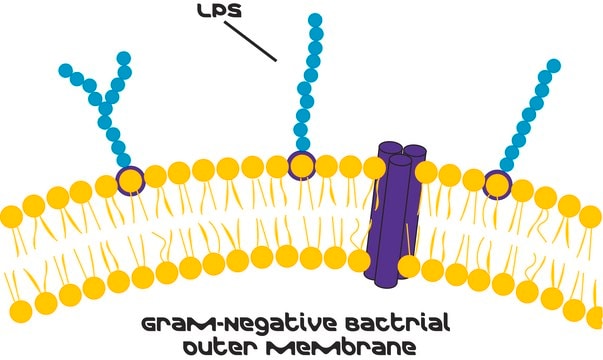
Ein Lipopolysaccharid ist ein Glykolipid, das aus Kohlenhydraten besteht, die mit Fettsäuren verbunden sind. Lipopolysaccharide (LPS) sind charakteristische Bestandteile der Zellwand von gramnegativen Bakterien. Ein typisches LPS-Molekül umfasst Lipid A (ein Glucosamin-basiertes Phospholipid), ein relativ kurzes Kern-Oligosaccharid und ein distales Polysaccharid (O-Antigen). LPS tragen zur Integrität der äußeren Membran bei und schützen die Zelle gegen die Wirkung von Gallensalzen und lipophilen Antibiotika. Sie stimulieren Wirtszellen via TLR2 und TLR4 (Toll-like-Rezeptoren). Diese Stimulation führt zur Erzeugung verschiedener entzündungsfördernder Zytokine, etwa TNFα (Tumornekrosefaktor), IL-1 (Interleukin-1) und IL-6.
Dieses Produkt wird mit Phenol aus Escherichia coli Serotyp O111:B4 extrahiert. Der für die Herstellung verwendete Stamm stammt aus einer Privatsammlung. Dieser LPS-Serotyp wurde zur Stimulation von B-Zellen und zur Induktion von NOS (Stickoxid-Synthase) in humanen Hepatozyten eingesetzt.
Dieses Produkt wird mit Phenol aus Escherichia coli Serotyp O111:B4 extrahiert. Der für die Herstellung verwendete Stamm stammt aus einer Privatsammlung. Dieser LPS-Serotyp wurde zur Stimulation von B-Zellen und zur Induktion von NOS (Stickoxid-Synthase) in humanen Hepatozyten eingesetzt.
Application
Lipopolysaccharide (LPS) aus Escherichia coli O111:B4 werden wie folgt verwendet:
- zur Stimulation von Makrophagen
- für die LPS-Vorkonditionierung bei Mäusen
- zur Auslösung einer akuten Nierenschädigung bei Mäusen
- zur Auslösung eines akuten Atemnotsyndroms (ARDS) bei Mäusen zur Untersuchung der entzündungshemmenden Wirkung von aus mesenchymalen Stammzellen des Knochenmarks (BMSCs) gewonnenen Exosomen
- zur Auslösung eines hyperinflammatorischen Zustands bei mit dem schweren akuten respiratorischen Syndrom Coronavirus 2 (SARS-CoV-2) infizierten Mäusen
Lipopolysaccharide (LPS) sind charakteristische Bestandteile der Zellwand von gramnegativen Bakterien. LPS und seine Lipid-A-Gruppe stimulieren Zellen des angeborenen Immunsystems durch den Toll-like-Rezeptor 4 (TLR4). TLR4 gehört zur Toll-like-Rezeptor-Proteinfamilie, die häufige Pathogen-assoziierte molekulare Strukturen (PAMPs) erkennt.
Biochem/physiol Actions
Lipopolysaccharide (LPS) dienen als Teil der äußeren Membran, was die äußere Membran durchlässig für hydrophobe Moleküle wie antimikrobielle Substanzen macht, die gramnegative Bakterien von Natur aus resistent machen. Die Funktion von LPS bei der Interaktion zwischen Bakterien und Wirten dient der Regulierung der Reaktionen des Wirtssystems.
Preparation Note
Das Produkt löst sich in Wasser (5 mg/ml) oder Zellkulturmedium (1 mg/ml) und ergibt eine trübe, schwach gelbe Lösung. Eine stärker konzentrierte, ebenfalls trübe Lösung (20 mg/ml) konnte in wässriger Kochsalzlösung nach Vortexen und Erwärmen auf 70-80 oC hergestellt werden. Lipopolysaccharide sind Moleküle, die in jedem Lösungsmittel Mizellen bilden. In Wasser und phosphatgepufferter Kochsalzlösung entstehen trübe Lösungen. Organische Lösungsmittel erzeugen keine klareren Lösungen. Mit Methanol ergibt sich eine trübe Suspension mit schwebenden Trübungen, während mit Wasser eine homogen trübe Lösung ensteht.
Other Notes
Füllen Sie bitte dieses Formular aus, um weitere Informationen zu unserem Sortiment an Biochemikalien zu erhalten.
Für einen umfassenden Überblick über unser vielfältiges Angebot an Lipopolysacchariden für Ihre Forschung empfehlen wir Ihnen den Besuch unserer Seite zur Kategorie Kohlenhydrate.
1 of 1
Dieser Artikel | |||
|---|---|---|---|
| description purified by phenol extraction | description Ready Made solution, 1 mg/mL | description purified by trichloroacetic acid extraction | description purified by gel-filtration chromatography |
| biological source Escherichia coli (O111:B4) | biological source Escherichia coli (O111:B4) | biological source Escherichia coli (O111:B4) | biological source Escherichia coli (O111:B4) |
| technique(s) cell based assay: suitable, ELISA: suitable, ligand binding assay: suitable | technique(s) - | technique(s) - | technique(s) - |
| Quality Level 300 | Quality Level 200 | Quality Level 200 | Quality Level 300 |
| solubility water: soluble | solubility water: soluble | solubility water: soluble | solubility water: soluble |
| form lyophilized powder | form aqueous solution | form lyophilized powder | form lyophilized powder |
| storage temp. 2-8°C | storage temp. 2-8°C | storage temp. 2-8°C | storage temp. 2-8°C |
Still not finding the right product?
Explore all of our products under Lipopolysaccharide aus Escherichia coli O111:B4
Signalwort
Danger
Gefahrencodes
Hazard Classifications
Acute Tox. 2 Oral
Lagerklasse
6.1A - Combustible acute toxic Cat. 1 and 2 / very toxic hazardous materials
Flammpunkt (°F)
Not applicable
Flammpunkt (°C)
Not applicable
PSA (Persönliche Schutzausrüstung)
Eyeshields, Gloves, type N95 (US)
Sicherheitshinweise
Hier finden Sie alle aktuellen Versionen:
Besitzen Sie dieses Produkt bereits?
In der Dokumentenbibliothek finden Sie die Dokumentation zu den Produkten, die Sie kürzlich erworben haben.
-
Hi, I recently received an order of this product for use in a whole blood assay. It was accidentally placed in a -20 C freezer. Is it suitable for use or will it have significantly lost potency? Thanks!
1 answer-
Helpful?
-
-
Is this product considered a rough strain or smooth strain?
1 answer-
This product (lipopolysaccharide from E. coli O111:B4) is classified as a smooth (S-type) lipopolysaccharide. Please see the link below to review a publication that may be helpful:
https://www.ncbi.nlm.nih.gov/books/NBK554414/Helpful?
-
-
Can I resuspend this LPS in PBS instead of water, without hindering its performance ?
1 answer-
This product can be resuspended in PBS instead of water. Both water and PBS are suitable solvents, and a hazy solution will form in either.
Helpful?
-
-
How can I determine the shelf life / expiration / retest date of this product?
1 answer-
If this product has an expiration or retest date, it will be shown on the Certificate of Analysis (COA, CofA). If there is no retest or expiration date listed on the product's COA, we do not have suitable stability data to determine a shelf life. For these products, the only date on the COA will be the release date; a retest, expiration, or use-by-date will not be displayed.
For all products, we recommend handling per defined conditions as printed in our product literature and website product descriptions. We recommend that products should be routinely inspected by customers to ensure they perform as expected.
For products without retest or expiration dates, our standard warranty of 1 year from the date of shipment is applicable.
For more information, please refer to the Product Dating Information document: https://www.sigmaaldrich.com/deepweb/assets/sigmaaldrich/marketing/global/documents/418/501/product-dating-information-06-25-mk.pdfHelpful?
-
-
When I compared COAs of two batches of LPS (L2630) we have been using, I realized the potency of the newer one is 10-fold higher than the older one (30000000 and 3000000 EU/mg). Is it common for LPS that different lots have such different potency?
1 answer-
Significant lot-to-lot variability in potency is quite normal for this product. It is a somewhat crude phenol extract; it is not chromatographically purified. That is, a chromatographically purified LPS such as Product L3012 would be expected to have better lot-to-lot consistency. Note that for both this product and L3012, the potency specification is greater than or equal to 500,000 Endotoxin units per milligram (EU/mg); there is a lower limit, but there is no upper limit.
Helpful?
-
-
How is shipping temperature determined? And how is it related to the product storage temperature?
1 answer-
Products may be shipped at a different temperature than the recommended long-term storage temperature. If the product quality is sensitive to short-term exposure to conditions other than the recommended long-term storage, it will be shipped on wet or dry-ice. If the product quality is NOT affected by short-term exposure to conditions other than the recommended long-term storage, it will be shipped at ambient temperature. As shipping routes are configured for minimum transit times, shipping at ambient temperature helps control shipping costs for our customers. For more information, please refer to the Storage and Transport Conditions document: https://www.sigmaaldrich.com/deepweb/assets/sigmaaldrich/marketing/global/documents/316/622/storage-transport-conditions-mk.pdf
Helpful?
-
-
Is there any harm in filter sterilizing a solution with this LPS before using it in cell culture or animals? Meaning does it change or lose potency if it is sterile filtered say through a 0.2 micron filter?
1 answer-
Sterile filtration should not affect the concentration or properties of the solution if the LPS is fully dissolved, but please keep in mind that this is a research-grade material that has not been best tested on animals. For a cell culture grade material that has already been γ-irradiated, please consider the following: https://www.sigmaaldrich.com/product/sigma/l4391
Helpful?
-
-
I received LPS L2630 at Room Temperature. Is it ok to keep it at Room Temperature before reconstitution, although recommendations are to store it between 2-8 C?
1 answer-
This product ships routinely at ambient temperature and is stable up to 2 weeks to allow for transit time. The item is to be stored at 2-8°C when received.
Please see the link below to review the product storage and shipping guidelines:
https://www.sigmaaldrich.com/deepweb/assets/sigmaaldrich/marketing/global/documents/232/426/storage-transport-conditions-ms.pdfHelpful?
-
-
Is product L2630 suitable for use in mammalian cell culture?
1 answer-
Specific testing or validation for the use of product L2630 in mammalian cell culture has not been conducted.
Helpful?
-
-
Hi i recieved L2630 10mg Lipopolysaccharides from Escherichia coli O111:B4 i will used in experimental work. how i will dilute it
1 answer-
The product is soluble in water (5 mg/mL) or cell culture medium (1 mg/mL). Please see the link below to review additional preparation and storage information:
https://www.sigmaaldrich.com/US/en/technical-documents/protocol/clinical-testing-and-diagnostics-manufacturing/bacteriology/lipopolysaccharidesHelpful?
-