Accéder au contenu
Merck

B9938

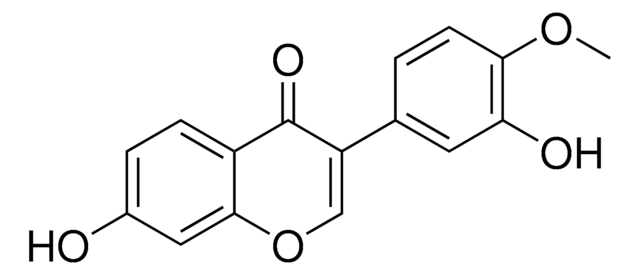
Calycosin

≥98% (HPLC)

Synonyme(s) :

3′,7-Dihydroxy-4′-methoxy-isoflavone, 3′-Hydroxyformononetin, Cyclosin

Se connecter pour consulter vos tarifs contractuels et ceux de votre entreprise/organisme

Sélectionner une taille de conditionnement

10 MG

350,00 €

350,00 €


Veuillez contacter notre Service Clients pour connaître la disponibilité de ce produit.

Demander une commande groupée

A propos de cet article

Formule empirique (notation de Hill) :
C16H12O5
Numéro CAS:
Poids moléculaire :
284.26
Numéro MDL:
Code UNSPSC :
12352200
ID de substance PubChem :
Nomenclature NACRES :
NA.25

Passer à

Service technique
Besoin d'aide ? Notre équipe de scientifiques expérimentés est là pour vous.
Laissez-nous vous aider

Niveau de qualité

Essai

≥98% (HPLC)

Forme

powder

Couleur

white to light yellow

Solubilité

methanol: 1 mg/mL, clear, colorless

Application(s)

metabolomics
vitamins, nutraceuticals, and natural products

Température de stockage

2-8°C

Chaîne SMILES 

O=C1C(C(C=C2)=CC(O)=C2OC)=COC3=CC(O)=CC=C13

InChI

1S/C16H12O5/c1-20-14-5-2-9(6-13(14)19)15-8-12(18)11-4-3-10(17)7-16(11)21-15/h2-8,17,19H,1H3

Clé InChI

QAGGICSUEVNSGH-UHFFFAOYSA-N

Vous recherchez des produits similaires ? Visite Guide de comparaison des produits

Comparer avec des articles similaires

Voir la comparaison complète

Montrer les différences

1 of 4

Cet article
PHL82491SMB004381087472
Calycosin phyproof® Reference Substance

PHL82491

Calycosin

Calycosin United States Pharmacopeia (USP) Reference Standard

USP

1087472

Calycosin

form

powder

form

solid

form

powder

form

-

assay

≥98% (HPLC)

assay

≥95.0% (HPLC)

assay

≥98% (HPLC)

assay

-

application(s)

metabolomics
vitamins, nutraceuticals, and natural products

application(s)

-

application(s)

metabolomics
vitamins, nutraceuticals, and natural products

application(s)

pharmaceutical (small molecule)

Quality Level

100

Quality Level

-

Quality Level

200

Quality Level

-

storage temp.

2-8°C

storage temp.

-

storage temp.

2-8°C

storage temp.

2-8°C

solubility

methanol: 1 mg/mL, clear, colorless

solubility

-

solubility

-

solubility

-

Description générale

Calycosin is a plant estrogen exhibiting both agonistic and antagonistic attitude towards estrogen. It is an isoflavone, occurring as the primary component of the Radix astragali extract.[1][2]

Application

Calycosin has been used:
  • to study its effect on the repression of glioblastomas by having an inhibitory effect on the expression of tyrosine-protein kinase Met (c-Met)[1]
  • to analyze its effect on the growth of nasopharyngeal carcinoma cells by modulating the long non-coding RNA, Ewing sarcoma-associated transcript 1(EWSAT1)[2]
  • to evaluate its effect on the left ventricular ejection fraction in rat model with myocardial ischemia[3]

Actions biochimiques/physiologiques

Calycosin exhibits various therapeutic properties such as anti-inflammatory, antioxidant, antiviral, and neuroprotective effects.[1][4] It is shown to exercise its anticarcinogenic effects against the cluster of breast cancer, osteosarcoma, hepatocellular carcinoma, and colorectal cancer.[2] It is also being promoted as a probable treatment for myocardial infarction due to its ability to hasten the process of angiogenesis and increase the expression of vascular endothelial growth factor (VEGF).[3][5] It has been found to show hyperpermeability induced by the conditions of low osmolarity.[4] Finally, calycosin is being suggested to be used as a prodrug for the treatment of hypoxia-related vascular diseases.[6]
Isoflavone and phytoestrogen isolated froma traditional Chinese medicinal herb. Calycosin induces angiogenesis in HUVEC and promotes proliferation of estrogen-receptor positive cells in vivo and in vitro. Also functions as a vasorelaxant on rat thoracic aorta.

Pictogrammes

Exclamation mark

Mention d'avertissement

Warning

Mentions de danger

Classification des risques

Skin Sens. 1

Code de la classe de stockage

11 - Combustible Solids

Classe de danger pour l'eau (WGK)

WGK 3

Point d'éclair (°F)

Not applicable

Point d'éclair (°C)

Not applicable


Faites votre choix parmi les versions les plus récentes :

Certificats d'analyse (COA)

Lot/Batch Number

Vous ne trouvez pas la bonne version ?

Si vous avez besoin d'une version particulière, vous pouvez rechercher un certificat spécifique par le numéro de lot.

Déjà en possession de ce produit ?

Retrouvez la documentation relative aux produits que vous avez récemment achetés dans la Bibliothèque de documents.

Consulter la Bibliothèque de documents

Gao Junqing et al.
Journal of traditional Chinese medicine = Chung i tsa chih ying wen pan, 35(2), 160-167 (2015-05-16)
To evaluated the effect of calycosin on left ventricular ejection fraction and angiogenesis. Adult male Sprague-Dawley rats were randomly assigned into calycosin-treated groups (0.5, 1, 2, and 4 mg/kg qd), a dimethyl sulfoxide (DMSO), or a sham-operated control group. The
Lingping Kong et al.
Biomedicine & pharmacotherapy = Biomedecine & pharmacotherapie, 106, 342-348 (2018-07-04)
The incidence of nasopharyngeal carcinoma (NPC) in China is relatively higher than that throughout the rest of the world, and NPC is geographically distributed. Long non-coding RNA (lncRNA) plays a key role in the development of tumors. Recent studies have
Youhua Xu et al.
Journal of ethnopharmacology, 137(1), 359-370 (2011-06-15)
Astragali radix is a traditional Chinese medicine that has long been used for treatment of diabetes and diabetes-associated disease, but its active component and mechanism on the disease is not well defined. Infiltration of leukocytes within the glomeruli and vasculature
Yi Fan et al.
European journal of pharmacology, 481(1), 33-40 (2003-11-26)
The purpose of the present study was to examine the effects of calycosin, an isoflavonoid isolated from Astragali Radix, on the impairment of barrier function induced by hypoxia in cultured human umbilical vein endothelial cells. Hypoxia induced an increase in
Xiaohu Nie et al.
Journal of biosciences, 44(4) (2019-09-11)
The antitumor effect of calycosin has been widely studied, but the targets of calycosin against glioblastomas are still unclear. In this study we focused on revealing c-Met as a potential target of calycosin suppressing glioblastomas. In this study, suppressed-cell proliferation

Questions

Reviews

No rating value

Active Filters

Notre équipe de scientifiques dispose d'une expérience dans tous les secteurs de la recherche, notamment en sciences de la vie, science des matériaux, synthèse chimique, chromatographie, analyse et dans de nombreux autres domaines..

Contacter notre Service technique