
47608

Formaldéhyde solution
Molecular Biology, BioReagent, ≥36.0% in H2O (T)
Synonyme(s) :
Formol
Sélectionner une taille de conditionnement
A propos de cet article
Passer à
Nom du produit
Formaldéhyde solution, Molecular Biology, BioReagent, ≥36.0% in H2O (T)
InChI
1S/CH2O/c1-2/h1H2
SMILES string
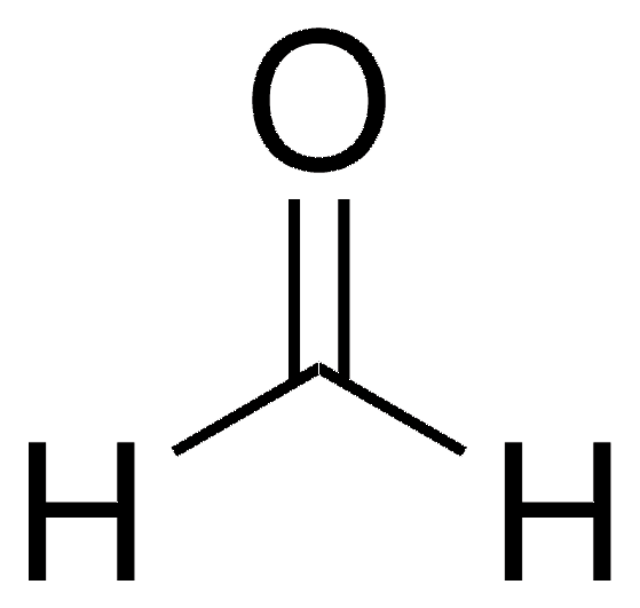
[H]C([H])=O
InChI key
WSFSSNUMVMOOMR-UHFFFAOYSA-N
grade
Molecular Biology
vapor density
1.03 (vs air)
vapor pressure
52 mmHg ( 37 °C)
product line
BioReagent
form
liquid
autoignition temp.
572 °F
contains
~10% methanol as stabilizer
concentration
≥36.0% in H2O (T)
36.0-38.0% (aldehyde method)
technique(s)
electrophoresis: suitable
impurities
≤0.03% free acid (as HCOOH)
ign. residue
≤0.05% (as SO4)
pH
2.8-4.0
density
1.09 g/mL at 20 °C
1.09 g/mL at 25 °C (lit.)
anion traces
chloride (Cl-): ≤10 mg/kg
sulfate (SO42-): ≤20 mg/kg
cation traces
Ca: ≤5 mg/kg
Cd: ≤1 mg/kg
Co: ≤1 mg/kg
Cr: ≤1 mg/kg
Cu: ≤1 mg/kg
Fe: ≤1 mg/kg
K: ≤20 mg/kg
Mg: ≤1 mg/kg
Mn: ≤1 mg/kg
Na: ≤100 mg/kg
Ni: ≤1 mg/kg
Pb: ≤1 mg/kg
Zn: ≤1 mg/mL
λ
2 M in H2O
UV absorption
λ: 260 nm Amax: 0.01
λ: 280 nm Amax: 0.01
suitability
in accordance for electrophoresis of RNA in agarose gels
storage temp.
room temp
Quality Level
Vous recherchez des produits similaires ? Visite Guide de comparaison des produits
1 of 4
Cet article | F8775 | 47083-U | 1.04003 |
|---|---|---|---|
| technique(s) electrophoresis: suitable | technique(s) ChIP: suitable, immunofluorescence: suitable, immunohistochemistry: suitable | technique(s) HPLC: suitable, gas chromatography (GC): suitable | technique(s) - |
| grade for molecular biology | grade for molecular biology | grade certified reference material | grade ACS reagent |
| Quality Level 100 | Quality Level 100 | Quality Level 300 | Quality Level 400 |
| form liquid | form liquid | form - | form liquid |
| density 1.09 g/mL at 20 °C, 1.09 g/mL at 25 °C (lit.) | density 1.09 g/mL at 25 °C (lit.) | density 1.09 g/mL at 25 °C (lit.) | density 1.09 g/cm3 at 20 °C, 1.09 g/mL at 25 °C (lit.) |
| cation traces Ca: ≤5 mg/kg, Co: ≤1 mg/kg, Cu: ≤1 mg/kg, K: ≤20 mg/kg, Mn: ≤1 mg/kg, Ni: ≤1 mg/kg, Zn: ≤1 mg/mL, Cd: ≤1 mg/kg, Fe: ≤1 mg/kg, Na: ≤100 mg/kg, Cr: ≤1 mg/kg, Pb: ≤1 mg/kg, Mg: ≤1 mg/kg | cation traces - | cation traces - | cation traces - |
Application
- denaturation and separation of RNA molecules
- anti-bacterial treatment
- fixation of cells
Biochem/physiol Actions
Disclaimer
General description
It is an aliphatic aldehyde that is widely used in industrial applications for the synthesis of several chemicals such as melamine formaldehyde, urea-formaldehyde, phenol formaldehyde and industrial resins, paraformaldehyde, polyols, chelating agents, slow release fertilizers, 1,4-butanediol and hexamethylenetetramine.[4]
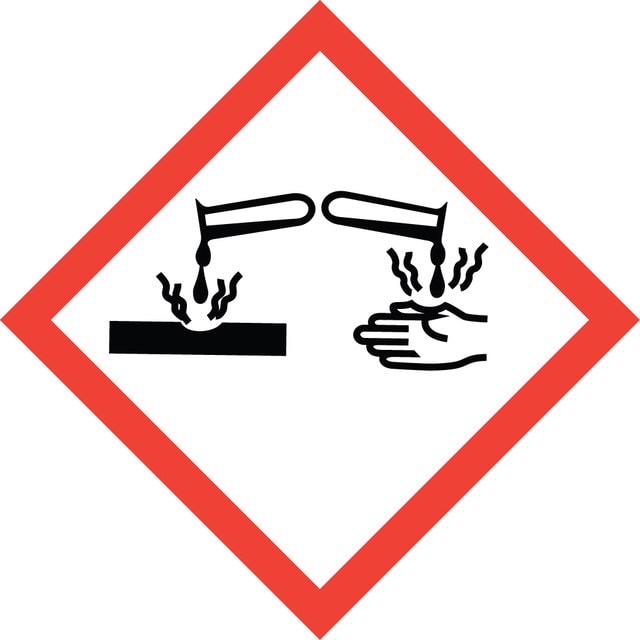
signalword
Danger
Hazard Classifications
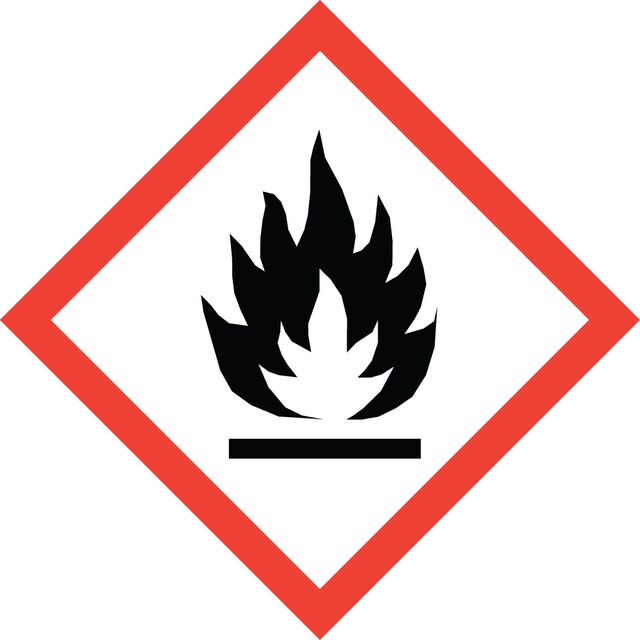
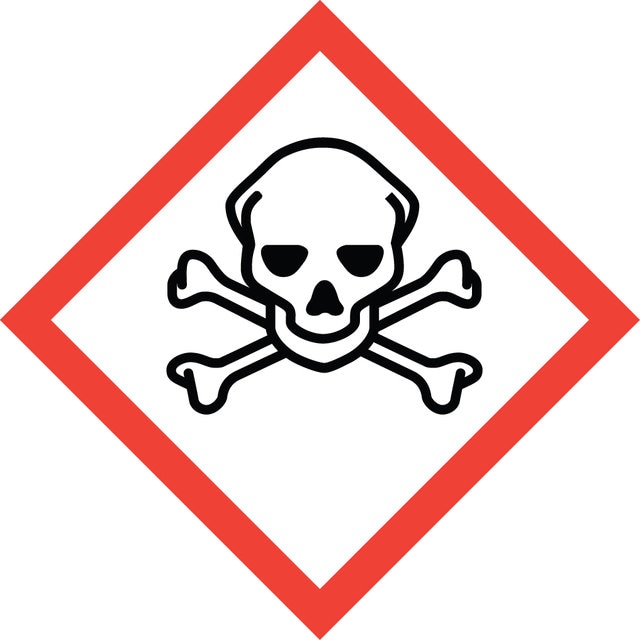
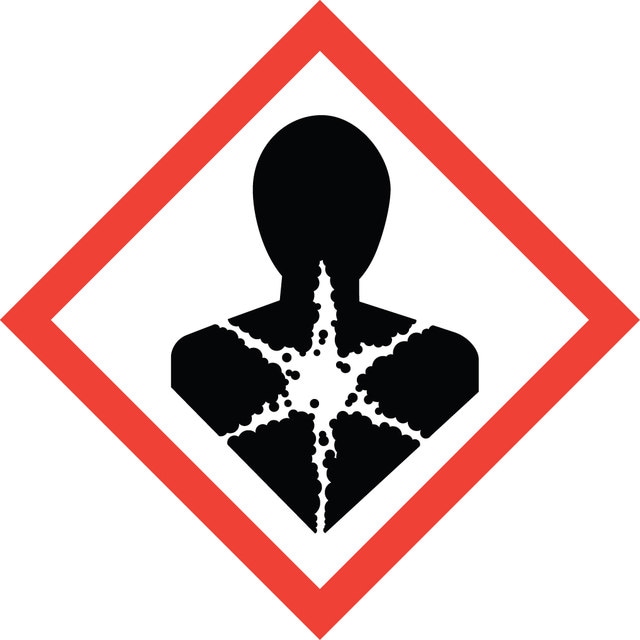
Acute Tox. 2 Inhalation - Acute Tox. 3 Dermal - Acute Tox. 3 Oral - Carc. 1B - Eye Dam. 1 - Flam. Liq. 3 - Muta. 2 - Skin Corr. 1B - Skin Sens. 1 - STOT SE 1 - STOT SE 3
target_organs
Eyes,Central nervous system, Respiratory system
Classe de stockage
3 - Flammable liquids
wgk
WGK 3
flash_point_f
133.0 °F - closed cup
flash_point_c
56.11 °C - closed cup
ppe
Faceshields, Gloves, Goggles, type ABEK (EN14387) respirator filter
Faites votre choix parmi les versions les plus récentes :
Déjà en possession de ce produit ?
Retrouvez la documentation relative aux produits que vous avez récemment achetés dans la Bibliothèque de documents.
Articles
Millicell® hanging cell culture inserts for staining and microscopic analysis directly from the insert. Learn to utilize hanging cell culture inserts in barrier measurements.
Organoid culture products to generate tissue and stem cell derived 3D brain, intestinal, gut, lung and cancer tumor organoid models.
Contenu apparenté
Active Filters
Notre équipe de scientifiques dispose d'une expérience dans tous les secteurs de la recherche, notamment en sciences de la vie, science des matériaux, synthèse chimique, chromatographie, analyse et dans de nombreux autres domaines..
Contacter notre Service technique