
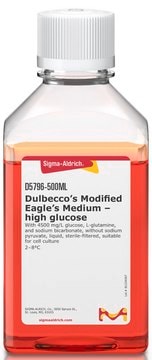


This product contains 3.7 g/L of NaHCO3.
D5796

DMEM - high glucose
With sodium Bicarbonate and ʟ-glutamine, without sodium pyruvate, liquid, sterile-filtered, suitable for cell culture
Dulbecco’s Modified Eagle’s Medium - high glucose
Synonyme(s) :
DME, DMEM
Se connecter pour consulter vos tarifs contractuels et ceux de votre entreprise/organisme
Sélectionner une taille de conditionnement
Le tarif et la disponibilité ne sont pas disponibles actuellement.
A propos de cet article
Code UNSPSC :
12352207
Nomenclature NACRES :
NA.75
Passer à
Service technique
Besoin d'aide ? Notre équipe de scientifiques expérimentés est là pour vous.
Laissez-nous vous aiderNom du produit
Milieu d′Eagle modifié par Dulbecco (DMEM) à teneur élevée en glucose, With 4500 mg/L glucose, L-glutamine, and sodium bicarbonate, without sodium pyruvate, liquid, sterile-filtered, suitable for cell culture
Stérilité
sterile-filtered
Forme
liquid
Technique(s)
cell culture | mammalian: suitable
Impuretés
endotoxin, tested
Composants
NaHCO3: yes
L-glutamine: yes
glucose: high
phenol red: yes
sodium pyruvate: no
HEPES: no
Conditions d'expédition
ambient
Température de stockage
2-8°C
Vous recherchez des produits similaires ? Visite Guide de comparaison des produits
1 of 4
Cet article | D5671 | D6429 | D6546 |
|---|---|---|---|
| sterility sterile-filtered | sterility sterile-filtered | sterility sterile-filtered | sterility sterile-filtered |
| technique(s) cell culture | mammalian: suitable | technique(s) cell culture | hybridoma: suitable, cell culture | mammalian: suitable | technique(s) cell culture | mammalian: suitable | technique(s) cell culture | mammalian: suitable |
| form liquid | form liquid | form liquid | form liquid |
| components NaHCO3: yes | components L-glutamine: no | components HEPES: no | components NaHCO3: yes |
| storage temp. 2-8°C | storage temp. 2-8°C | storage temp. 2-8°C | storage temp. 2-8°C |
| shipped in ambient | shipped in ambient | shipped in ambient | shipped in ambient |
Description générale
Ce milieu DMEM à teneur élevée en glucose (« DMEM-Hi ») est un milieu complet 1x sans facteurs de supplémentation (modifications courantes) tels que L-alanyl-L-glutamine, HEPES ou pyruvate de sodium. Il diffère de la formulation DMEM-Hi d′origine en ce que le pyridoxal a été remplacé par de la pyridoxine. Le pyridoxal est un constituant instable des milieux.
Application
Le milieu de Eagle modifié par Dulbecco (DMEM) est une variante du milieu de Eagle de base (BME) qui contient quatre fois plus d'acides aminés et de vitamines. La formulation d'origine contenait 1 000 mg/l de glucose et servait à la culture de cellules embryonnaires de souris. Depuis, le milieu a été modifié à plusieurs reprises pour convenir aux primocultures de cellules de souris et de poulet ainsi que de diverses cellules normales ou transformées. Chacun de ces milieux apporte une combinaison différente de L-glutamine et de pyruvate de sodium. En outre, le taux de glucose a été augmenté à 4 500 mg/l, d'où le nom "DMEM/High" pour DMEM riche en glucose.
Produit(s) apparenté(s)
Réf. du produit
Description
Tarif
used together
Réf. du produit
Description
Tarif
Code de la classe de stockage
12 - Non Combustible Liquids
Classe de danger pour l'eau (WGK)
WGK 1
Point d'éclair (°F)
Not applicable
Point d'éclair (°C)
Not applicable
Faites votre choix parmi les versions les plus récentes :
Déjà en possession de ce produit ?
Retrouvez la documentation relative aux produits que vous avez récemment achetés dans la Bibliothèque de documents.
Kai-Liang Zhang et al.
OncoTargets and therapy, 12, 6515-6523 (2019-10-17)
The efficacy of traditional therapies for oral carcinoma (OC) is limited. Oncolytic adenovirus, a novel strategy of cancer therapy, shows potential use in OC treatment. However, its clinical application is limited by pre-existing neutralizing antibodies. Thus, this study aimed to
Refael Minnes et al.
Scientific reports, 7(1), 4381-4381 (2017-07-01)
The vast majority of cancer related deaths are caused by metastatic tumors. Therefore, identifying the metastatic potential of cancer cells is of great importance both for prognosis and for determining the correct treatment. Infrared (IR) spectroscopy of biological cells is
Huan Lin et al.
Nature communications, 9(1), 1875-1875 (2018-05-16)
It has been generally thought that tRNA modifications are stable and static, and their frequencies are rarely regulated. N6-threonylcarbamoyladenosine (t6A) occurs at position 37 of five mitochondrial (mt-)tRNA species. We show that YRDC and OSGEPL1 are responsible for t6A37 formation
Roubina Tatavosian et al.
Nature communications, 9(1), 2080-2080 (2018-05-29)
Over 80% of diffuse intrinsic pontine gliomas (DIPGs) harbor a point mutation in histone H3.3 where lysine 27 is substituted with methionine (H3.3K27M); however, how the mutation affects kinetics and function of PcG proteins remains elusive. We demonstrate that H3.3K27M
Deepa Rajagopalan et al.
PLoS pathogens, 13(10), e1006681-e1006681 (2017-10-19)
HIV1-TAT interactive protein (TIP60) is a haploinsufficient tumor suppressor. However, the potential mechanisms endowing its tumor suppressor ability remain incompletely understood. It plays a vital role in virus-induced cancers where TIP60 down-regulates the expression of human papillomavirus (HPV) oncoprotein E6
Articles
Organoid culture products to generate tissue and stem cell derived 3D brain, intestinal, gut, lung and cancer tumor organoid models.
Protocoles
Detailliertes Verfahren zur Durchführung einer lentiviralen Transduktion von MISSION shRNA lentiviralen Partikeln, um eine stabile, langfristige Stilllegung und Phänotypveränderung zu erreichen.
Discover our collection of primary human hepatic sinusoidal endothelial cells, a protocol for thawing, plating, and growing HHSECs, and a recipe for our HHSEC maintenance media formulation.
Detailed procedure for how to perform a lentiviral transduction of MISSION shRNA lentiviral particles to achieve a stable long term silencing and phenotypic change.
Contenu apparenté
Learn how to use our cell culture tested, ready-to-use MilliShot™ single dose antibiotic solutions, conveniently packaged in one-time use vials.
Discover our collection of primary human hepatic stellate cells and protocol for thawing, plating, and growing stellate cells. Find our stellate culture maintenance media formulation.
Instructions
-
What is the NaHCO3 concentration? Conventional cell culture requires 5% of CO2. But it will depend on the NaHCO3 concentration. Does this product use 1.2 or 3.7 g/L?
1 answer-
Helpful?
-
-
What are the product numbers for DMEM and EMEM used to grow the 293 and 293T cell lines?
1 answer-
To grow the 293 and 293T cells, the following product recommendations are provided:
For the 293 cell line (product number 85120602), ECACC recommends using EMEM media (EBSS) with 2mM Glutamine, 1% Non Essential Amino Acids (NEAA), and 10% FCS. ECACC uses the product number M4655 for this purpose.
For the 293T cell line (product number 12022001), ECACC recommends using DMEM media with 2mM Glutamine and 10% Fetal Bovine Serum (FBS). ECACC uses the product number D5796 media for sub-culturing this cell line.
Helpful?
-
-
What is the conc. of L glutamine
1 answer-
The concentration of L-Glutamine in this product is 0.584 g/L. Please see the link below to review the DMEM Formulation Tables: https://www.sigmaaldrich.com/deepweb/assets/sigmaaldrich/product/documents/340/109/d5796for.pdf
Helpful?
-
-
pH는 몇으로 조정되어 있나요?
1 answer-
The pH specification of this product is 7.0-7.6. The exact value will be reported in the lot specific Certificate of Analysis. Please see the link below to review a sample Certificate of Analysis: https://www.sigmaaldrich.com/coa/SIGMA/D5796/RNBL9771.
Helpful?
-
Active Filters
Notre équipe de scientifiques dispose d'une expérience dans tous les secteurs de la recherche, notamment en sciences de la vie, science des matériaux, synthèse chimique, chromatographie, analyse et dans de nombreux autres domaines..
Contacter notre Service technique