

If this product has an expiration or retest date, it will be shown on the Certificate of Analysis (COA, CofA). If there is no retest or expiration date listed on the product's COA, we do not have suitable stability data to determine a shelf life. For these products, the only date on the COA will be the release date; a retest, expiration, or use-by-date will not be displayed.
For all products, we recommend handling per defined conditions as printed in our product literature and website product descriptions. We recommend that products should be routinely inspected by customers to ensure they perform as expected.
For products without retest or expiration dates, our standard warranty of 1 year from the date of shipment is applicable.
For more information, please refer to the Product Dating Information document: https://www.sigmaaldrich.com/deepweb/assets/sigmaaldrich/marketing/global/documents/418/501/product-dating-information-06-25-mk.pdf
L6026

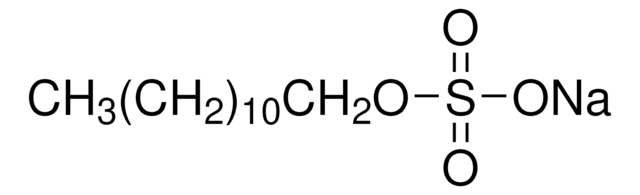
Dodecilsulfatosódico

BioXtra, ≥99.0% (GC)
Sinónimos:
Dodecil sulfato de sodio, Dodecil sulfato sodium salt, Lauril sulfato sodium salt, Laurilsulfato de sodio, SDS
Seleccione un Tamaño
Acerca de este artículo
Saltar a
origen biológico
synthetic (oragnic)
Nivel de calidad
descripción
anionic
Línea del producto
BioXtra
Ensayo
≥99.0% (GC)
Formulario
powder
mol peso
micellar avg mol wt 18,000
características de los productos alternativos más sostenibles
Catalysis
Learn more about the Principles of Green Chemistry.
sustainability
Greener Alternative Product
número de agregación
62
impurezas
Insoluble matter, passes filter test
pérdida
≤0.5% loss on drying, HV, 20-25 °C
CMC
7-10 mM (20-25°C)
mp
204-207 °C (lit.)
temperatura de transición
cloud point >100 °C
solubilidad
H2O: 0.1 M, clear, colorless
densidad
0.496 g/cm3
trazas de anión
chloride (Cl-): ≤0.05%
phosphate (PO43-): ≤0.0001%
trazas de catión
Al: ≤0.0005%
Ba: ≤0.0005%
Bi: ≤0.0005%
Ca: ≤0.001%
Cd: ≤0.0005%
Co: ≤0.0005%
Cr: ≤0.0005%
Cu: ≤0.0005%
Fe: ≤0.0005%
K: ≤0.02%
Li: ≤0.0005%
Mg: ≤0.0005%
Mn: ≤0.0005%
Mo: ≤0.0005%
Ni: ≤0.0005%
Pb: ≤0.0005%
Sr: ≤0.0005%
Zn: ≤0.0005%
Absorción
≤0.05 at 280 in H2O at 0.1 M
≤0.08 at 260 in H2O at 0.1 M
HLB
40
cadena SMILES
[Na+].CCCCCCCCCCCCOS([O-])(=O)=O
categoría alternativa más sostenible
InChI
1S/C12H26O4S.Na/c1-2-3-4-5-6-7-8-9-10-11-12-16-17(13,14)15;/h2-12H2,1H3,(H,13,14,15);/q;+1/p-1
Clave InChI
DBMJMQXJHONAFJ-UHFFFAOYSA-M
¿Está buscando productos similares? Visita Guía de comparación de productos
1 of 4
Este artículo | L3771 | 75746 | 71726 |
|---|---|---|---|
| form powder | form powder | form rod | form rod |
| assay ≥99.0% (GC) | assay ≥98.5% (GC) | assay ≥99.0% (GC) | assay ≥99.0% (GC) |
| aggregation number 62 | aggregation number 62 | aggregation number 62 | aggregation number - |
| cation traces Al: ≤0.0005%, Bi: ≤0.0005%, Cd: ≤0.0005%, Cr: ≤0.0005%, Fe: ≤0.0005%, Li: ≤0.0005%, Mn: ≤0.0005%, Ni: ≤0.0005%, Sr: ≤0.0005%, Ba: ≤0.0005%, Co: ≤0.0005%, K: ≤0.02%, Mo: ≤0.0005%, Zn: ≤0.0005%, Ca: ≤0.001%, Mg: ≤0.0005%, Cu: ≤0.0005%, Pb: ≤0.0005% | cation traces heavy metals (as Pb): ≤10 ppm | cation traces Ca: ≤25 mg/kg, Cd: ≤5 mg/kg, Co: ≤5 mg/kg, Cr: ≤5 mg/kg, Cu: ≤5 mg/kg, Fe: ≤10 mg/kg, K: ≤200 mg/kg, Mg: ≤20 mg/kg, Mn: ≤5 mg/kg, Ni: ≤5 mg/kg, Pb: ≤5 mg/kg, Zn: ≤5 mg/kg | cation traces - |
| description anionic | description anionic | description anionic | description anionic, 62 |
| HLB 40 | HLB 40 | HLB 40(lit.) | HLB 40 |
Descripción general
Aplicación
Características y beneficios
- Tested to confirm low levels of heavy metal contamination, ensuring suitability for various applications
- Tested for trace levels of Anions and Cations
- High-purity product ideal for biochemical research purposes
Otras notas
producto comparable
Palabra de señalización
Danger
Frases de peligro
Consejos de prudencia
Clasificaciones de peligro
Acute Tox. 4 Oral - Aquatic Chronic 3 - Eye Dam. 1 - Skin Irrit. 2
Código de clase de almacenamiento
11 - Combustible Solids
Clase de riesgo para el agua (WGK)
WGK 2
Punto de inflamabilidad (°F)
338.0 °F
Punto de inflamabilidad (°C)
170 °C
Equipo de protección personal
Eyeshields, Faceshields, Gloves, type P3 (EN 143) respirator cartridges
Elija entre una de las versiones más recientes:
¿Ya tiene este producto?
Encuentre la documentación para los productos que ha comprado recientemente en la Biblioteca de documentos.
Contenido relacionado
-
How can I determine the shelf life / expiration / retest date of this product?
1 respuesta-
¿Le ha resultado útil?
-
-
How is shipping temperature determined? And how is it related to the product storage temperature?
1 respuesta-
Products may be shipped at a different temperature than the recommended long-term storage temperature. If the product quality is sensitive to short-term exposure to conditions other than the recommended long-term storage, it will be shipped on wet or dry-ice. If the product quality is NOT affected by short-term exposure to conditions other than the recommended long-term storage, it will be shipped at ambient temperature. As shipping routes are configured for minimum transit times, shipping at ambient temperature helps control shipping costs for our customers. For more information, please refer to the Storage and Transport Conditions document: https://www.sigmaaldrich.com/deepweb/assets/sigmaaldrich/marketing/global/documents/316/622/storage-transport-conditions-mk.pdf
¿Le ha resultado útil?
-
Filtros activos
Nuestro equipo de científicos tiene experiencia en todas las áreas de investigación: Ciencias de la vida, Ciencia de los materiales, Síntesis química, Cromatografía, Analítica y muchas otras.
Póngase en contacto con el Servicio técnico